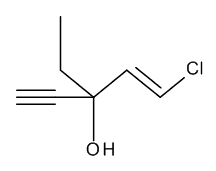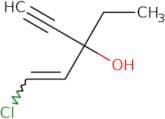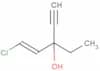
CAS 113-18-8
:Éthchlorvynol
- 1-Chloro-3-ethyl-1-penten-4-yn-3-ol
- 3-(β-Chlorvinyl)-1-pentyn-3-ol
- Alvinol
- Arvynol
- Ethchlorovynol
- Ethchlorvinol
- Ethchlorvynol
- Ethclorvynol
- Ethochlorvynol
- Ethyl β-chlorovinyl ethynyl carbinol
- Ethyl-2-chlorovinyl ethynyl carbinol
- Normoson
- Nostel
- Nsc 30372
- Placidyl
- Roeridorm
- Serenesil
- Serensil
- (1Z)-1-chloro-3-ethylpent-1-en-4-yn-3-ol
- 1-chloro-3-ethylpent-1-en-4-yn-3-ol
- (1E)-1-chloro-3-ethylpent-1-en-4-yn-3-ol
- Voir plus de synonymes
Ethchlorvynol
CAS :Produit contrôléApplications Controlled substance (depressant). Sedative; hypnotic.
Not a dangerous good if item is equal to or less than 1g/ml and there is less than 100g/ml in the package
References Horwitz, et al.: Drug Metab. Dispos., 8, 77 (1980),Formule :C7H9ClOCouleur et forme :NeatMasse moléculaire :144.6Ethchlorvynol
CAS :Produit contrôléEthchlorvynol is a sedative, hypnotic, and anticonvulsant drug that is used to treat insomnia. It has been shown to cause cell lysis in tissue culture and decreases the levels of ATP in the cells. Ethchlorvynol also causes hyperpolarization of the cell membrane and inhibits the activity of p-450 enzymes. The clinical response to ethchlorvynol has been shown to be related to its ability to induce pleural fluid accumulation, leading to clinical pathology changes in patients with untreated tuberculosis. This drug can be detected by chromatographic methods or by biocompatible polymer methods, such as enzyme-linked immunosorbent assay (ELISA).
Formule :C7H9ClODegré de pureté :Min. 95%Masse moléculaire :144.6 g/molEthchlorvynol CIV
CAS :Produit contrôléEthchlorovynol (inn)Formule :C7H9ClOCouleur et forme :LiquidMasse moléculaire :144.03419