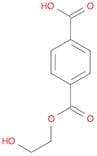
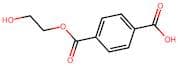
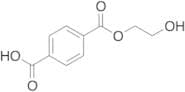
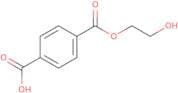
CAS 1137-99-1
:acide 4-((2-hydroxyéthoxy)carbonyl)benzoïque
Description :
acide 4-((2-hydroxyéthoxy)carbonyl)benzoïque, également connu sous son numéro CAS 1137-99-1, est un composé organique caractérisé par sa structure d'acide benzoïque modifiée avec un groupe hydroxyéthoxycarbonyle en position para. Ce composé apparaît généralement sous forme de solide blanc à blanc cassé et est soluble dans des solvants polaires en raison de la présence de groupes fonctionnels d'acide carboxylique et d'éther. Sa structure moléculaire suggère qu'il a des applications potentielles dans les produits pharmaceutiques et comme élément de base dans la synthèse organique. Le groupe hydroxyéthoxy peut conférer des propriétés supplémentaires telles qu'une hydrophilie accrue, ce qui peut influencer sa réactivité et son interaction avec les systèmes biologiques. L'acidité du composé est attribuée au groupe acide carboxylique, qui peut participer à des liaisons hydrogène et affecter sa solubilité et sa stabilité dans divers environnements. Dans l'ensemble, acide 4-((2-hydroxyéthoxy)carbonyl)benzoïque est un composé polyvalent avec une utilité potentielle dans diverses applications chimiques et industrielles.
Formule :C10H9O5
InChI :InChI=1S/C10H10O5/c11-5-6-15-10(14)8-3-1-7(2-4-8)9(12)13/h1-4,11H,5-6H2,(H,12,13)
Code InChI :InChIKey=BCBHDSLDGBIFIX-UHFFFAOYSA-N
SMILES :C(OCCO)(=O)C1=CC=C(C(O)=O)C=C1
Synonymes :- 1,4-Benzenedicarboxylic acid, 1-(2-hydroxyethyl) ester
- 1,4-Benzenedicarboxylic acid, mono(2-hydroxyethyl) ester
- 1-(2-Hydroxyethyl) 1,4-benzenedicarboxylate
- 2-Hydroxyethyl hydrogen terephthalate
- 2-Hydroxyethyl terephthalate
- Ethylene glycol terephthalate (1:1)
- Ethylene glycol, hydrogen terephthalate (1:1)
- Ethylene glycol, mono(hydrogen terephthalate)
- Ethylene glycol-terephthalic acid monoester
- Hydrogen 2-hydroxyethyl terephthalate
- Mono(2-hydroxyethyl) terephthalate
- Mono(β-hydroxyethyl) terephthalate
- Terephthalic acid ethylene glycol monoester
- Terephthalic acid, 2-hydroxyethyl ester
- Terephthalic acid, mono(2-hydroxyethyl) ester
- Voir plus de synonymes
Trier par
Degré de pureté (%)
0
100
|
0
|
50
|
90
|
95
|
100
5 produits concernés.
4-((2-Hydroxyethoxy)carbonyl)benzoic acid
CAS :Formule :C10H10O5Degré de pureté :95%Couleur et forme :SolidMasse moléculaire :210.18344-((2-Hydroxyethoxy)Carbonyl)Benzoic Acid
CAS :4-((2-Hydroxyethoxy)Carbonyl)Benzoic AcidDegré de pureté :95%Masse moléculaire :210.18g/mol1-(2-Hydroxyethyl) Ester, 1,4-Benzenedicarboxylic Acid
CAS :Applications 1-(2-Hydroxyethyl) Ester, 1,4-Benzenedicarboxylic Acid could be used to condition bacteria to enable it to target polymer polyethylene terephthalate (PET).
References Kumar, V., et al.: J. Environ. Chem. Eng., 8, 103977 (2020);Formule :C10H10O5Couleur et forme :NeatMasse moléculaire :210.1834-(2-Hydroxyethoxycarbonyl)benzoate
CAS :4-(2-Hydroxyethoxycarbonyl)benzoate (4HB) is a monomer of poly(4HB). It is used as a biodegradable polymer for the synthesis of hydrogels. 4HB is synthesized from the corresponding dicarboxylic acid, which contains two or more carboxyl groups. The synthesis of 4HB involves esterification with 2-hydroxyethanol and subsequent alkali hydrolysis to remove water. The product is purified by precipitation with ethanol, filtration, and vacuum drying. 4HB has been used as a substrate in biological treatment processes such as anaerobic digestion and aerobic composting. 4HB can be used as a functional group that can react at various temperatures, making it suitable for thermophilic organisms like Thermus aquaticus. The phylogenetic tree of the enzyme β-galactosidase reveals that the enzyme evolved from a common ancestor shared with LacB (β-Formule :C10H10O5Degré de pureté :Area-% Min. 95 Area-%Couleur et forme :White Off-White PowderMasse moléculaire :210.18 g/mol4-((2-Hydroxyethoxy)carbonyl)benzoic acid
CAS :Degré de pureté :95%Couleur et forme :SolidMasse moléculaire :210.1849976