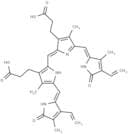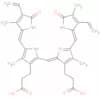
CAS 114-25-0
:Biliverdine
Description :
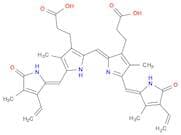
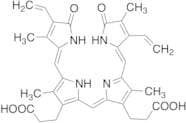
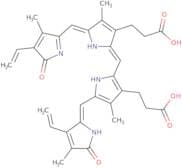
Biliverdine est un pigment biliaire tétrapyrrolique vert qui est un produit de la dégradation de l'hème, formé principalement à partir de la décomposition de l'hémoglobine. Il se caractérise par sa couleur verte, qui est due à son système de doubles liaisons conjuguées, lui permettant d'absorber la lumière dans le spectre visible. Biliverdine est soluble dans l'eau et a une formule moléculaire de C33H34N4O6, avec un poids moléculaire d'environ 582,6 g/mol. Il joue un rôle significatif dans divers processus biologiques, y compris en agissant comme un antioxydant et en participant à la régulation des fonctions cellulaires. Biliverdine est également un précurseur de la bilirubine, un autre pigment biliaire important. En termes de stabilité, Biliverdine peut être sensible à la lumière et aux changements de pH, ce qui peut affecter sa structure et sa réactivité. Sa présence dans les systèmes biologiques est souvent associée à la fonction hépatique et peut être indicative de certaines conditions médicales lorsqu'elle est trouvée en concentrations anormales. Dans l'ensemble, Biliverdine est un composé important en biochimie et en médecine, reflétant les processus complexes du métabolisme de l'hème.
Formule :C33H34N4O6
InChI :InChI=1/C33H34N4O6/c1-7-20-19(6)32(42)37-27(20)14-25-18(5)23(10-12-31(40)41)29(35-25)15-28-22(9-11-30(38)39)17(4)24(34-28)13-26-16(3)21(8-2)33(43)36-26/h7-8,13-15,35H,1-2,9-12H2,3-6H3,(H,36,43)(H,37,42)(H,38,39)(H,40,41)/b26-13-,27-14-,28-15-
Code InChI :InChIKey=QBUVFDKTZJNUPP-BBROENKCSA-N
SMILES :C(\C1=C(CCC(O)=O)C(C)=C(/C=C\2/C(C=C)=C(C)C(=O)N2)N1)=C3/C(CCC(O)=O)=C(C)C(/C=C\4/C(C)=C(C=C)C(=O)N4)=N3
Synonymes :- 21H-Biline-8,12-dipropanoic acid, 3,18-diethenyl-1,19,22,24-tetrahydro-2,7,13,17-tetramethyl-1,19-dioxo-
- 3,18-Diethenyl-1,19,22,24-tetrahydro-2,7,13,17-tetramethyl-1,19-dioxo-21H-biline-8,12-dipropanoic acid
- 3-[(2Z)-2-[[3-(2-carboxyethyl)-4-methyl-5-[(Z)-(4-methyl-5-oxo-3-vinyl-pyrrol-2-ylidene)methyl]-1H-pyrrol-2-yl]methylene]-4-methyl-5-[(Z)-(3-methyl-5-oxo-4-vinyl-pyrrol-2-ylidene)methyl]pyrrol-3-yl]propanoic acid
- 3-[2-[(E)-[(5E)-3-(2-carboxyethyl)-4-methyl-5-[(3-methyl-5-oxo-4-vinyl-pyrrol-2-yl)methylene]pyrrol-2-ylidene]methyl]-4-methyl-5-[(E)-(4-methyl-5-oxo-3-vinyl-pyrrol-2-ylidene)methyl]-1H-pyrrol-3-yl]propanoic acid
- 3-[2-[(Z)-[(5E)-3-(2-carboxyethyl)-4-methyl-5-[(3-methyl-5-oxo-4-vinyl-pyrrol-2-yl)methylene]pyrrol-2-ylidene]methyl]-4-methyl-5-[(Z)-(4-methyl-5-oxo-3-vinyl-pyrrol-2-ylidene)methyl]-1H-pyrrol-3-yl]propanoic acid
- 3-[2-[(Z)-[(5Z)-3-(2-carboxyethyl)-4-methyl-5-[(3-methyl-5-oxo-4-vinyl-pyrrol-2-yl)methylene]pyrrol-2-ylidene]methyl]-4-methyl-5-[(Z)-(4-methyl-5-oxo-3-vinyl-pyrrol-2-ylidene)methyl]-1H-pyrrol-3-yl]propanoic acid
- 3-[2-[[3-(2-carboxyethyl)-4-methyl-5-[(3-methyl-5-oxo-4-vinyl-pyrrol-2-yl)methylene]pyrrol-2-ylidene]methyl]-4-methyl-5-[(4-methyl-5-oxo-3-vinyl-pyrrol-2-ylidene)methyl]-1H-pyrrol-3-yl]propanoic acid
- Biline-8,12-dipropionic acid, 1,19,22,24-tetrahydro-2,7,13,17-tetramethyl-1,19-dioxo-3,18-divinyl-
- Biline-8,12-dipropionic acid, 1,19,22,24-tetrahydro-2,7,13,17-tetramethyl-1,19-dioxo-3,18-divinyl- (8CI)
- Biliverdin IXalpha
- Biliverdin IXα
- Biliverdina
- Biliverdine
- Biliverdine (VAN)
- Biliverdine dihydrochloride
- Dehydrobilirubin
- Nsc 62793
- Oocyan
- Protobiliverdin IXα
- Pyrrole-3-propionic acid, 2-[[3-(2-carboxyethyl)-4-methyl-5-[(3-methyl-5-oxo-4-vinyl-3-pyrrolin-2-ylidene)methyl]-2H-pyrrol-2-ylidene]methyl]-4-methyl-5-[(4-methyl-5-oxo-3-vinyl-3-pyrrolin-2-ylidene)methyl]-
- Uteroverdine
- α-Biliverdin
- Biliverdin
- 3-[2-[(Z)-[(5E)-3-(2-carboxyethyl)-5-[(4-ethenyl-3-methyl-5-oxo-pyrrol-2-yl)methylidene]-4-methyl-pyrrol-2-ylidene]methyl]-5-[(Z)-(3-ethenyl-4-methyl-5-oxo-pyrrol-2-ylidene)methyl]-4-methyl-1H-pyrrol-3-yl]propanoic acid
- 3-[2-[(E)-[(5E)-3-(2-carboxyethyl)-5-[(4-ethenyl-3-methyl-5-oxo-pyrrol-2-yl)methylidene]-4-methyl-pyrrol-2-ylidene]methyl]-5-[(E)-(3-ethenyl-4-methyl-5-oxo-pyrrol-2-ylidene)methyl]-4-methyl-1H-pyrrol-3-yl]propanoic acid
- ocyan
- 3,18-Diethenyl-1,19,22,24-tetrahydro-2,7,13,17-tetrametyl-1,19-dioxo-21H-biline-8,12-dipropanoic Acid
- Voir plus de synonymes
Trier par
Degré de pureté (%)
0
100
|
0
|
50
|
90
|
95
|
100
5 produits concernés.
3,18-Diethenyl-1,19,22,24-tetrahydro-2,7,13,17-tetramethyl-1,19-dioxo-21H-biline-8,12-dipropanoic acid
CAS :Formule :C33H34N4O6Degré de pureté :70%Couleur et forme :SolidMasse moléculaire :582.6463Biliverdine
CAS :Stability Light Sensitive
Applications Biliverdine is a precursor of Bilirubin. Biliverdine is formed in the body from hemoglobin. The bile of amphibians and of birds contains Biliverdine only. It is also an inhibitor for hepatitis C virus.
References Lemberg et al.: Biochem. J., 35, 363 (1941); Gutierrez-Grobe, Y. et al.: Annals. Hepatol., 10, 105 (2011);Formule :C33H34N4O6Couleur et forme :Dark Green To BlackMasse moléculaire :582.65Biliverdine-d4 (Major, may contain up to 3% d0) (Technical Grade)
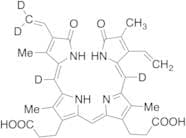
CAS :Produit contrôléApplications Labelled Biliverdine is a precursor of Bilirubin. Biliverdine is formed in the body from hemoglobin. The bile of amphibians and of birds contains Biliverdine only. It is also an inhibitor for hepatitis C virus.
References Lemberg et al.: Biochem. J., 35, 363 (1941); Gutierrez-Grobe, Y. et al.: Annals. Hepatol., 10, 105 (2011);Formule :C33H30D4N4O6Degré de pureté :>90%Couleur et forme :NeatMasse moléculaire :586.67Biliverdine
CAS :Biliverdine is a fluorescent probe that selectively binds to bilirubin and other hydroxycinnamic acids in tissue. Biliverdine can be used to measure the oxidative injury of tissues as well as the activity of enzymes involved in the metabolism of these compounds. The use of biliverdin with other fluorescent probes has been shown to improve the sensitivity and specificity for detecting oxidative injury. Biliverdin has also been shown to have anti-inflammatory properties, which may be due to its ability to inhibit the production of growth factor-β1 and 4-hydroxycinnamic acid.Formule :C33H34N4O6Degré de pureté :Min. 70 Area-%Couleur et forme :Green PowderMasse moléculaire :582.65 g/molBiliverdin
CAS :Biliverdin, produced through the oxidation of bilirubin, can also be synthesized through a non-protoporphyrin pathway in Corynebacterium glutamicum [1].Formule :C33H34N4O6Couleur et forme :SolidMasse moléculaire :582.65