CAS 1143-38-0
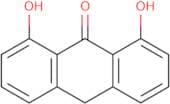
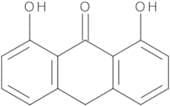
:Dithranol
Description :
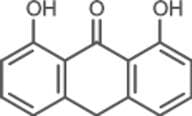
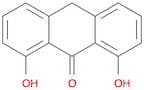
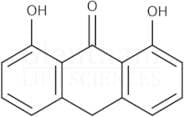
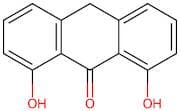
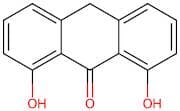
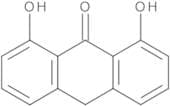
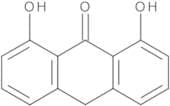
Dithranol, également connu sous le nom d'antraline, est un composé organique principalement utilisé dans des applications dermatologiques, en particulier pour le traitement du psoriasis. Il se présente sous la forme d'un solide cristallin jaune à brun et est connu pour ses propriétés anti-inflammatoires et kératolytiques. Dithranol agit en inhibant la prolifération des cellules cutanées et en favorisant la normalisation de la différenciation de la peau, ce qui est bénéfique pour la gestion des lésions psoriasiques. Le composé est généralement appliqué par voie topique et peut être formulé en différentes concentrations, selon la gravité de la condition à traiter. Il est important de noter que Dithranol peut provoquer des irritations cutanées et des taches, nécessitant une application et une manipulation soigneuses. De plus, il est sensible à la lumière et à l'air, ce qui peut affecter sa stabilité et son efficacité. En tant que substance chimique, Dithranol a une solubilité relativement faible dans l'eau mais est soluble dans des solvants organiques, ce qui le rend adapté à l'incorporation dans diverses formulations topiques. Dans l'ensemble, Dithranol reste un agent thérapeutique précieux en dermatologie, en particulier pour les affections cutanées chroniques.
Formule :C14H10O3
InChI :InChI=1S/C14H10O3/c15-10-5-1-3-8-7-9-4-2-6-11(16)13(9)14(17)12(8)10/h1-6,15-16H,7H2
Code InChI :InChIKey=NUZWLKWWNNJHPT-UHFFFAOYSA-N
SMILES :O=C1C=2C(CC=3C1=C(O)C=CC3)=CC=CC2O
Synonymes :- 1,8-Dihydroxy-10H-anthracen-9-one
- 1,8-Dihydroxy-9,10-dihydroanthracen-9-one
- 1,8-Dihydroxy-9-Anthrone
- 1,8-Dihydroxy-Anthrone
- 1,8-Dihydroxyanthracen-9(10H)-on
- 1,8-Dihydroxyanthrone
- 1,8-dihidroxiantracen-9(10H)-ona
- 1,8-dihydroxy-9(10H)-anthracenone
- 1,8-dihydroxyanthracen-9(10H)-one
- 1,8-dihydroxyanthracene-9(10H)-one
- 9(10H)-Anthracenone, 1,8-dihydroxy-
- Anthra-Derm
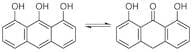
- Anthracene-1,8,9-Triol
- Anthralin
- Anthrone, 1,8-dihydroxy-
- Batidrol
- Batridol
- Batridrol
- Chrysodermol
- Cignolin
- Cigthranol
- Cygnolin
- Dermaline
- Derobin
- DithraSal
- Dithrocream
- DrithoCreme
- Drithoscalp
- Lasan
- Nsc 43970
- Nsc 629313
- Psodadrate
- Psoriacid-Stift
- Psoriacide
- Voir plus de synonymes
Trier par
Degré de pureté (%)
0
100
|
0
|
50
|
90
|
95
|
100
14 produits concernés.
DITHRANOL CRS
CAS :DITHRANOL CRSFormule :C14H10O3Couleur et forme :Crystalline Powder. Yellow. Dark. Powder.Masse moléculaire :226.2274Dithranol
CAS :DithranolFormule :C14H10O3Degré de pureté :98.8%Couleur et forme :Yellow-Red PowderMasse moléculaire :226.06299Anthralin
CAS :Ketone-phenols and ketones with other oxygen functionFormule :C14H10O3Couleur et forme :Yellow Brownish Yellow Microcrystalline PowderMasse moléculaire :226.06299Dithranol
CAS :Dithranol (cignoline) is an anthracene derivative that disrupts MITOCHONDRIA function and structure and is used for the treatment of DERMATOSES, especiallyFormule :C14H10O3Degré de pureté :93.49% - 99.33%Couleur et forme :Physical Description Lemon Yellow Leaflets Or Plates Or An Orange Powder MeltingMasse moléculaire :226.239(10H)-Anthracenone, 1,8-dihydroxy-
CAS :Formule :C14H10O3Degré de pureté :98%Couleur et forme :SolidMasse moléculaire :226.2274Dithranol
CAS :Formule :C14H10O3Degré de pureté :(Titration) 96.0 - 103.0 % (dried basis)Couleur et forme :Yellow to orange-brown crystalline powderMasse moléculaire :226.23Dithranol, EP grade
CAS :Formule :C14H10O3Degré de pureté :≤ 2.5%Couleur et forme :Yellow or brown-yellow crystalline powderMasse moléculaire :226.231,8-Dihydroxyanthracen-9(10H)-One
CAS :1,8-Dihydroxyanthracen-9(10H)-OneDegré de pureté :98%Masse moléculaire :226.23g/molDithranol
CAS :Formule :C14H10O3Degré de pureté :>95.0%(T)(HPLC)Couleur et forme :Light yellow to Brown powder to crystalMasse moléculaire :226.23Anthralin
CAS :Anthralin is a synthetic retinoid that has been used to treat bowel diseases such as ulcerative colitis and Crohn's disease. Anthralin belongs to a class of drugs called "reactive" or "synthetic" retinoids, which are chemically similar to the natural form of vitamin A. It is thought that anthralin may work by altering the permeability of the cell membrane, which leads to an increase in reactive oxygen species and a decrease in mitochondrial membrane potential. In vivo studies on humans have shown that it can be used as a treatment for mild-to-moderate disease activity in ulcerative colitis, but not Crohn's disease. Anthralin has also been found to be effective at reducing the side effects of corticosteroids when used with them in combination therapy.Formule :C14H10O3Degré de pureté :Min. 95 Area-%Couleur et forme :Yellow PowderMasse moléculaire :226.23 g/molAnthralin
CAS :Produit contrôléStability Hygroscopic
Applications Antipsoriatic.
References Ashton, R.E., et al.: J. Am. Acad. Dermatol., 9, 173 (1983), Kemeny, L., et al.: Skin Pharmacol., 3, 1 (1990), Mahrle, G., et al.: Clin. Dermatol., 15, 723 (1997)Formule :C14H10O3Couleur et forme :Yellow-OrangeMasse moléculaire :226.23