CAS 114627-30-4
:Éthyl ester de N-gamma-glutamylcystéine
Description :
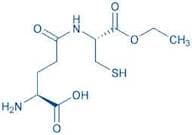
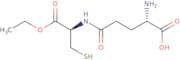
Éthyl ester de N-gamma-glutamylcystéine, avec le numéro CAS 114627-30-4, est un composé synthétique qui sert de dérivé du glutathion, un antioxydant crucial dans les systèmes biologiques. Ce composé présente une structure qui inclut un groupe gamma-glutamyle lié à une moiety de cystéine, avec une modification d'ester éthylique qui améliore sa lipophilie et sa biodisponibilité potentielle. Il est principalement étudié pour son rôle dans la défense antioxydante cellulaire et ses applications thérapeutiques potentielles, en particulier dans les conditions liées au stress oxydatif. La forme d'ester éthylique peut faciliter l'absorption cellulaire, en faisant un sujet d'intérêt dans la recherche pharmacologique. En termes de solubilité, il est généralement soluble dans des solvants organiques, et sa stabilité peut être influencée par le pH et la température. Comme de nombreux dérivés d'acides aminés, il peut présenter diverses activités biologiques, y compris la modulation des voies de signalisation cellulaire. Cependant, des recherches supplémentaires sont nécessaires pour élucider complètement ses mécanismes d'action et ses applications potentielles en médecine et en biochimie.
Formule :C10H18N2O5S
InChI :InChI=1/C10H18N2O5S/c1-2-17-10(16)7(5-18)12-8(13)4-3-6(11)9(14)15/h6-7,18H,2-5,11H2,1H3,(H,12,13)(H,14,15)
SMILES :CCOC(=O)C(CS)N=C(CCC(C(=O)O)N)O
Synonymes :- Glu-cys-oet
- N-gamma-L-Glutamyl-L-cysteine ethyl ester
- gamma-Gce
- gamma-Glutamylcysteinylethyl ester
- L-Cysteine, N-L-gamma-glutamyl-, 1-ethyl ester
- ethyl L-gamma-glutamyl-L-cysteinate
- Ethyl Gamma-Glutamylcysteinate
- N-gamma-Glutamylcysteine ethyl ester
Trier par
Degré de pureté (%)
0
100
|
0
|
50
|
90
|
95
|
100
2 produits concernés.
(Des-Gly)-Glutathione-monoethyl ester (reduced)
CAS :γ-GCE has been shown to be much more easily transported into isolated rat hepatocytes than glutathione. Within the cells it could be converted into reduced glutathione. Therefore it could – better than glutathione – prevent immunological cell injury in isolated rat hepatocytes treated with anti-rat liver plasma membrane rabbit antiserum. γ-GCE may help to reduce oxidative stress in various biological systems by promoting the biosynthesis of glutathion. For this reason, administration of GCEE and N-acetyl-cysteine (NAC) was discussed as a potential therapeutic approach for Alzheimer disease.Formule :C10H18N2O5SDegré de pureté :> 87%Couleur et forme :White PowderMasse moléculaire :278.33(Des-Gly)-Glutathione-monoethyl ester (reduced)
CAS :Glutathione (GSH) is a tripeptide that is synthesized in the liver by the enzyme glutathione synthetase and plays an important role in protecting cells from oxidative damage. The reduced form of glutathione is produced by the enzyme glutathione reductase, which reduces oxidized glutathione using NADPH as a cofactor. Glutathione monoethyl ester (GME) is a reversible covalent inhibitor of aminotransferases that has been shown to have hepatoprotective effects in animal models and clinical use. GME reversibly binds to the active site of aminotransferases, preventing their catalytic activity. It also has been shown to inhibit mitochondrial membrane potential and reactive oxygen species production, leading to an increase in cellular energy metabolism. Glutathione monoethyl ester (GME) was initially developed as a means of increasing blood levels of reduced glutathione and of interfering withFormule :C10H18N2O5SDegré de pureté :Min. 95%Masse moléculaire :278.33 g/mol