CAS 114715-54-7
:D-Glucopyranose, O-2,3,4,6-tétra-O-acétyl-α-D-glucopyranosyl-(1→4)-O-2,3,6-tri-O-acétyl-α-D-glucopyranosyl-(1→4)-O-2,3,6-tri-O-acétyl-α-D-glucopyranosyl-(1→4)-O-2,3,6-tri-O-acétyl-α-D-glucopyranosyl-(1→4)-O-2,3,6-tri-O-acétyl-α-D-glucopyranosyl-(1→4)-O-2,3,6-tri-O-acétyl-α-D-glucopyranosyl-(1→4)-, 1,2,3,6-tétraacétate
Description :
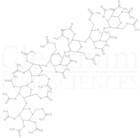
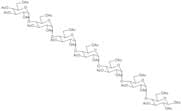
D-Glucopyranose, O-2,3,4,6-tétra-O-acétyl-α-D-glucopyranosyl-(1→4)-O-2,3,6-tri-O-acétyl-α-D-glucopyranosyl-(1→4)-O-2,3,6-tri-O-acétyl-α-D-glucopyranosyl-(1→4)-O-2,3,6-tri-O-acétyl-α-D-glucopyranosyl-(1→4)-O-2,3,6-tri-O-acétyl-α-D-glucopyranosyl-(1→4)-O-2,3,6-tri-O-acétyl-α-D-glucopyranosyl-(1→4)-, 1,2,3,6-tétraacétate, avec le numéro CAS 114715-54-7, est un dérivé de glucides complexes caractérisé par plusieurs groupes acétyle attachés aux unités de glucopyranose. Ce composé présente une structure hautement ramifiée, composée de plusieurs unités de α-D-glucopyranosyle liées par des liaisons glycosidiques (1→4). La présence de groupes acétyle améliore sa solubilité dans les solvants organiques et peut influencer sa réactivité et sa stabilité. En général, de tels dérivés sont utilisés en chimie organique synthétique et en chimie des glucides pour diverses applications, y compris la synthèse d'oligosaccharides et de glycosides. L'acétylation modifie les groupes hydroxyles, ce qui peut affecter l'activité biologique du composé, le rendant intéressant pour la recherche pharmaceutique et biochimique. Dans l'ensemble, cette substance illustre la complexité et la polyvalence de la chimie des glucides.
Formule :C88H118O59
InChI :InChI=1S/C88H118O59/c1-31(89)112-24-54-61(119-38(8)96)68(120-39(9)97)76(128-47(17)105)83(136-54)143-63-56(26-114-33(3)91)138-85(78(130-49(19)107)70(63)122-41(11)99)145-65-58(28-116-35(5)93)140-87(80(132-51(21)109)72(65)124-43(13)101)147-67-60(30-118-37(7)95)141-88(81(133-52(22)110)74(67)126-45(15)103)146-66-59(29-117-36(6)94)139-86(79(131-50(20)108)73(66)125-44(14)102)144-64-57(27-115-34(4)92)137-84(77(129-48(18)106)71(64)123-42(12)100)142-62-55(25-113-32(2)90)135-82(134-53(23)111)75(127-46(16)104)69(62)121-40(10)98/h54-88H,24-30H2,1-23H3/t54-,55-,56-,57-,58-,59-,60-,61-,62-,63-,64-,65-,66-,67-,68+,69+,70+,71+,72+,73+,74+,75-,76-,77-,78-,79-,80-,81-,82?,83-,84-,85-,86-,87-,88-/m1/s1
Code InChI :InChIKey=VZHZTOMVTDULCM-HTQOMODDSA-N
SMILES :O([C@H]1[C@H](OC(C)=O)[C@@H](OC(C)=O)[C@@H](O[C@H]2[C@H](OC(C)=O)[C@@H](OC(C)=O)[C@@H](O[C@H]3[C@H](OC(C)=O)[C@@H](OC(C)=O)[C@@H](O[C@H]4[C@H](OC(C)=O)[C@@H](OC(C)=O)C(OC(C)=O)O[C@@H]4COC(C)=O)O[C@@H]3COC(C)=O)O[C@@H]2COC(C)=O)O[C@@H]1COC(C)=O)[C@@H]5[C@H](OC(C)=O)[C@@H](OC(C)=O)[C@H](O[C@@H]6[C@H](OC(C)=O)[C@@H](OC(C)=O)[C@H](O[C@@H]7[C@H](OC(C)=O)[C@@H](OC(C)=O)[C@H](OC(C)=O)[C@@H](COC(C)=O)O7)[C@@H](COC(C)=O)O6)[C@@H](COC(C)=O)O5
Synonymes :- Peracetyl-D-maltoheptaose
- D-Glucopyranose, O-2,3,4,6-tetra-O-acetyl-α-D-glucopyranosyl-(1→4)-O-2,3,6-tri-O-acetyl-α-D-glucopyranosyl-(1→4)-O-2,3,6-tri-O-acetyl-α-D-glucopyranosyl-(1→4)-O-2,3,6-tri-O-acetyl-α-D-glucopyranosyl-(1→4)-O-2,3,6-tri-O-acetyl-α-D-glucopyranosyl-(1→4)-O-2,3,6-tri-O-acetyl-α-D-glucopyranosyl-(1→4)-, tetraacetate
- D-Glucopyranose, O-2,3,4,6-tetra-O-acetyl-α-D-glucopyranosyl-(1→4)-O-2,3,6-tri-O-acetyl-α-D-glucopyranosyl-(1→4)-O-2,3,6-tri-O-acetyl-α-D-glucopyranosyl-(1→4)-O-2,3,6-tri-O-acetyl-α-D-glucopyranosyl-(1→4)-O-2,3,6-tri-O-acetyl-α-D-glucopyranosyl-(1→4)-O-2,3,6-tri-O-acetyl-α-D-glucopyranosyl-(1→4)-, 1,2,3,6-tetraacetate
Trier par
Degré de pureté (%)
0
100
|
0
|
50
|
90
|
95
|
100
2 produits concernés.
Maltoheptaose tricosaacetate
CAS :CO2-philic compound; used in pharmaceuticals and CO2-based processesFormule :C88H118O59Degré de pureté :Min. 95%Couleur et forme :PowderMasse moléculaire :2,119.92 g/mol