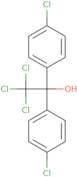
CAS 115-32-2
:dicofol
Description :
dicofol est un composé organochloré principalement utilisé comme pesticide, en particulier pour le contrôle des acariens sur diverses cultures. Il se caractérise par sa structure chimique, qui comprend un groupe phénolique chloré, contribuant à son efficacité en tant qu'acaricide. dicofol est généralement un liquide incolore à jaune pâle avec une légère odeur et est relativement stable dans des conditions normales. Il présente une faible solubilité dans l'eau mais est soluble dans des solvants organiques, ce qui facilite son application dans les milieux agricoles. Le composé a un profil de toxicité modéré à élevé pour les organismes aquatiques, soulevant des préoccupations environnementales concernant son utilisation. De plus, dicofol est connu pour bioaccumuler dans la chaîne alimentaire, entraînant des impacts écologiques potentiels à long terme. Le contrôle réglementaire a augmenté au fil des ans en raison de sa persistance dans l'environnement et des risques potentiels pour la santé humaine et la faune. En conséquence, son utilisation a été restreinte ou interdite dans plusieurs pays, incitant à la recherche d'alternatives plus sûres dans la gestion des nuisibles.
Formule :C14H9Cl5O
InChI :InChI=1/C14H9Cl5O/c15-11-5-1-9(2-6-11)13(20,14(17,18)19)10-3-7-12(16)8-4-10/h1-8,20H
Code InChI :InChIKey=UOAMTSKGCBMZTC-UHFFFAOYSA-N
SMILES :C(C(Cl)(Cl)Cl)(O)(C1=CC=C(Cl)C=C1)C2=CC=C(Cl)C=C2
Synonymes :- 1,1-Bis(4-chlorophenyl)-2,2,2-trichloroethanol
- 1,1-Bis(p-chlorophenyl)-2,2,2-trichloroethanol
- 2,2,2-Trichloro-1,1-Bis(4-Chlorophenyl)Ethanol
- 2,2,2-Trichloro-1,1-bis(p-chlorophenyl)ethanol
- 2,2,2-Trichloro-1,1-di(4-chlorophenyl)ethanol
- 4,4'-Dichloro-α-(trichloromethyl)benzhydrol
- 4-Chloro-Α-(4-Chlorophenyl)-Α-(Trichloromethyl)Benzenemethanol
- Acarin
- Afd 25
- Agravertin
- Benzenemethanol, 4-chloro-α-(4-chlorophenyl)-α-(trichloromethyl)-
- Benzhydrol, 4,4'-dichloro-α-(trichloromethyl)-
- Chloretanol
- Colonel-S
- Cpca
- Dacomain
- Decofol
- Dichlorokelthane
- Dicofo
- Dicofol [Benzenemethanol, 4-chloro-α-(4-chlorophenyl)-α-(trichloromethyl)-]
- Dicofol kelthene
- Dtmc
- Ent 23,648
- Ethanol, 2,2,2-trichloro-1,1-bis(4-chlorophenyl)-
- Fw 293
- Keltane
- Kelthane
- Kelthane A
- Kelthanethanol
- Milbol
- Mitigan
- p,p'-Dicofol
- p,p'-Kelthane
- 1,1,1-Trichlor-2,2-bis(4-chlorphenyl)-aethanol
- DI(P-CHLOROPHENYL)TRICHLOROMETHYL-CARBINOL
- FW 293(R)
- 1,1-Bis-(chlorophenyl)-2,2,2-trichloroethanol
- CEKUDIFOL
- KELTHANE (TM)
- DICOFOL
- DICOCHEM
- 4,4'-Dichloro-alpha-(trichloromethyl)benzhydrol
- 1,1,1-TRICHLORO-2,2-BIS-(4-CHLOROPHENYL)-ETHANOL
- AGROTHANE
- DTMC(R)
- Voir plus de synonymes
Trier par
Degré de pureté (%)
0
100
|
0
|
50
|
90
|
95
|
100
Dicofol
CAS :Produit contrôléDicofol is a pyrimidine compound with a methyl myristate group at the C-4 position. It is synthesized by bacteria and has been used as an insecticide for over 50 years. Dicofol also inhibits cell growth in some bacterial strains, including high-resistance bacterial strains. Dicofol does not have any significant effect on ryanodine receptor activity in plant tissues, but it does inhibit the release of calcium from the endoplasmic reticulum. The presence of dicofol can be detected using analytical chemistry methods that are sensitive to picomolar concentrations.
Formule :C14H9Cl5ODegré de pureté :Min. 85 Area-%Couleur et forme :Red Clear LiquidMasse moléculaire :370.48 g/mol