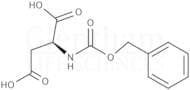
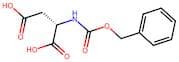
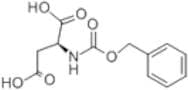
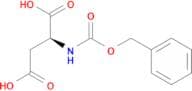
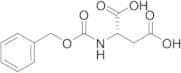
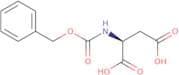
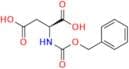
CAS 1152-61-0
:Acide benzyloxycarbonyl-L-aspartique
Description :
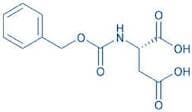
Acide benzyloxycarbonyl-L-aspartique, communément appelé Z-Asp, est un dérivé de l'acide aminé acide aspartique, caractérisé par la présence d'un groupe protecteur benzyloxycarbonyle (Z). Ce composé est généralement utilisé dans la synthèse peptidique comme groupe protecteur pour la fonctionnalité amino de l'acide aspartique, ce qui aide à prévenir les réactions indésirables pendant le processus de synthèse. Le groupe Z est stable dans des conditions basiques mais peut être éliminé dans des conditions acides, permettant une déprotection sélective. Acide benzyloxycarbonyl-L-aspartique est un solide cristallin blanc à blanc cassé et est soluble dans des solvants organiques tels que le méthanol et le diméthylsulfoxyde (DMSO), mais a une solubilité limitée dans l'eau. Sa structure moléculaire comprend un groupe fonctionnel acide carboxylique, contribuant à ses propriétés acides. Le composé est utilisé dans diverses applications biochimiques, y compris la synthèse de peptides et de protéines, et sert d'intermédiaire important dans le développement de produits pharmaceutiques. Une manipulation et un stockage appropriés sont essentiels en raison de sa réactivité et de son potentiel d'hydrolyse dans des environnements aqueux.
Formule :C12H13NO6
InChI :InChI=1S/C12H13NO6/c14-10(15)6-9(11(16)17)13-12(18)19-7-8-4-2-1-3-5-8/h1-5,9H,6-7H2,(H,13,18)(H,14,15)(H,16,17)/t9-/m0/s1
Code InChI :InChIKey=XYXYXSKSTZAEJW-VIFPVBQESA-N
SMILES :C(OC(N[C@@H](CC(O)=O)C(O)=O)=O)C1=CC=CC=C1
Synonymes :- (2S)-2-(Phenylmethoxycarbonylamino)butanedioic acid
- (2S)-2-[[(Benzyloxy)carbonyl]amino]butanedioic acid
- (2S)-2-{[(benzyloxy)carbonyl]amino}butanedioate
- <span class="text-smallcaps">L</span>-Aspartic acid, N-[(phenylmethoxy)carbonyl]-
- Aspartic acid, N-carboxy-, N-benzyl ester
- Aspartic acid, N-carboxy-, N-benzyl ester, <span class="text-smallcaps">L</span>-
- Benzyloxycarbonyl-<span class="text-smallcaps">L</span>-aspartic acid
- CBZ-L-Aspartic Acid-OH
- Carbobenzoxy-<span class="text-smallcaps">L</span>-aspartic acid
- Cbz-Asp-OH
- Cbz-L-aspartic acid
- N-(Benzyloxycarbonyl)-<span class="text-smallcaps">L</span>-aspartic acid
- N-Benzyloxycarbonyl-L-aspartic acid
- N-Benzyloxylcarbonyl-<span class="text-smallcaps">L</span>-aspartic acid
- N-CBZ-L-Aspartic acid N-Carbobenzyloxy-L-aspartic acid
- N-Carbobenzoxy-<span class="text-smallcaps">L</span>-aspartic acid
- N-Carbobenzoxy-L-aspatic acid
- N-Carbobenzyloxy-<span class="text-smallcaps">L</span>-aspartic acid
- N-Cbz-L-Asp-OH
- N-Cbz-L-aspartic acid
- N-[(Phenylmethoxy)carbonyl]-<span class="text-smallcaps">L</span>-aspartic acid
- N-[(benzyloxy)carbonyl]-D-aspartic acid
- N-[(benzyloxy)carbonyl]-L-aspartic acid
- N-[(benzyloxy)carbonyl]aspartic acid
- N-cbz-L-aspartic acid crystalline
- NALPHA-Benzyloxycarbonyl-L-aspartic acid
- NSC 88479
- NSC 9972
- Z-Asp-OH
- Z-L-Aspartic acid
- z-Asp
- Carbobenzoxy-L-aspartic acid
- N-[(Phenylmethoxy)carbonyl]-L-aspartic acid
- Aspartic acid, N-carboxy-, N-benzyl ester, L-
- Voir plus de synonymes
Trier par
Degré de pureté (%)
0
100
|
0
|
50
|
90
|
95
|
100
11 produits concernés.
N-Benzyloxycarbonyl-L-aspartic Acid
CAS :Formule :C12H13NO6Degré de pureté :>99.0%(T)Couleur et forme :White to Almost white powder to crystalMasse moléculaire :267.24Z-Asp-OH
CAS :Bachem ID: 4000471.
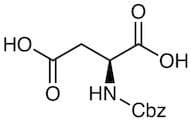
Formule :C12H13NO6Degré de pureté :> 98%Couleur et forme :WhiteMasse moléculaire :267.24L-Aspartic acid, N-[(phenylmethoxy)carbonyl]-
CAS :Formule :C12H13NO6Degré de pureté :98%Couleur et forme :SolidMasse moléculaire :267.2347N-Z-L-aspartic acid
CAS :Formule :C12H13NO6Degré de pureté :≥ 98.0%Couleur et forme :White to off-white solidMasse moléculaire :267.24Z-L-Aspartic Acid extrapure, 99%
CAS :Formule :C12H13NO6Degré de pureté :min. 99%Couleur et forme :White to off white, Crystalline powderMasse moléculaire :267.2Z-Asp-OH
CAS :M03043 - Z-Asp-OH
Formule :C12H13NO6Degré de pureté :98%Couleur et forme :SolidMasse moléculaire :267.237N-Cbz-L-aspartic Acid
CAS :Produit contrôléApplications N-Cbz-L-aspartic acid is an N-Cbz-protected form of L-Aspartic acid (A790024). L-Aspartic acid is a nonessential amino acid that is used to biosynthesize other amino acids within the human body. L-Aspartic acid also increases membrane conductance of mammalian neurons by voltage-dependent means, causing depolarization and nerve impulses that travel to key areas of the central nervous system.
References Anderson, H., et al.: J. Nutr., 99, 82 (1969); Honey, C., et al.: Neurosci. Lett., 61, 135 (1985); MacDonald, J., et al.: Brain Res., 237, 248 (1982)Formule :C12H13NO6Couleur et forme :White To Off-WhiteMasse moléculaire :267.23Z-L-Asp-OH
CAS :Z-L-Asp-OH is a protease inhibitor that inhibits the activity of serine proteases, including trypsin and chymotrypsin. Z-L-Asp-OH binds to the active site of these enzymes and prevents them from cleaving their substrates. The optimal pH for this enzyme is 8.0, which corresponds to its maximum level of activity. Z-L-Asp-OH also has apoptotic activities in cells by causing cellular pathway changes, leading to cell death via programmed cell death or apoptosis. This agent is activated by hydrolysis at ester linkages and polymerizes into films in aqueous solution at physiological pH. It has been shown to inhibit the growth of human ovarian carcinoma cells in vitro, but not normal cells.Formule :C12H13NO6Degré de pureté :Min. 95%Masse moléculaire :267.23 g/mol


![L-Aspartic acid, N-[(phenylmethoxy)carbonyl]-](/_next/image/?url=https%3A%2Fstatic.cymitquimica.com%2Fproducts%2FIN%2Fthumb%2FDA000GEV.jpg&w=3840&q=75)