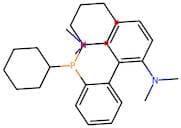
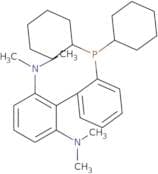
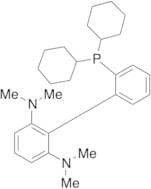
![2′-(Dicyclohexylphosphino)-N2,N2,N6,N6-tetramethyl[1,1′-biphenyl]-2,6-diamine](/_next/image/?url=https%3A%2Fstatic.cymitquimica.com%2Fcas-image%2Fthumb-webp%2F144702-2-dicyclohexylphosphino-n2-n2-n6-n6-tetramethyl-11-biphenyl-26-diamine.webp&w=3840&q=75)
CAS 1160556-64-8
:2'-(Dicyclohexylphosphino)-N2,N2,N6,N6-tétraméthyl[1,1'-biphényle]-2,6-diamine
Description :
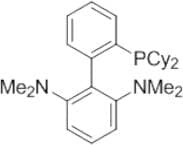
2'-(Dicyclohexylphosphino)-N2,N2,N6,N6-tétraméthyl[1,1'-biphényle]-2,6-diamine, identifié par son numéro CAS 1160556-64-8, est un composé organophosphoré spécialisé qui présente une structure de biphényle substituée par une diamine tétraméthylée et un groupe dicyclohexylphosphino. Ce composé se caractérise par son agencement structurel unique, qui confère une hindrance stérique significative et des propriétés électroniques, le rendant utile dans diverses applications catalytiques, en particulier dans la catalyse des métaux de transition. La présence du groupe dicyclohexylphosphino améliore sa capacité à stabiliser des complexes métalliques, facilitant ainsi des réactions telles que le couplage croisé et d'autres transformations en synthèse organique. De plus, la solubilité et la réactivité du composé peuvent être influencées par les volumineux groupes cyclohexyles, qui peuvent également affecter son interaction avec les substrats et les catalyseurs. Dans l'ensemble, ce composé suscite de l'intérêt dans le domaine de la chimie organométallique et de la catalyse en raison de ses propriétés distinctives et de ses applications potentielles dans les méthodologies synthétiques.
Formule :C28H41N2P
InChI :InChI=1S/C28H41N2P/c1-29(2)25-19-13-20-26(30(3)4)28(25)24-18-11-12-21-27(24)31(22-14-7-5-8-15-22)23-16-9-6-10-17-23/h11-13,18-23H,5-10,14-17H2,1-4H3
Code InChI :InChIKey=DRNAQRXLOSUHBQ-UHFFFAOYSA-N
SMILES :P(C1=C(C=CC=C1)C2=C(N(C)C)C=CC=C2N(C)C)(C3CCCCC3)C4CCCCC4
Synonymes :- (2-Indanylidene)malononitrile
- 2-(2-Dicyclohexylphosphanylphenyl)-1-N,1-N,3-N,3-N-tetramethylbenzene-1,3-diamine
- 2-(Dicyanomethylen)indan
- 2′-(Dicyclohexylphosphino)-N2,N2,N6,N6-tetramethyl-[1,1′-biphenyl]-2,6-diamine
- 2′-(Dicyclohexylphosphino)-N<sup>2</sup>,N<sup>2</sup>,N<sup>6</sup>,N<sup>6</sup>-tetramethyl[1,1′-biphenyl]-2,6-diamine
- CPhos
- Malononitrile,(2-Indanylidene)
- [1,1′-Biphenyl]-2,6-diamine, 2′-(dicyclohexylphosphino)-N<sup>2</sup>,N<sup>2</sup>,N<sup>6</sup>,N<sup>6</sup>-tetramethyl-
- [1,1′-Biphenyl]-2,6-diamine, 2′-(dicyclohexylphosphino)-N2,N2,N6,N6-tetramethyl-
- 2-Dicyclohexylphosphino-2',6'-bis(diMethylaMino)-1,1'-biphenyl
Trier par
Degré de pureté (%)
0
100
|
0
|
50
|
90
|
95
|
100
7 produits concernés.
2-Dicyclohexylphosphino-2',6'-bis(dimethylamino)-1,1'-biphenyl, min. 98% CPhos
CAS :2-Dicyclohexylphosphino-2',6'-bis(dimethylamino)-1,1'-biphenyl, min. 98% CPhos
Formule :C28H41N2PDegré de pureté :min. 98%Couleur et forme :off-white to orange xtl.Masse moléculaire :436.61[1,1'-Biphenyl]-2,6-diamine, 2'-(dicyclohexylphosphino)-N2,N2,N6,N6-tetramethyl-
CAS :Formule :C28H41N2PDegré de pureté :95%Couleur et forme :SolidMasse moléculaire :436.61232-Dicyclohexylphosphino-2',6'-bis(N,N-dimethylamino)biphenyl
CAS :2-Dicyclohexylphosphino-2',6'-bis(N,N-dimethylamino)biphenyl (PCP-DMAP) is a phosphorus compound that is used for the synthesis of aryl chlorides. It has been validated as an effective reagent for the conversion of aryl chlorides to aryl halides. PCP-DMAP can be used in peptidomimetic synthesis and profiling. It is also useful in the synthesis of natural products where activation with N,N-dimethylchloramine (DMC) is required. PCP-DMAP can be used as an efficient alternative to other methods for activation with DMC, using less time and producing less waste. This compound has been shown to be stable against hydrolysis and oxidation in both acidic and basic media, making it a good reagent for use under these conditions. PCP-DMAP can also be used in the synthesisFormule :C28H41N2PDegré de pureté :Min. 95%Couleur et forme :PowderMasse moléculaire :436.61 g/molCPhos
CAS :Produit contrôléApplications CPhos, is used as a catalyst in the synthetic preparation of palladium-catalyzed Negishi coupling of secondary alkylzinc halides with aryl bromides and chlorides.
References Han, C., et al.: J. Am. Chem. Soc., 131, 7532 (2009)Formule :C28H41N2PCouleur et forme :NeatMasse moléculaire :436.61

![[1,1'-Biphenyl]-2,6-diamine, 2'-(dicyclohexylphosphino)-N2,N2,N6,N6-tetramethyl-](/_next/image/?url=https%3A%2Fstatic.cymitquimica.com%2Fproducts%2FIN%2Fthumb%2FDA000BI1.jpg&w=3840&q=75)