


CAS 1167421-25-1
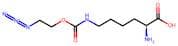
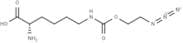
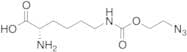
:Nε-2-Azidoéthyloxycarbonyl-L-lysine
- Nε-2-Azidoethyloxycarbonyl-L-lysine
- (S)-2-Amino-6-((2-azidoethoxy)carbonylamino)hexanoic acid
- N3-Lys
- Nε-2-AzidoethyL
- N6-[(2-Azidoethoxy)carbonyl]-L-lysine
- Click-Amino-Acid / N3-Lys
- UAA crosslinker 1
- (2S)-2-amino-6-{[(2-azidoethoxy)carbonyl]amino}hexanoic acid
- (S)-2-amino-6-((2-azidoethoxy)carbonylamino)hexanoic acid hydrochloride
- -2-Azidoethyloxycarbonyl-L-lysine
(2S)-2-amino-6-{[(2-azidoethoxy)carbonyl]amino}hexanoic acid
CAS :Formule :C9H17N5O4Degré de pureté :95%Couleur et forme :SolidMasse moléculaire :259.2624N6-((2-Azidoethoxy)carbonyl)-L-lysine
CAS :N6-((2-Azidoethoxy)carbonyl)-L-lysineDegré de pureté :95%Masse moléculaire :259.27g/molUAA crosslinker 1
CAS :UAA crosslinker 1 hydrochloride enables in vivo ncAAs incorporation into proteins via wildtype/engineered aminoacyl-tRNA synthetases.Formule :C9H17N5O4Degré de pureté :98%Couleur et forme :SolidMasse moléculaire :259.26NEpsilon-2-Azidoethyloxycarbonyl-L-lysine
CAS :Produit contrôléStability Light Sensitive
Applications Nε-2-Azidoethyloxycarbonyl-L-lysine is derived from 2-Azidoethanol (A848560), which is used as a reagent in the glycosylation of mono- or polysaccharides. 2-Azidoethanol is also used as a 2’-deoxy-ethynyluridine (EdU) blocker in nuclear DNA, preventing cross relativity with other antibodies in order to better study its related pathways in the body.
References Liboska, R., et al.: PLOS ONE, 7, e51679 (2012); Sun, X., et al.: Biomacromolecules, 3, 1065 (2002)Formule :C9H17N5O4Couleur et forme :NeatMasse moléculaire :259.26N6-[(2-Azidoethoxy)carbonyl]-l-lysine
CAS :N6-[(2-Azidoethoxy)carbonyl]-l-lysine is a triazole that is chemically synthesized. It has been used to label recombinant proteins and it can be used as a fluorescent probe for labeling DNA or RNA. N6-[(2-Azidoethoxy)carbonyl]-l-lysine can be used to introduce site-specific intramolecular crosslinks in proteins by reacting with an amine group on the protein and a nucleophilic group on the same protein. This chemical reaction results in the formation of a covalent bond between two amino acid residues, causing a change in the topology of the protein. The introduction of this chemical moiety into erythromycin A was shown to decrease its antibiotic activity against Gram-positive bacteria such as Streptococcus pneumoniae, Streptococcus pyogenes, Enterococcus faecalis, and Enterococcus faecium.
Formule :C9H17N5O4Degré de pureté :Min. 95%Couleur et forme :PowderMasse moléculaire :259.26 g/mol





![N6-[(2-Azidoethoxy)carbonyl]-l-lysine](/_next/image/?url=https%3A%2Fstatic.cymitquimica.com%2Fproducts%2F3D%2Fthumb%2FFA178291.jpg&w=3840&q=75)
