CAS 117-08-8
:Anhydride tétrachlorophtalique
Description :
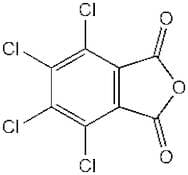
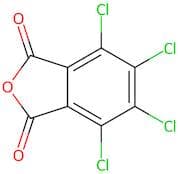
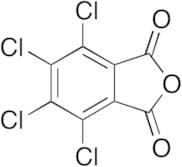
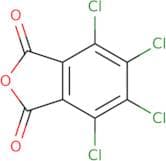
Anhydride tétrachlorophtalique (CAS 117-08-8) est un composé chimique caractérisé par son groupe fonctionnel anhydride dérivé de l'acide phtalique, avec quatre atomes de chlore substitués sur l'anneau aromatique. Il apparaît sous forme de solide cristallin blanc à jaune clair et est connu pour son point de fusion élevé et sa faible solubilité dans l'eau, ce qui le rend plus soluble dans les solvants organiques. Ce composé est principalement utilisé dans la production de polyimides et d'autres polymères, servant d'intermédiaire clé dans diverses synthèses chimiques. Sa réactivité est notable, car il peut subir une hydrolyse pour former de l'acide tétrachlorophthalique, et il peut également participer à des réactions avec des nucléophiles en raison de la nature électrophile du groupe anhydride. Anhydride tétrachlorophtalique est considéré comme dangereux, avec des effets potentiels sur la santé en cas d'exposition, nécessitant des mesures de sécurité appropriées lors de la manipulation. Ses applications s'étendent à la fabrication de revêtements, d'adhésifs et en tant qu'intermédiaire chimique dans la synthèse d'autres composés, soulignant son importance dans la chimie industrielle.
Formule :C8Cl4O3
InChI :InChI=1S/C8Cl4O3/c9-3-1-2(8(14)15-7(1)13)4(10)6(12)5(3)11
Code InChI :InChIKey=AUHHYELHRWCWEZ-UHFFFAOYSA-N
SMILES :ClC1=C2C(=C(Cl)C(Cl)=C1Cl)C(=O)OC2=O
Synonymes :- (2,3,6-Trichlorophenyl)Acetic Acid
- 1,3-Dioxy-4,5,6,7-tetrachloroisobenzofuran
- 1,3-Isobenzofurandione, 4,5,6,7-Tetrachloro
- 3,4,5,6-Tetrachlorophthalic anhydride
- 4,5,6,7-Tetrachloro-1,3-isobenzofurandione
- 4,5,6,7-Tetrachloro-2-Benzofuran-1,3-Dione
- 4,5,6,7-Tetrachloroisobenzofuran-1,3-dione
- 4,5,6,7-Tetrachlorp-l,3-dioxoph-thalan
- NSC 1484
- Niagathal
- Phthalic anhydride, tetrachloro-
- Tetra Chloro Phthalic Anhydride
- Tetrachloro Phthalic Anhydride
- Tetrachlorophthalic acid anhydride
- Voir plus de synonymes
Trier par
Degré de pureté (%)
0
100
|
0
|
50
|
90
|
95
|
100
4 produits concernés.
Tetrachlorophthalic anhydride, 98%
CAS :Protection of amines as their tetrachlorophthalimide derivatives, by reaction with the anhydride in the presence of triethylamine, has been found to be useful in oligosaccharide chemistry. The group is stable to a wide range of reagents but can be selectively cleaved with ethylenediamine at lower teFormule :C8Cl4O3Degré de pureté :98%Couleur et forme :White, Powder or crystalline powderMasse moléculaire :285.89Tetrachlorophthalic anhydride
CAS :Tetrachlorophthalic anhydrideFormule :C8Cl4O3Degré de pureté :97%Couleur et forme : white powderMasse moléculaire :285.90g/molTetrachlorophthalic Anhydride
CAS :Produit contrôléApplications Tetrachlorophthalic Anhydride is used in the synthesis of nucleoside analogues with a specific structure as apoptosis inducing active compounds. Also used in the synthesis of carbonic anhydrase inhbitors. Chlorinated Reactive Flame Retardant Intermediate
References Hirschhaeuser, C. et al.: Chem. A. Eur. J., 19, 13017 (2013); Sethi, K. et al.: Bioorg. Med. Chem., 21, 5168 (2013);Formule :C8Cl4O3Couleur et forme :NeatMasse moléculaire :285.9Tetrachlorophthalic anhydride
CAS :Produit contrôléTetrachlorophthalic anhydride (TCPA) is a reactive chemical that has been shown to have anti-inflammatory activity. TCPA has been found to inhibit the release of histamine from mast cells in humans, and it inhibits the production of pro-inflammatory cytokines such as tumor necrosis factor alpha (TNF-α). TCPA has also been shown to have a toxic effect on human lymphocyte transformation, which may be due to its ability to induce apoptosis. The toxicity of TCPA was studied in rats and mice, where it was found that TCPA did not cause any significant changes in clinical pathology or hydroxyl group levels.Formule :C8Cl4O3Degré de pureté :Min. 97.5 Area-%Couleur et forme :White/Off-White SolidMasse moléculaire :285.89 g/mol