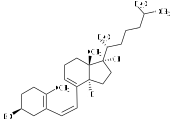
CAS 1173-13-3
:Prévitaine D3
- (1S)-3-[(1Z)-2-[(1R,3aR,7aR)-1-[(1R)-1,5-Dimethylhexyl]-2,3,3a,6,7,7a-hexahydro-7a-methyl-1H-inden-4-yl]ethenyl]-4-methyl-3-cyclohexen-1-ol
- (1S)-3-[2-[(1R,3aR,7aR)-1-[(1R)-1,5-dimethylhexyl]-7a-methyl-1,2,3,3a,6,7-hexahydroinden-4-yl]vinyl]-4-methyl-cyclohex-3-en-1-ol
- (3S,6Z,14β)-9,10-secocholesta-5(10),6,8-trien-3-ol
- (3beta,6Z)-9,10-Secocholesta-5(10),6,8-trien-3-ol
- 3-Cyclohexen-1-ol, 3-[(1Z)-2-[(1R,3aR,7aR)-1-[(1R)-1,5-dimethylhexyl]-2,3,3a,6,7,7a-hexahydro-7a-methyl-1H-inden-4-yl]ethenyl]-4-methyl-, (1S)-
- 9,10-Secocholesta-5(10),6,8-trien-3-ol, (3β,6Z)-
- 9,10-Secocholesta-5(10),6,8-trien-3β-ol
- Precalciferol
- Precalciferol<sub>3</sub>
- Precholecalciferol
- Previtamin D
- Previtamin D(3)
- Previtamin D<sub>3</sub>
- Voir plus de synonymes
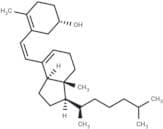
Previtamin D3
CAS :Previtamin D3 is an intermediate in the production of cholecalciferol (vitamin D3).Formule :C27H44OCouleur et forme :SolidMasse moléculaire :384.648Previtamin D3 (>80%)
CAS :Produit contrôléStability Light Sensitive, Temperature Sensitive
Applications Vitamin D3 (V676045) isomer. Vitamin D3 mediates intestinal calcium absorbtion, bone calcium metabolism and many other processes. During exposure to sunlight 7-dehydrocholesterol in converted to pre-vitamin D3, which undergoes a rapid transformation within the plasma membrane to vitamin D3.
Not a dangerous good if item is equal to or less than 1g/ml and there is less than 100g/ml in the package
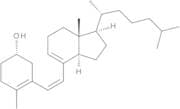
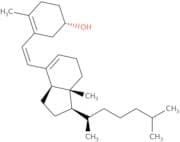
References Holick, M. et al.; J. Bone. Miner. Metab. 22, V28 (2007); Tian, X. & Holick, M.; J. Biol. Chem. 270, 8706 (1995)Formule :C27H44ODegré de pureté :>80%Couleur et forme :ColourlessMasse moléculaire :384.64Precholecalciferol
CAS :Precholecalciferol is a vitamin D analog that has been shown to be active in the target tissue. It is used for the treatment of chronic kidney disease and autoimmune diseases, including multiple sclerosis. The activated form of this drug is converted to calcitriol by hydroxylation, which is then metabolized by the liver. This form of the drug can also be converted by epoxide hydrolase to 25-hydroxycholecalciferol, which can be further metabolized by cytochrome P450 enzymes to 1,25-dihydroxycholecalciferol (1,25-(OH)2D3). This form of the drug can bind to nuclear receptors and activate gene transcription. Precholecalciferol has been shown to activate growth factors such as insulin-like growth factor-I and platelet-derived growth factor, which may contribute to its role in treating autoimmune diseases.
Formule :C27H44ODegré de pureté :Min. 95%Couleur et forme :PowderMasse moléculaire :384.64 g/mol