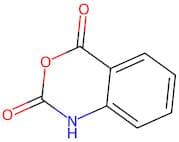
CAS 118-48-9
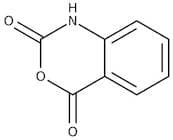
:Anhydride isatoïque
Description :
Anhydride isatoïque, avec le numéro CAS 118-48-9, est un composé organique caractérisé par son groupe fonctionnel anhydride dérivé de l'acide isatoïque. Il apparaît sous forme de solide cristallin blanc à jaune pâle et est connu pour sa solubilité relativement faible dans l'eau mais sa bonne solubilité dans des solvants organiques tels que l'éthanol et l'acétone. Le composé a un point de fusion qui se situe généralement dans une plage modérée, indiquant son état solide à température ambiante. Anhydride isatoïque est principalement utilisé dans la synthèse organique, en particulier dans la production de colorants, de produits pharmaceutiques et d'agrochimiques. Il peut agir comme un réactif dans diverses réactions chimiques, y compris les processus d'acylation. De plus, il présente une réactivité envers les nucléophiles, ce qui le rend précieux dans la synthèse de molécules organiques plus complexes. Des précautions de sécurité doivent être observées lors de la manipulation de ce composé, car il peut présenter des risques pour la santé en cas d'exposition. Dans l'ensemble, Anhydride isatoïque est un élément de base polyvalent dans la chimie organique de synthèse.
Formule :C8H5NO3
InChI :InChI=1/C8H5NO3/c10-7-5-3-1-2-4-6(5)9-8(11)12-7/h1-4H,(H,9,11)
Code InChI :InChIKey=TXJUTRJFNRYTHH-UHFFFAOYSA-N
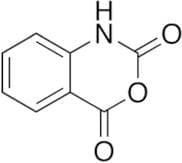
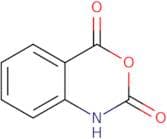
SMILES :O=C1C=2C(NC(=O)O1)=CC=CC2
Synonymes :- 1,2-Dihydro-3,1-benzoxazine-2,4-dione
- 1H-3,1-Benzoxazine-2,4-dione
- 1H-Benz[d][1,3]oxazine-2,4-dione
- 1H-Benzo[d][1,3]oxazin-2,4-dione
- 1H-Benzo[d][1,3]oxazine-2,4-dione
- 2,4-Dihydro-1H-3,1-benzoxazine-2,4-dione
- 2,4-Dioxo-1,2-dihydro-4H-3,1-benzoxazine
- 2-Hydroxy-4H-3,1-benzoxazin-4-one
- 3,1-Benzoxazine-2,4(1H)-dione
- 4H-3,1-Benzoxazin-2,4(1H)-dion
- 4H-3,1-Benzoxazine-2,4(1H)-dione
- 4H-3,1-benzoxazina-2,4(1H)-diona
- Benzoic acid, 2-(carboxyamino)-, cyclic anhydride
- Isatoic Anhydride
- Isatoic acid anhydride
- Isatosaeureanhydrid
- Nsc 104662
- Nsc 29555
- 2H-3,1-Benzoxazine-2,4(1H)-dione
- 2-(carboxyamino)-benzoicacicyclicanhydride
- ANTHRANILIC ACID N-CARBOXYLIC ACID ANHYDRIDE
- ISATOLC ANHYDRIDE
- TIMTEC-BB SBB003928
- 1,4-DIHYDRO-2H-3,1-BENZOXAZIN-2,4-DIONE
- BENZOXAZINEDIONE
- N-CARBOXYANTHRANILIC ACID CYCLIC ANHYDRIDE
- Anthranilic acid, N-carboxy-, cyclic anhydride
- LABOTEST-BB LT00053651
- Voir plus de synonymes
Trier par
Degré de pureté (%)
0
100
|
0
|
50
|
90
|
95
|
100
7 produits concernés.
Isatoic Anhydride
CAS :Formule :C8H5NO3Degré de pureté :>98.0%(T)(HPLC)Couleur et forme :White to Almost white powder to crystalMasse moléculaire :163.13Isatoic anhydride, 97%
CAS :This Thermo Scientific Chemicals brand product was originally part of the Alfa Aesar product portfolio. Some documentation and label information may refer to the legacy brand. The original Alfa Aesar product / item code or SKU reference has not changed as a part of the brand transition to Thermo Sci
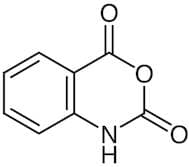
Formule :C8H5NO3Degré de pureté :97%Couleur et forme :White to grey or cream to pale brown, PowderMasse moléculaire :163.131H-Benzo[d][1,3]oxazine-2,4-dione
CAS :Formule :C8H5NO3Degré de pureté :96%Couleur et forme :SolidMasse moléculaire :163.1302Isatoic Anhydride
CAS :Produit contrôléApplications Isatoic anhydride is a potent inactivator of α-chymotrypsin and inactivates stoichiometrically. Isatoic Anhydride is an important compound in the preparation of serine protease inhibitors.
References Moorman, A.J. et al.: J. AM. Chem. Soc., 104, 6785 (1982); Shinogi, M. et al.: J. Pharmac. Sci., 74, 782 (1985); Khiav, B. et al.: Int. Arch. Allergy Immunol., 113, 291 (1997);Formule :C8H5NO3Couleur et forme :NeatMasse moléculaire :163.13Isatoic anhydride
CAS :Formule :C8H5NO3Degré de pureté :96%Couleur et forme :Solid, White - Almost white powderMasse moléculaire :163.132Isatoic anhydride
CAS :Isatoic anhydride is a nitro compound that has minimal toxicity and is soluble in water. It does not have a redox potential, but is easily oxidized by atmospheric oxygen or peroxide to form nitrate. Isatoic anhydride reacts with amines to produce hydroxyl groups and diazonium salts. This product has been used as an antimicrobial agent, as well as a reagent for the synthesis of other compounds. The mechanism of this reaction is believed to involve the formation of a nitroso-diazonium salt intermediate, which reacts with amines to produce hydroxyl groups and diazonium salts.Formule :C8H5NO3Degré de pureté :Min. 95%Masse moléculaire :163.13 g/mol


![1H-Benzo[d][1,3]oxazine-2,4-dione](/_next/image/?url=https%3A%2Fstatic.cymitquimica.com%2Fproducts%2FIN%2Fthumb%2FDA00351G.jpg&w=3840&q=75)