CAS 118231-04-2
:tachyplésine
Description :
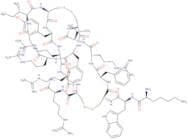
tachyplésine est un peptide dérivé du sang du limule, spécifiquement de l'espèce Tachypleus tridentatus. Il est connu pour ses propriétés antimicrobiennes, montrant une activité contre une gamme de bactéries, de champignons et de virus. tachyplésine se caractérise par sa taille relativement petite, consistant généralement en environ 18 acides aminés, et présente une structure unique qui inclut une forte proportion de résidus chargés positivement, ce qui contribue à sa capacité à perturber les membranes microbiennes. Le peptide est également remarquable pour sa stabilité et sa résistance à la dégradation protéolytique, ce qui en fait un sujet d'intérêt dans la recherche biomédicale, en particulier dans le développement de nouveaux agents antimicrobiens. De plus, tachyplésine a été étudié pour ses applications potentielles dans la cicatrisation des plaies et comme modèle pour concevoir des peptides antimicrobiens synthétiques. Son numéro CAS, 118231-04-2, est utilisé pour l'identification dans les bases de données chimiques et les contextes réglementaires. Dans l'ensemble, tachyplésine représente un exemple significatif de composés antimicrobiens naturels avec des applications thérapeutiques potentielles.
Formule :C99H151N35O19S4
InChI :InChI=1/C99H151N35O19S4/c1-5-53(4)78-94(153)132-75-51-157-156-50-74(91(150)127-69(43-55-28-32-58(135)33-29-55)85(144)121-64(24-14-38-114-96(105)106)81(140)119-47-76(137)133-78)131-93(152)77(52(2)3)134-84(143)67(27-17-41-117-99(111)112)124-86(145)68(42-54-18-7-6-8-19-54)126-90(149)73(130-88(147)71(125-80(139)61(101)21-11-12-36-100)45-57-46-118-62-22-10-9-20-60(57)62)49-155-154-48-72(89(148)120-63(79(102)138)23-13-37-113-95(103)104)129-83(142)66(26-16-40-116-98(109)110)122-82(141)65(25-15-39-115-97(107)108)123-87(146)70(128-92(75)151)44-56-30-34-59(136)35-31-56/h6-10,18-20,22,28-35,46,52-53,61,63-75,77-78,118,135-136H,5,11-17,21,23-27,36-45,47-51,100-101H2,1-4H3,(H2,102,138)(H,119,140)(H,120,148)(H,121,144)(H,122,141)(H,123,146)(H,124,145)(H,125,139)(H,126,149)(H,127,150)(H,128,151)(H,129,142)(H,130,147)(H,131,152)(H,132,153)(H,133,137)(H,134,143)(H4,103,104,113)(H4,105,106,114)(H4,107,108,115)(H4,109,110,116)(H4,111,112,117)/t53-,61-,63-,64-,65-,66-,67-,68-,69-,70-,71-,72-,73-,74-,75-,77-,78-/m0/s1
SMILES :CC[C@H](C)[C@H]1C(=N[C@H]2CSSC[C@@H](C(=N[C@@H](Cc3ccc(cc3)O)C(=N[C@@H](CCCNC(=N)N)C(=NCC(=N1)O)O)O)O)N=C([C@H](C(C)C)N=C([C@H](CCCNC(=N)N)N=C([C@H](Cc1ccccc1)N=C([C@H](CSSC[C@@H](C(=N[C@@H](CCCNC(=N)N)C(=N)O)O)N=C([C@H](CCCNC(=N)N)N=C([C@H](CCCNC(=N)N)N=C([C@H](Cc1ccc(cc1)O)N=C2O)O)O)O)N=C([C@H](Cc1c[nH]c2ccccc12)N=C([C@H](CCCCN)N)O)O)O)O)O)O)O
Synonymes :- Tachyplesin I
- Tachyplesin
- L-Argininamide, L-lysyl-L-tryptophyl-L-cysteinyl-L-phenylalanyl-L-arginyl-L-valyl-L-cysteinyl-L-tyrosyl-L-arginylglycyl-L-isoleucyl-L-cysteinyl-L-tyrosyl-L-arginyl-L-arginyl-L-cysteinyl-, cyclic (3→16),(7→12)-bis(disulfide)
- Tachyplesin I (9CI)
- Tachyplesin peptide, Tachypleus tridentatus
Trier par
Degré de pureté (%)
0
100
|
0
|
50
|
90
|
95
|
100
2 produits concernés.
Tachyplesin I
CAS :Tachyplesin I is an antimicrobial peptide originally detected in the extract of hemocytes from the Japanese horseshoe crab. It inhibits the growth of both Gramnegative and -positive bacteria and forms a complex with bacterial lipopolysaccharides. These results suggest that this peptide belongs to the family of arthropodous peptide antibiotics. Furthermore this peptide has been shown to have antiviral activity against vesicular stomatitis virus, influenza A virus and HIV-1.Formule :C99H151N35O19S4Degré de pureté :> 97%Couleur et forme :White PowderMasse moléculaire :2263.78Tachyplesin I trifluoroacetate
CAS :Tachyplesin I trifluoroacetate is an antimicrobial peptide with action on bacterial and fungal membranes by disrupting their integrity and is used for research on antimicrobial properties and potential therapeutic applications.
Formule :C99H151N35O19S4•(C2HF3O2)xDegré de pureté :Min. 95%Couleur et forme :PowderMasse moléculaire :2,263.75 g/mol