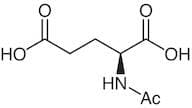
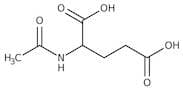
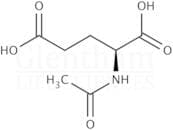
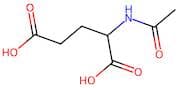
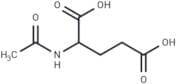
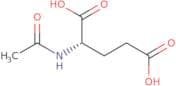
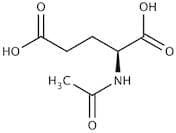
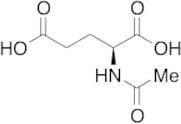
CAS 1188-37-0
:Acide N-acétyl-L-glutamique
- (2S)-2-(acetylamino)pentanedioate
- (2S)-2-Acetamidopentanedioic acid
- <span class="text-smallcaps">L</span>-Glutamic acid, N-acetyl-
- <span class="text-smallcaps">L</span>-N-Acetylglutamic acid
- Ac-Glu-OH
- Ac-Gly
- Acetyl-L-glutamic acid
- Acetylglutamic acid
- Glutamic acid, N-acetyl-, <span class="text-smallcaps">L</span>-
- N-Acetyl-<span class="text-smallcaps">L</span>-glutamic acid
- N-Acetyl-<span class="text-smallcaps">L</span>-glutaminic acid
- N-Acetyl-L-glutamate
- N-Acetyl-L-glutamic acid
- N-Acetyl-S-glutamic acid
- N-Acetylglutamate
- N-acetylglutamic acid
- α-(N-Acetyl)-<span class="text-smallcaps">L</span>-glutamic acid
- Glutamic acid, N-acetyl-, L-
- Voir plus de synonymes
N-Acetyl-L-glutamic Acid
CAS :Formule :C7H11NO5Degré de pureté :>98.0%(T)(HPLC)Couleur et forme :White to Almost white powder to crystalMasse moléculaire :189.17N-Acetyl-L-glutamic acid, 99%
CAS :N-Acetyl-L-glutamic acid is used as pharmaceutical intermediates. This Thermo Scientific Chemicals brand product was originally part of the Alfa Aesar product portfolio. Some documentation and label information may refer to the legacy brand. The original Alfa Aesar product / item code or SKU referenFormule :C7H11NO5Degré de pureté :99%Couleur et forme :Crystals or powder or crystalline powder, WhiteMasse moléculaire :189.17N-Acetyl-L-glutamic acid
CAS :Formule :C7H11NO5Degré de pureté :98%Couleur et forme :SolidMasse moléculaire :189.1659N-Acetyl-L-glutamic acid
CAS :Formule :C7H11NO5Degré de pureté :(Titration) ≥ 98.0%Couleur et forme :White crystalline powder or crystalsMasse moléculaire :189.17N-Acetyl-L-glutamic acid
CAS :N-Acetyl-L-glutamic acidDegré de pureté :≥98%Masse moléculaire :189.17g/molN-Acetyl-L-glutamic acid
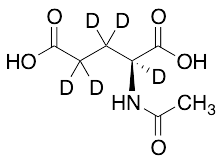
CAS :N-Acetyl-L-glutamic acidFormule :C7H11NO5Degré de pureté :99%Couleur et forme : white crystalline powderMasse moléculaire :189.17g/molN-Acetyl-L-glutamic-2,3,3,4,4-d5 Acid
CAS :Formule :HOOCCD2CD2CD(NHCOCH3)COOHDegré de pureté :98 atom % DCouleur et forme :White SolidMasse moléculaire :194.09511N-Acetyl-L-glutamic acid
CAS :NAcGlu, made from glutamic acid & acetyl-CoA by NAGS, activates urea cycle enzyme. NAGS deficiency causes Type I hyperammonemia.Formule :C7H11NO5Degré de pureté :99.64% - 99.95%Couleur et forme :SolidMasse moléculaire :189.17N-Acetyl-L-glutamic-2,3,3,4,4-d5 Acid
CAS :Produit contrôléApplications N-Acetyl-L-glutamic-2,3,3,4,4-d5 Acid is the deuterium labelled form of N-Acetyl-L-glutamic Acid (A178255), which is the N-Acetyl analogue of the non-essential amino acid L-glutamic acid (G596960). N-Acetyl-L-glutamic Acid activates carbamoyl phosphate synthetase in the urea cycle.
References Saheki, T. et al.: J. Biochem., 77, 659 (1975); Rivas, J. et al.: Acta Biol. Med. Ger., 36, 1673 (1977); Zollner, H.: Biochim. Biophys. Acta, 676, 170 (1981);Formule :C7D5H6NO5Couleur et forme :NeatMasse moléculaire :194.2N-Acetyl-L-glutamic acid
CAS :N-Acetylglutamic acid is a biologically active compound that is found in the cells. It is a product of the urea cycle and has been shown to inhibit the activity of enzymes such as ester hydrochloride synthetase, which catalyzes the conversion of arginine and citrulline to ornithine and carbamoyl phosphate. N-Acetylglutamic acid also plays an important role in cellular physiology, such as transcriptional regulation and protein synthesis. Deficiency can lead to glutamate accumulation and neurological disorders such as epilepsy. The biochemical properties of N-acetylglutamic acid are still not well known, but it has been shown to react with ammonia to form glutamine.
Formule :C7H11NO5Degré de pureté :Min 98%Couleur et forme :White PowderMasse moléculaire :189.17 g/molN-Acetyl-L-Glutamic Acid extrapure, 99%
CAS :Formule :C7H11NO5Degré de pureté :min 99%Couleur et forme :White to off white, PowderMasse moléculaire :189.17N-Acetyl-L-glutamic acid
CAS :Formule :C7H11NO5Degré de pureté :98%Couleur et forme :SolidMasse moléculaire :189.167N-Acetyl-L-glutamic Acid
CAS :Produit contrôléApplications N-Acetyl-L-glutamic Acid is the N-Acetyl analogue of the non-essential amino acid, L-glutamic acid (G596960). N-Acetyl-L-glutamic Acid activates carbamoyl phosphate synthetase in the urea cycle.
References Saheki, T. et al.: J. Biochem., 77, 659 (1975); Rivas, J. et al.: Acta Biol. Med. Ger., 36, 1673 (1977); Zollner, H.: Biochim. Biophys. Acta, 676, 170 (1981);Formule :C7H11NO5Couleur et forme :NeatMasse moléculaire :189.17