CAS 1191-95-3
:Cyclobutanone
Description :
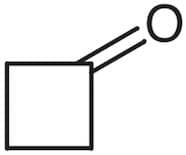
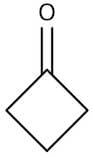
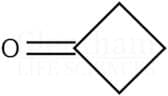
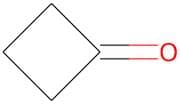
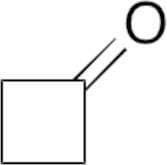
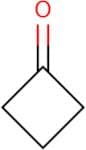
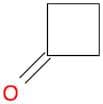
Cyclobutanone est une cétone cyclique caractérisée par un cycle de carbone à quatre membres avec un groupe carbonyle (C=O) attaché à l'un des atomes de carbone. Sa formule moléculaire est C4H6O, et elle présente une structure unique qui influence ses propriétés chimiques. Cyclobutanone est un liquide incolore à température ambiante, avec une odeur distinctive. Il est relativement instable par rapport aux cétones cycliques plus grandes en raison de la contrainte de cycle associée à sa petite taille de cycle. Cette contrainte peut entraîner une réactivité, rendant Cyclobutanone susceptible à diverses réactions chimiques, y compris l'addition nucléophile et l'oxydation. Le composé est soluble dans des solvants organiques mais a une solubilité limitée dans l'eau. Cyclobutanone est utilisé dans la synthèse organique et comme intermédiaire dans la production de produits pharmaceutiques et d'autres composés chimiques. Sa réactivité et ses caractéristiques structurelles en font un sujet d'étude intéressant dans le domaine de la chimie organique, en particulier dans le contexte de la contrainte de cycle et de ses implications pour le comportement chimique.
Formule :C4H6O
InChI :InChI=1S/C4H6O/c5-4-2-1-3-4/h1-3H2
Code InChI :InChIKey=SHQSVMDWKBRBGB-UHFFFAOYSA-N
SMILES :O=C1CCC1
Synonymes :- Ai3-37787
- Ciclobutanona
- Cyclobutanon
- Nsc 87632
- Cyclobutanone
Trier par
Degré de pureté (%)
0
100
|
0
|
50
|
90
|
95
|
100
10 produits concernés.
Cyclobutanone (stabilized with Na2CO3)
CAS :Formule :C4H6ODegré de pureté :>97.0%(GC)Couleur et forme :Colorless to Yellow to Orange clear liquidMasse moléculaire :70.09Cyclobutanone, 98%, stab. with ca 0.1% BHT
CAS :Cyclobutanone is used in preparation of cyclobutane derivatives. It is used as a starting material for aminocyclobutanecarboxylic acid through sulfonyloxiranes. It is also used to prepare dihydro-furan-2-one in presence of polystyrene-bound phenylselenic acid as catalyst. Further, it is involved inFormule :C4H6ODegré de pureté :0.1%Couleur et forme :Clear or slightly turbid, colorless to pale yellow, LiquidMasse moléculaire :70.09Cyclobutanone
CAS :Formule :C4H6ODegré de pureté :(GC) ≥ 99.0%Couleur et forme :Clear, colourless to light yellow liquidMasse moléculaire :70.09Cyclobutanone (stabilized with 0.1% BHT)
CAS :Formule :C4H6ODegré de pureté :98.0%Couleur et forme :Liquid, ClearMasse moléculaire :70.091Cyclobutanone
CAS :CyclobutanoneFormule :C4H6ODegré de pureté :98%Couleur et forme : yellowish liquidMasse moléculaire :70.08983g/molCyclobutanone
CAS :Produit contrôléStability Volatile
Applications Cyclobutanone is a member of cycloketone compounds that have potential genotoxic and cytotoxic effects and are most commonly found in irradiated food.
Not a dangerous good if item is equal to or less than 1g/ml and there is less than 100g/ml in the package
References Anandon, A., et al.: EFSA Journal, 9, 1930 (2011); Delincee, H., et al.: Radiat. Phys. Chem., 63, 431 (2002); Obana, H. ,et al.: J. Health Sci., 52, 375 (2006)Formule :C4H6OCouleur et forme :NeatMasse moléculaire :70.09Cyclobutanone - stabilise 0.01 % BHT
CAS :Cyclobutanone is a chemical compound that is used as a model system for studying the oxidation of organic compounds. Cyclobutanone can be synthesized by the reaction of trifluoroacetic acid with cyclohexanone, which in turn can be produced from the hydrogenation of acetone or by dehydration of propionaldehyde. This chemical has been shown to inhibit the growth of infectious bacteria such as Mycobacterium tuberculosis and Streptococcus pneumoniae. It is also effective against other bacterial strains, such as Escherichia coli, Salmonella typhi, and Pseudomonas aeruginosa. Cyclobutanone inhibits the metabolism of glucose in cells by blocking the enzyme hexokinase and preventing glycolysis from occurring, leading to an accumulation of lactic acid in blood and urine. This effect on glucose metabolism may contribute to some autoimmune diseases, such as type 1 diabetes mellitus and celiac disease. The structure of cyclFormule :C4H6ODegré de pureté :Min. 95%Couleur et forme :Colorless Clear LiquidMasse moléculaire :70.09 g/molCyclobutanone
CAS :Formule :C4H6ODegré de pureté :95%Couleur et forme :LiquidMasse moléculaire :70.0898Ref: IN-DA000I79
Produit arrêté