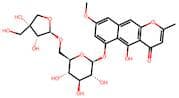
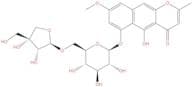
![6-[(6-O-D-Apio-β-D-furanosyl-β-D-glucopyranosyl)oxy]-5-hydroxy-8-methoxy-2-methyl-4H-naphtho[2,3-b…](/_next/image/?url=https%3A%2Fstatic.cymitquimica.com%2Fcas-image%2Fthumb-webp%2F480816-6-6-o-d-apio-b-d-furanosyl-b-d-glucopyranosyl-oxy-5-hydroxy-8-methoxy-2-methyl-4h-naphtho-23-b-pyran-4-one.webp&w=3840&q=75)
CAS 119170-51-3
:6-[(6-O-D-Apio-β-D-furanosyl-β-D-glucopyranosyl)oxy]-5-hydroxy-8-méthoxy-2-méthyl-4H-naphtho[2,3-b]pyran-4-one
Description :
La substance chimique connue sous le nom de "6-[(6-O-D-Apio-β-D-furanosyl-β-D-glucopyranosyl)oxy]-5-hydroxy-8-méthoxy-2-méthyl-4H-naphtho[2,3-b]pyran-4-one," avec le numéro CAS 119170-51-3, est un dérivé flavonoïde glycosylé complexe. Ce composé présente une structure de naphthopyran, qui est caractéristique de nombreux flavonoïdes, contribuant à ses potentielles propriétés antioxydantes. La présence de plusieurs unités de sucre, spécifiquement une unité de furanosyle et une unité de glucopyranosyle, suggère qu'elle pourrait présenter une solubilité et une biodisponibilité accrues par rapport aux flavonoïdes non glycosylés. Les groupes hydroxyle et méthoxy sur la structure de naphthopyran peuvent influencer sa réactivité et son interaction avec les systèmes biologiques, affectant potentiellement ses activités pharmacologiques. De tels composés sont souvent étudiés pour leur potentiel thérapeutique, y compris des propriétés anti-inflammatoires et anticancéreuses. De plus, la complexité structurelle peut indiquer un rôle dans les mécanismes de défense des plantes ou des interactions avec d'autres molécules biologiques. Dans l'ensemble, cette substance représente un domaine de recherche fascinant en chimie des produits naturels et en pharmacognosie.
Formule :C26H30O14
InChI :InChI=1S/C26H30O14/c1-10-3-13(28)18-14(38-10)5-11-4-12(35-2)6-15(17(11)20(18)30)39-24-22(32)21(31)19(29)16(40-24)7-36-25-23(33)26(34,8-27)9-37-25/h3-6,16,19,21-25,27,29-34H,7-9H2,1-2H3/t16-,19-,21+,22-,23+,24-,25-,26-/m1/s1
Code InChI :InChIKey=NIVCJAYDAMQSJO-PAMAHNMISA-N
SMILES :O(C=1C2=C(C=C3C(=C2O)C(=O)C=C(C)O3)C=C(OC)C1)[C@@H]4O[C@H](CO[C@H]5[C@H](O)[C@](CO)(O)CO5)[C@@H](O)[C@H](O)[C@H]4O
Synonymes :- 4H-Naphtho[2,3-b]pyran-4-one, 6-[(6-O-<span class="text-smallcaps">D</smallcap>-apio-β-<smallcap>D</smallcap>-furanosyl-β-<smallcap>D</span>-glucopyranosyl)oxy]-5-hydroxy-8-methoxy-2-methyl-
- 6-[(6-O-<span class="text-smallcaps">D</smallcap>-Apio-β-<smallcap>D</smallcap>-furanosyl-β-<smallcap>D</span>-glucopyranosyl)oxy]-5-hydroxy-8-methoxy-2-methyl-4H-naphtho[2,3-b]pyran-4-one
- Cassiaside B
- CassiasideB
- Rubrofusarin-6-O-β-<span class="text-smallcaps">D</smallcap>-apiofuranosyl-(1→6)-O-β-<smallcap>D</span>-glucopyranoside
- 4H-Naphtho[2,3-b]pyran-4-one, 6-[(6-O-D-apio-β-D-furanosyl-β-D-glucopyranosyl)oxy]-5-hydroxy-8-methoxy-2-methyl-
- 6-[(6-O-D-Apio-β-D-furanosyl-β-D-glucopyranosyl)oxy]-5-hydroxy-8-methoxy-2-methyl-4H-naphtho[2,3-b]pyran-4-one
- Rubrofusarin-6-O-β-D-apiofuranosyl-(1→6)-O-β-D-glucopyranoside
Trier par
Degré de pureté (%)
0
100
|
0
|
50
|
90
|
95
|
100
4 produits concernés.
Cassiaside B
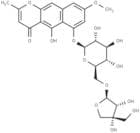
CAS :Cassiaside B is a natural product with potent antibacterial activity.Formule :C26H30O14Degré de pureté :99.82%Couleur et forme :SolidMasse moléculaire :566.51Cassiaside B
CAS :<p>Cassiaside B is a type of natural anthraquinone glycoside, derived primarily from the seeds of the Cassia genus, particularly Cassia tora and Cassia obtusifolia. These plants are well-recognized in traditional medicine systems for their therapeutic properties. The mode of action of Cassiaside B involves its role as a potent antioxidant, scavenging free radicals and reducing oxidative stress. Additionally, it exhibits anti-inflammatory effects by modulating specific pathways that are instrumental in the inflammatory response.</p>Formule :C26H30O14Degré de pureté :Min. 95%Masse moléculaire :566.50 g/mol