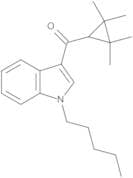
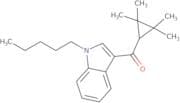
CAS 1199943-44-6
:(1-Pentyl-1H-indol-3-yl)(2,2,3,3-tétraméthylcyclopropyl)méthanone
Description :
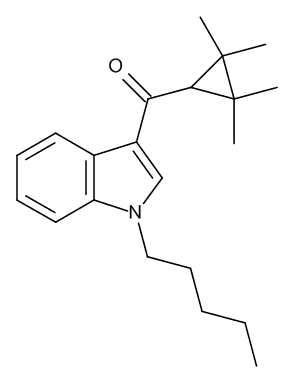
(1-Pentyl-1H-indol-3-yl)(2,2,3,3-tétraméthylcyclopropyl)méthanone, identifié par son numéro CAS 1199943-44-6, est un composé synthétique qui appartient à la classe des dérivés de l'indole. Cette substance se caractérise par sa structure moléculaire complexe, qui comprend un groupe indole lié à un groupe cyclopropyle. La présence de la chaîne pentyle contribue à ses propriétés hydrophobes, tandis que le composant tétraméthylcyclopropyle ajoute du volume stérique, influençant son interaction avec les cibles biologiques. Ce composé a suscité de l'intérêt dans les contextes de recherche, en particulier dans les études liées aux récepteurs cannabinoïdes, en raison de ses effets psychoactifs potentiels. Sa solubilité et sa stabilité peuvent varier en fonction des conditions environnementales, et il peut présenter des propriétés pharmacologiques uniques. Comme pour de nombreux cannabinoïdes synthétiques, comprendre son profil de sécurité, y compris la toxicité et le potentiel d'abus, est crucial pour évaluer ses implications dans des contextes thérapeutiques et récréatifs. Une manipulation appropriée et le respect des réglementations sont essentiels lors de la manipulation de telles substances dans des environnements de laboratoire.
Formule :C21H29NO
InChI :InChI=1S/C21H29NO/c1-6-7-10-13-22-14-16(15-11-8-9-12-17(15)22)18(23)19-20(2,3)21(19,4)5/h8-9,11-12,14,19H,6-7,10,13H2,1-5H3
Code InChI :InChIKey=NBMMIBNZVQFQEO-UHFFFAOYSA-N
SMILES :C(=O)(C1C(C)(C)C1(C)C)C=2C=3C(N(CCCCC)C2)=CC=CC3
Synonymes :- (1-Pentyl-1H-Indol-3-Yl)(2,2,3,3-Tetramethylcyclopropyl)Methanone
- Methanone, (1-pentyl-1H-indol-3-yl)(2,2,3,3-tetramethylcyclopropyl)-
- Methanone, (1- pentyl- 1H- indol- 3- yl) (2, 2, 3, 3- tetramethylcycloprop yl)
- Ur-144
Trier par
Degré de pureté (%)
0
100
|
0
|
50
|
90
|
95
|
100
9 produits concernés.
UR-144 ((1-Pentylindol-3-yl)(2,2,3,3-tetramethylcyclopropyl)methanone; KM X-1)
CAS :Produit contrôléCouleur et forme :NeatUR-144 ((1-Pentylindol-3-yl)(2,2,3,3-tetramethyl-cyclopropyl)methanone; KM X-1) 0.1 mg/ml in Acetonitrile
CAS :Produit contrôléCouleur et forme :Single SolutionUR-144 ((1-Pentylindol-3-yl)(2,2,3,3-tetramethylcyclopropyl)methanone; KM X-1) 1.0 mg/ml in Acetonitrile
CAS :Produit contrôléCouleur et forme :Colourless(1-Pentyl-1H-indol-3-yl)(2,2,3,3-tetramethylcyclopropyl)methanone (UR-144)
CAS :Produit contrôléApplications (1-Pentyl-1H-indol-3-yl)(2,2,3,3-tetramethylcyclopropyl)methanone is an Indol-3-ylcycloalkyl Ketone with high affinity for the CB2 cannabinoid receptor. Tetramethylcyclopropyl group was found to lead to high affinity CB2 agonists. Synthetic Cannabinoids
References Malan, T., et al.: Curr. Opin. Pharmacol., 3, 62 (2003), Cabral, G., et al.: J. Leukocyte Biol., 78, 1192 (2005), Beltramo, M., et al.: Eur. J. Neurosci., 23, 1530 (2006), Dziadulewicz, E., et al.: J. Med. Chem., 50, 3851 (2007),Formule :C21H29NOCouleur et forme :White To Off-WhiteMasse moléculaire :311.46(1-Pentyl-1H-indol-3-yl)(2,2,3,3-tetramethylcyclopropyl)methanone (UR-144) (1.0 mg/mL in Methanol)
CAS :Produit contrôléFormule :C21H29NOCouleur et forme :Single SolutionMasse moléculaire :311.46UR 144
CAS :Produit contrôléUR-144 is a weak synthetic cannabinoid that binds as a selective full agonist to the peripheral cannabinoid receptor CB2 (EC50 = 72 nM). It also binds to CB1 (EC50 = 421 nM) with much lower affinity1. It was recently shown to impair cell proliferation and induce the activation of apoptotic pathways in vitro through different mechanisms as well as causing loss of mitochondrial membrane potential in placental trophoblasts in vitro2. Salmonella/microsome assays revealed induction of DNA damage without gene aberration in lymphocytes3. In vivo mice models showed depression of locomotor activity, catalepsy and hypothermia at a dosage of 10mg/kg, indicating a weak cannabinoid-like activity1.Formule :C21H29NODegré de pureté :Min. 95%Masse moléculaire :311.46 g/mol