CAS 120-14-9
:3,4-Diméthoxybenzaldéhyde
Description :
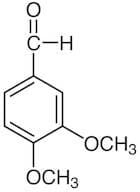
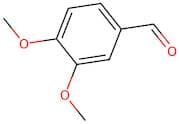
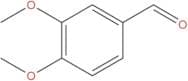
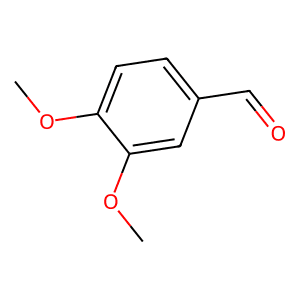
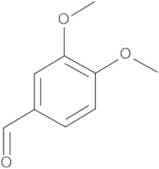
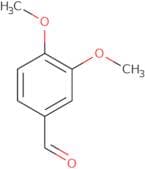
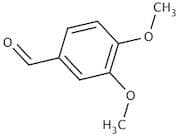
3,4-Diméthoxybenzaldéhyde, avec le numéro CAS 120-14-9, est un composé organique appartenant à la classe des aldéhydes aromatiques. Il présente un cycle benzénique substitué par deux groupes méthoxy (-OCH3) aux positions 3 et 4, ainsi qu'un groupe fonctionnel aldéhyde (-CHO) à la première position. Ce composé est typiquement un liquide incolore à jaune pâle avec un arôme doux et floral, ce qui le rend utile dans l'industrie des parfums. Il a un point d'ébullition modéré et est soluble dans des solvants organiques tels que l'éthanol et l'éther, mais a une solubilité limitée dans l'eau en raison de ses groupes méthoxy hydrophobes. 3,4-Diméthoxybenzaldéhyde est souvent utilisé comme intermédiaire dans la synthèse organique, en particulier dans la production de divers médicaments et agrochimiques. Sa réactivité est caractérisée par la présence du groupe aldéhyde, qui peut subir des réactions typiques telles que l'oxydation et la condensation. Des précautions de sécurité doivent être prises lors de la manipulation de ce composé, car il peut provoquer des irritations de la peau et des yeux.
Formule :C9H10O3
InChI :InChI=1S/C9H10O3/c1-11-8-4-3-7(6-10)5-9(8)12-2/h3-6H,1-2H3
Code InChI :InChIKey=WJUFSDZVCOTFON-UHFFFAOYSA-N
SMILES :O(C)C1=C(OC)C=CC(C=O)=C1
Synonymes :- 3,4-Dimethoxy benzaldehyde
- 3,4-Dimethoxy-Benzaldehyd
- 3,4-Dimethoxybenzaldehhyde
- 3,4-Dimethoxybenzenecarbonal
- 3,4-Dimethoxyphenylaldehyde
- 4-O-Methylvanillin
- Benzaldehyde, 3,4-dimethoxy-
- Benzaldehyde, 3,4-dimethoxy-veratraldehyde
- Methylvanillin
- Nsc 24521
- Nsc 8500
- P-Veratricaldehyde
- Protocatechualdehyde dimethyl ether
- Protocatechuecaldehyde dimethyl ether
- Protocatechuecaldehydedimethylether
- Protocatechuic aldehyde dimethyl ether
- Vanillin methyl ether
- Varatraldehyde
- Veratral
- Veratraldehido
- Veratraldehyde
- Veratric Aldehyde
- Veratrum aldehyde
- Veratrumaldehyd
- Veratryl aldehyde
- p-Veratric aldehyde
- Voir plus de synonymes
Trier par
Degré de pureté (%)
0
100
|
0
|
50
|
90
|
95
|
100
17 produits concernés.
3,4-Dimethoxybenzaldehyde
CAS :Formule :C9H10O3Degré de pureté :>98.0%(GC)Couleur et forme :White to Light yellow to Light orange powder to crystalMasse moléculaire :166.18Veratraldehyde, 99%
CAS :Veratraldehyde was used in the preparation of 4-chloromethyl-2-(dimethoxyphenyl)-1,3-dioxolane. It was used in the synthesis of (+)-lithospermic acid, having anti-HIV activity. It forms 1:1 inclusion complexes with cyclodextrins. It reacts with 3-acetyl-2,5-dimethythiophene to yield chalcone dye, (2Formule :C9H10O3Degré de pureté :99%Couleur et forme :Flakes, White to cream to pale yellowMasse moléculaire :166.18Verapamil Related Compound E (3,4-dimethoxybenzaldehyde)
CAS :Aldehyde-ethers, aldehyde-phenols and aldehydes with otFormule :C9H10O3Couleur et forme :PowderMasse moléculaire :166.06299Benzaldehyde, 3,4-dimethoxy-
CAS :Formule :C9H10O3Degré de pureté :95%Couleur et forme :SolidMasse moléculaire :166.1739Verapamil EP Impurity G (Verapamil USP Related Compound E)
CAS :Formule :C9H10O3Masse moléculaire :166.18Veratraldehyde, 10mM (in DMSO)
CAS :Veratraldehyde, 10mM (in DMSO)Degré de pureté :≥98%Masse moléculaire :166.17g/molp-Veratricaldehyde
CAS :Formule :C9H10O3Degré de pureté :95%~99%Couleur et forme :PowderMasse moléculaire :166.176Veratraldehyde
CAS :Veratraldehyde (3,4-Dimethoxybenzaldehyde) has antifungal activity .It is found in Cymbopogon javanensis.Formule :C9H10O3Degré de pureté :98.73%Couleur et forme :Yellow To Orange SolidMasse moléculaire :166.173,4-Dimethoxybenzaldehyde
CAS :3,4-DimethoxybenzaldehydeDegré de pureté :99%Masse moléculaire :166.17g/mol3,4-Dimethoxybenzaldehyde
CAS :Formule :C9H10O3Couleur et forme :Light BrownMasse moléculaire :166.173,4-Dimethoxybenzaldehyde
CAS :3,4-Dimethoxybenzaldehyde is a crystalline cellulose that has been shown to have anthelmintic properties. 3,4-Dimethoxybenzaldehyde reduces the redox potential of the parasite and inhibits the oxidative metabolism of p-hydroxybenzoic acid (pHBA). It also inhibits the biosynthesis of dihydroconiferyl alcohol and usnic acid, which are building blocks for bacterial cell walls. The reaction mechanism is thought to be due to a hydrogen atom transfer from 3,4-dimethoxybenzaldehyde to the p-hydroxybenzoic acid molecule. The product of this reaction is an aromatic ring with a hydroxyl group on carbon 2 and an ether oxygens on carbons 3 and 4. This aromatic ring will then react with another molecule of 3,4-dimethoxybenzaldehyde to produce a new molecule with two hydroxyl groups on carbons 2 and 5. This willFormule :C9H10O3Degré de pureté :Min. 95%Couleur et forme :PowderMasse moléculaire :166.17 g/mol3,4-Dimethoxybenzaldehyde
CAS :Formule :C9H10O3Degré de pureté :95%Couleur et forme :CrystallineMasse moléculaire :166.176n-Veratraldehyde pure, 98%
CAS :Formule :C9H10O3Degré de pureté :min. 98%Couleur et forme :White to pale yellow to light orange to tan, Crystalline powder, ClearMasse moléculaire :166.18