CAS 120066-38-8
:facteur de libération de la corticotropine *fragment 6-33
Description :
Le fragment 6-33 du facteur de libération de la corticotropine (CRF) est un peptide dérivé de l'hormone de libération de la corticotropine plus grande, qui joue un rôle crucial dans la réponse du corps au stress. Ce fragment spécifique est composé des acides aminés 6 à 33 de la CRF de longueur complète et est connu pour son implication dans la modulation de l'axe hypothalamo-hypophyso-surrénalien (HPA). Le numéro CAS 120066-38-8 identifie ce peptide dans les bases de données chimiques. Caractéristiquement, le fragment CRF 6-33 présente une activité biologique liée à la réponse au stress, influençant la libération de l'hormone adrénocorticotrope (ACTH) par la glande pituitaire. Il est généralement synthétisé par synthèse peptidique en phase solide et peut être utilisé dans la recherche pour étudier les troubles liés au stress, les fonctions neuroendocrines et les applications thérapeutiques potentielles. Le peptide est généralement soluble dans des solutions aqueuses et peut présenter des affinités de liaison spécifiques aux récepteurs de CRF, contribuant à ses effets physiologiques. Dans l'ensemble, le fragment CRF 6-33 sert d'outil important dans la recherche en neurobiologie et en endocrinologie.
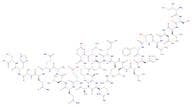
Formule :C141H231N41O43S
Synonymes :- CRF (6-33) (human, rat)
- H-Ile-Ser-Leu-Asp-Leu-Thr-Phe-His-Leu-Leu-Arg-Glu-Val-Leu-Glu-Met-Ala-Arg-Ala-Glu-Gln-Leu-Ala-Gln-Gln-Ala-His-Ser-OH
- CORTICOTROPIN RELEASING FACTOR FRAGMENT 6-33, HUMAN, RAT
- CRF (6-33)
- 6-33-Corticotropin-releasing factor (human) (9CI)
- CRF (6-33) (human, rat) H-Ile-Ser-Leu-Asp-Leu-Thr-Phe-His-Leu-Leu-Arg-Glu-Val-Leu-Glu-Met-Ala-Arg-Ala-Glu-Gln-Leu-Ala-Gln-Gln-Ala-His-Ser-OH
- CORTICOTROPIN RELEASING FACTOR FRAGMENT 6-33, HUMA
- CRF(6-33)(human)
- ILE-SER-LEU-ASP-LEU-THR-PHE-HIS-LEU-LEU-ARG-GLU-VAL-LEU-GLU-MET-ALA-ARG-ALA-GLU-GLN-LEU-ALA-GLN-GLN-ALA-HIS-SER
- CORTICOTROPIN-RELEASING FACTOR (6-33) (HUMAN, RAT)
- Corticotropin Releasing Factor Fragment 6-33 human, rat >=97% (HPLC)
Trier par
Degré de pureté (%)
0
100
|
0
|
50
|
90
|
95
|
100
4 produits concernés.
CRF (6-33) (human, rat)
CAS :This CRF fragment may have two different beneficial effects in Alzheimer’s disease (AD). First CRF (6-33) dissociates CRF from the CRF-binding protein and may therefore be able to restore the dramatic reduction of free CRF content in AD. Second this fragment shows cognition-enhancing properties in animal models of learning and memory, without the characteristic anxiogenic effects of CRF receptor agonists, and may therefore be useful in the treatment of memory deficits seen in AD.Formule :C141H231N41O43SDegré de pureté :96.8%Couleur et forme :WhiteMasse moléculaire :3220.7CRF (6-33) (Human, Rat)
CAS :Formule :C141H231N41O43SDegré de pureté :97%Masse moléculaire :3220.6567CRF(6-33)(human)
CAS :CRFBP inhibitor peptide; blocks CRF, reduces weight gain, boosts activity in obese rats.Formule :C141H231N41O43SDegré de pureté :98%Couleur et forme :SolidMasse moléculaire :3220.68CRF (6-33) (human, rat)
CAS :CRF (6-33) is a neuropeptide that is found in the human cerebral cortex and rat liver. It has been shown to inhibit protein synthesis and sequenced by Edmond H. Fischer, who also discovered corticotropin-releasing factor (CRF). CRF (6-33) binds to its receptor CRFR1, which activates phospholipase C and generates inositol 1,4,5-triphosphate. This leads to the release of calcium from intracellular stores and the activation of protein kinase C. The release of calcium ions into the cytosol causes an increase in intracellular levels of cAMP, which activates a series of reactions responsible for the cellular effects of CRF. CRF (6-33) has been shown to be involved in depression by controlling neurotransmitter levels.br>Formule :C141H231N41O43SDegré de pureté :Min. 95%Masse moléculaire :3,220.66 g/mol