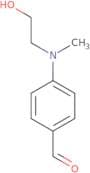
CAS 1201-91-8
:4-(n-Méthyl-n-hydroxyéthyl)amino benzaldéhyde
Description :
4-(n-Méthyl-n-hydroxyéthyl)amino benzaldéhyde, avec le numéro CAS 1201-91-8, est un composé organique caractérisé par sa structure aromatique, présentant un groupe benzaldéhyde lié à un groupe amino qui est en outre substitué par un groupe hydroxyéthyle et un groupe méthyle. Ce composé apparaît généralement sous forme solide ou liquide, selon sa forme spécifique et sa pureté. Il est connu pour ses applications potentielles dans divers domaines, y compris les produits pharmaceutiques et la fabrication de colorants, en raison de sa réactivité et de sa capacité à participer à diverses réactions chimiques, telles que la condensation et la substitution. La présence des deux groupes fonctionnels, aldéhyde et amino, permet un comportement chimique diversifié, ce qui en fait un intermédiaire précieux dans la synthèse organique. De plus, le groupe hydroxyéthyle contribue à sa solubilité dans les solvants polaires, augmentant son utilité dans différents environnements chimiques. Les données de sécurité doivent être consultées pour la manipulation, car des composés de cette nature peuvent présenter des risques pour la santé s'ils ne sont pas gérés correctement.
Formule :C10H13NO2
InChI :InChI=1/C10H13NO2/c1-11(6-7-12)10-4-2-9(8-13)3-5-10/h2-5,8,12H,6-7H2,1H3
SMILES :CN(CCO)c1ccc(cc1)C=O
Synonymes :- N-Hydroxyethyl-N-Methyl-4-Aminobenzaldehyde
- N-methyl-N-hydroxyethyl-4-amino benzaldehyde
- 4-[(2-Hydroxyethyl)(Methyl)Amino]Benzaldehyde
- N-Methyl-N-(2-hydroxyethyl)-4-aminobenzaldehyde
Trier par
Degré de pureté (%)
0
100
|
0
|
50
|
90
|
95
|
100
7 produits concernés.
Benzaldehyde, 4-[(2-hydroxyethyl)methylamino]-
CAS :Formule :C10H13NO2Degré de pureté :97%Couleur et forme :SolidMasse moléculaire :179.2157N-Methyl-N-(2-hydroxyethyl)-4-aminobenzaldehyde
CAS :N-Methyl-N-(2-hydroxyethyl)-4-aminobenzaldehydeDegré de pureté :97%Couleur et forme :SolidMasse moléculaire :179.22g/mol4-[(2-Hydroxyethyl)(methyl)amino]benzaldehyde
CAS :Formule :C10H13NO2Degré de pureté :>95.0%(T)(HPLC)Couleur et forme :White to Light yellow to Light orange powder to crystalMasse moléculaire :179.224-((2-Hydroxyethyl)(methyl)amino)benzaldehyde
CAS :Formule :C10H13NO2Degré de pureté :97%Masse moléculaire :179.2194-[(2-Hydroxyethyl)methylamino]benzaldehyde
CAS :Produit contrôléApplications 4-[(2-hydroxyethyl)methylamino]-Benzaldehyde is used in the synthesis crosslinkable tricyanopyrroline polymeric electro-optic materials. 4-[(2-hydroxyethyl)methylamino]-Benzaldehyde is also used in the chemical process when synthesizing polymethacrylates.
References Wang, L. et al.: Polym. Sci. Ser. B, 54, 297 (2012); Rondou, P. et al.: Makromol. Chem., 193, 3045 (1992); Liu, J. et al.: J. Mat. Sci. Mat. Elect., 23, 1182 (2012);Formule :C10H13NO2Couleur et forme :NeatMasse moléculaire :179.22N-Methyl-N-hydroxyethyl-4-aminobenzaldehyde
CAS :N-Methyl-N-hydroxyethyl-4-aminobenzaldehyde (NHABA) is a bathochromic molecule that absorbs light at wavelengths of 400 to 500 nm. It is reactive and reacts with metal cations to form chromophores. NHABA has been shown to be a fluorescent probe for the detection of tyrosinase and autophagy in human serum. It also has inhibitory properties against tyrosinase, which may be due to its ability to inhibit the formation of melanin. NHABA is used as an analytical chemistry reagent for the determination of ammonia, nitrite, and nitrate ions in water samples. This molecule can also be used as a chemosensor for the detection of phenolic compounds in water samples.Formule :C10H13NO2Degré de pureté :Min. 95%Masse moléculaire :179.22 g/mol
![Benzaldehyde, 4-[(2-hydroxyethyl)methylamino]-](/_next/image/?url=https%3A%2Fstatic.cymitquimica.com%2Fproducts%2FIN%2Fthumb%2FDA000QAS.jpg&w=3840&q=75)

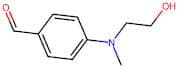

![4-[(2-Hydroxyethyl)(methyl)amino]benzaldehyde](/_next/image/?url=https%3A%2Fstatic.cymitquimica.com%2Fproducts%2F3B%2Fthumb%2FH1844.jpg&w=3840&q=75)



![4-[(2-Hydroxyethyl)methylamino]benzaldehyde](/_next/image/?url=https%3A%2Fstatic.cymitquimica.com%2Fproducts%2FTR%2Fthumb%2FH942255.jpg&w=3840&q=75)