CAS 1219803-97-0
:Trier par
Degré de pureté (%)
0
100
|
0
|
50
|
90
|
95
|
100
5 produits concernés.
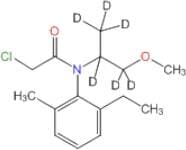
Metolachlor-d6 (propyl-d6)
CAS :Degré de pureté :98 atom % DCouleur et forme :Colorless LiquidMasse moléculaire :289.83Metolachlor D6 (propyl D6) 100 µg/mL in Acetone
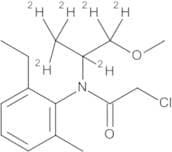
CAS :Produit contrôléFormule :C15H6H16ClNO2Couleur et forme :Single SolutionMasse moléculaire :289.83Metolachlor D6 (propyl D6)
CAS :Produit contrôléFormule :C15H6H16ClNO2Couleur et forme :NeatMasse moléculaire :289.83Metolachlor-d6
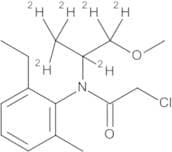
CAS :Produit contrôléApplications Isotope labelled Metolachlor (M338702), which is an acyanilide herbicide similar to selective pre-emergence herbicides (1). It is a contaminant in the groundwater and potential pollutant (2). Drinking water contaminant candidate list 3 (CCL 3) compound as per United States Environmental Protection Agency (EPA), environmental, and food contaminants.
Not a dangerous good if item is equal to or less than 1g/ml and there is less than 100g/ml in the package
References 1. McGahen, L. et al.: J. Agric. Food Chem. 1978 26 (2), pp 414–4192. Chesters, G. et al.: Rev. Environ Contam Toxicol. 1989;110:1-74.Formule :C152H6H16ClNO2Couleur et forme :Light Yellow To Light BrownMasse moléculaire :289.83Metolachlor-d6
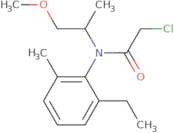
CAS :Metolachlor-d6 is a pesticide that is used to control broadleaf weeds, grasses and sedges in agricultural fields. It is degraded by sunlight and microorganisms in the environment, but its residues are still found in wastewater treatment plants. Metolachlor-d6 has been detected in the environment at levels up to 20 parts per billion (ppb). Chronic exposure to metolachlor-d6 can lead to metabolic changes, including decreased energy metabolism and altered thyroid hormone levels. Metolachlor-d6 has also been shown to cause reproductive effects such as reduced fertility and increased embryo mortality when administered orally or by injection. The most common method of treatment for metolachlor-d6 contamination is solid phase microextraction followed by gas chromatography/mass spectrometry analysis. This process can be applied to other environmental pollutants such as polychlorinated biphenyls (PCBs), polycyclic aromatic hydrocarbons (PAHs), polyFormule :C15H16ClD6NO2Degré de pureté :Min. 95%Couleur et forme :Clear LiquidMasse moléculaire :289.83 g/mol