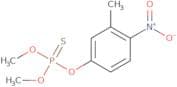
CAS 122-14-5
:Fénitrothion
Description :
Fénitrothion est un insecticide et acaricide organophosphoré, principalement utilisé dans des applications agricoles pour le contrôle des ravageurs. Il se caractérise par sa capacité à inhiber l'acétylcholinestérase, une enzyme cruciale pour le bon fonctionnement du système nerveux chez les insectes, entraînant leur paralysie et leur mort. Fénitrothion est généralement un liquide incolore à jaune pâle avec une odeur faible, et il est soluble dans des solvants organiques mais a une solubilité limitée dans l'eau. Sa structure chimique comprend un groupe thiophosphate, qui contribue à son activité biologique. La substance est connue pour sa toxicité modérée pour les humains et d'autres organismes non ciblés, nécessitant une manipulation et une application prudentes. La persistance environnementale peut varier, avec des facteurs tels que la température et l'activité microbienne influençant sa dégradation. En raison de son impact potentiel sur la santé humaine et l'environnement, Fénitrothion est soumis à un examen réglementaire dans de nombreux pays, et son utilisation est souvent restreinte ou surveillée pour atténuer les risques associés à l'exposition aux pesticides.
Formule :C9H12NO5PS
InChI :InChI=1S/C9H12NO5PS/c1-7-6-8(4-5-9(7)10(11)12)15-16(17,13-2)14-3/h4-6H,1-3H3
Code InChI :InChIKey=ZNOLGFHPUIJIMJ-UHFFFAOYSA-N
SMILES :O(P(OC)(OC)=S)C1=CC(C)=C(N(=O)=O)C=C1
Synonymes :- 8057Hc
- Accothion
- Agria 1050
- Agriya 1050
- Agrothion
- Arbogal
- Bay 41831
- Bayer 41831
- Bayer S 5660
- Cl 47300
- Cp 47114
- Dimethyl 4-nitro-m-tolyl phosphorothionate
- Ei 47300
- Ent 25,715
- Fenition
- Fenitrothion
- Fenitrotion
- Fenutrithion
- Folithion
- Folithion EC 50
- Insectigas F
- MEP
- MEP (pesticide)
- Metathion
- Metathion E 50
- Metathione
- Metathionine E 50
- Metation
- Metation E 50
- Methadion
- Methylnitrophos
- Mglawik F
- Monsanto CP 47114
- Nitrophos
- Nuvanol
- O, O-Dimethyl-O-(3-methyl-4-nitrophenyl) phosphorothioate
- O,O-DiMe O-(3-methyl-4-nitrophenyl) thiophosphate
- O,O-Dimethyl O-(3-methyl-4-nitrophenyl) thiophosphate
- O,O-Dimethyl O-(4-nitro-3-methylphenyl)thiophosphate
- O,O-Dimethyl O-4-nitro-m-tolyl phosphorothioate
- O,O-Dimethyl O-4-nitro-m-tolyl thiophosphate
- Oleometathion
- Oleosumifene
- Oms 43
- Ovadofos
- Owadofos
- Owadophos
- Paluthion
- Phenitrothion
- Phosphorothioate, O,O-Dimethyl O-(3-Methyl- 4-Nitrophenyl)
- Phosphorothioic acid O,O-dimethyl O-(3-methyl-4-nitrophenyl) ester
- Phosphorothioic acid, O,O-dimethyl O-(4-nitro-m-tolyl) ester
- S 112A
- S 5660
- ShaMingSong
- Smichion 10FL
- Sumi oil
- Sumifene
- Sumigran
- Sumithion
- Sumithion 10FL
- Sumithion 20F
- Sumithion 20MC
- Sumithion 50EC
- Sumithion Super
- Sumithion Super 1000EC
- Super Sumithion
- Tionfos 50 LE
- Verthion
- Aceothion
- Metathionine
- Dimethyl O-(4-nitro-m-tolyl) phosphorothioate
- Dimethyl 3-methyl-4-nitrophenyl phosphorothionate
- Cyfen
- O,O-dimethyl S-(3-methyl-4-nitrophenyl) phosphorothioate
- Cresol, 4-nitro-, O-ester with O,O-dimethyl phosphorothioate
- Fenitox
- Novathion
- Cytel
- Nuvanol/N-20
- Dybar
- Kotion
- Voir plus de synonymes
Trier par
Degré de pureté (%)
0
100
|
0
|
50
|
90
|
95
|
100
Fenitrothion
CAS :Produit contrôlé<p>Applications Insecticide.<br> Not a dangerous good if item is equal to or less than 1g/ml and there is less than 100g/ml in the package<br>References Nishizawa, Y., et al.: Agric. Biol. Chem., 25, 605 (1961),<br></p>Formule :C9H12NO5PSCouleur et forme :NeatMasse moléculaire :277.23Fenitrothion
CAS :<p>Fenitrothion is a neurotoxic organophosphate insecticide that has been widely used in agriculture. It is toxic to humans and animals, causing headaches, dizziness, nausea, vomiting, diarrhea, and respiratory distress. Fenitrothion has been shown to cause locomotor activity changes in rats. The matrix effect of this chemical has also been studied and found to be high resistance when compared with other organophosphates. Toxicological studies on fenitrothion have shown that it is toxic to the liver and kidneys as well as having biochemical composition that may lead to metabolic disorders. The toxicity of fenitrothion has also been studied using an in vitro assay in which it was found that the compound inhibits acetylcholinesterase (AChE) enzyme activities. Fenitrothion can be analyzed using dispersive solid-phase extraction (DSPE), which involves extracting the chemical from a solid matrix by adsorption on silica particles followed by el</p>Formule :C9H12NO5PSDegré de pureté :Min. 95%Couleur et forme :Buff To Dark BrownMasse moléculaire :277.24 g/mol