CAS 1225497-78-8
:ON-01910
Description :
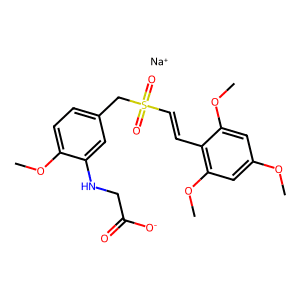
ON-01910, avec le numéro CAS 1225497-78-8, est une petite molécule qui a attiré l'attention dans le domaine de la recherche sur le cancer en raison de son potentiel en tant qu'agent anticancéreux. Elle fonctionne principalement comme un inhibiteur sélectif de la protéine kinase, qui joue un rôle crucial dans divers processus cellulaires, y compris la croissance et la division cellulaire. Le composé a été étudié pour sa capacité à induire l'apoptose (mort cellulaire programmée) dans les cellules cancéreuses et à inhiber la croissance tumorale dans des modèles précliniques. ON-01910 se caractérise par sa structure chimique unique, qui lui permet d'interagir spécifiquement avec des protéines cibles impliquées dans la progression du cancer. De plus, il a montré des promesses pour surmonter la résistance à d'autres thérapies anticancéreuses, ce qui en fait un candidat pour des traitements combinés. Son profil pharmacologique comprend des propriétés telles que la solubilité et la stabilité, qui sont essentielles pour son efficacité et sa biodisponibilité dans les applications thérapeutiques. La recherche en cours continue d'explorer ses mécanismes d'action et ses applications cliniques potentielles en oncologie.
Formule :C21H24NNaO8S
Synonymes :- ON-01910
- ON 01910 sodium salt
- ON-01910;ESTYBON
- ON-01910 USP/EP/BP
- ON-01910; ON01910; ON 01910
- brand name: Estybon.
- Rigosertib (ON-01910)
- 2-[2-methoxy-5-[2-(2,4,6-trimethoxyphenyl)vinylsulfonylmethyl]anilino]acetic acid
- ON-01910 (rigosertib)
- N-[2-Methoxy-5-[[[2-(2,4,6-trimethoxyphenyl)ethenyl]sulfonyl]methyl]phenyl]glycine sodium salt Rigosertib (ON-01910)
- ON01910; ON 01910; ON-01910; RIGOSERTIB SODIUM; BRAND NAME: ESTYBON.
- N-[2-methoxy-5-[[[2-(2,4,6-trimethoxyphenyl)ethenyl]sulfonyl]methyl]phenyl]-glycine,sodium salt (1:1)
- Estybon
- Rigosertio
- on 1910 sodium salt
- CS-551
- Rigosertib Sodium(Random Configuration)
- N-[2-Methoxy-5-[[[2-(2,4,6-trimethoxyphenyl)ethenyl]sulfonyl]methyl]phenyl]glycine sodium salt
- Rigosertib sodium salt
- sodium 2-((2-methoxy-5-(((2,4,6-trimethoxystyryl)sulfonyl)methyl)phenyl)amino)acetate|||
- Sodium (E)-2-((2-methoxy-5-(((2,4,6-trimethoxystyryl)sulfonyl)methyl)phenyl)amino)acetate
- Voir plus de synonymes
Trier par
Degré de pureté (%)
0
100
|
0
|
50
|
90
|
95
|
100
5 produits concernés.
Glycine, N-[2-methoxy-5-[[[2-(2,4,6-trimethoxyphenyl)ethenyl]sulfonyl]methyl]phenyl]-, sodium salt (1:1)
CAS :Formule :C21H24NNaO8SDegré de pureté :99%Couleur et forme :SolidMasse moléculaire :473.4719(E/Z)-Rigosertib sodium
CAS :(E/Z)-Rigosertib sodiumDegré de pureté :≥95%Masse moléculaire :473.47g/mol(E/Z)-Rigosertib sodium
CAS :ON-01910 is a non-ATP-competitive PLK1 inhibitor(IC50 of 9 nM, in a cell-free assay).Formule :C21H24NNaO8SDegré de pureté :98.56% - 99.82%Couleur et forme :SolidMasse moléculaire :473.47ON-01910 Sodium Salt
CAS :Produit contrôléApplications Rigosertib (ON-01910) is a non-ATP-competitive inhibitor of Polo-like kinase 1 (PLK1).
References Gumireddy, K., et al.: Cancer Cell, 7, 275 (2005); Reddy, M., et al.: J. Med. Chem., 54, 6254 (2011)Formule :C21H24NNaO8SCouleur et forme :NeatMasse moléculaire :473.47Rigosertib
CAS :Rigosertib is a small molecule that inhibits the activity of the protein ErbB2. It has been shown to induce reactive oxygen species (ROS) and inhibit tumor growth in preclinical models. Rigosertib is being investigated as an investigational agent for cancer therapeutics. It has been shown to be well tolerated in animals and humans with minimal toxicity. Rigosertib prevents cell-cell interactions by binding to EGFR, which may have therapeutic potential in squamous cell carcinomas and melanoma cells. Rigosertib also inhibits the activity of tyrosine kinases and may be useful for treatment of cancers that are resistant to other therapies, such as coumarin derivatives, which are used in combination with chemotherapy for treatment of acute myeloid leukemia. RIGSERTIB blocks tumor growth by inducing apoptosis through activation of caspase-3 and caspase-7 pathways, which causes DNA fragmentation, nuclear condensation, and cleavage of polyDegré de pureté :Min. 95%
![Glycine, N-[2-methoxy-5-[[[2-(2,4,6-trimethoxyphenyl)ethenyl]sulfonyl]methyl]phenyl]-, sodium salt…](/_next/image/?url=https%3A%2Fstatic.cymitquimica.com%2Fproducts%2FIN%2Fthumb%2FDA0017G2.jpg&w=3840&q=75)