CAS 123-00-2
:4-(3-Aminopropyl)morpholine
Description :
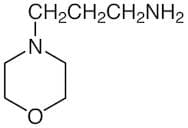
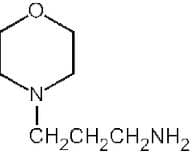
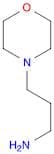
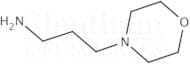
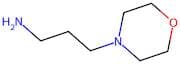
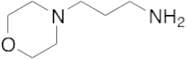
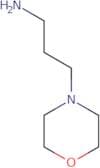
4-(3-Aminopropyl)morpholine, avec le numéro CAS 123-00-2, est un composé organique caractérisé par sa structure en anneau de morpholine, qui est un hétérocycle à six membres contenant un atome d'azote. Ce composé présente une chaîne latérale de propylamine en position 4 de la morpholine, contribuant à sa fonctionnalité amine. Il est généralement un liquide ou un solide incolore à jaune pâle, selon la température et la pureté. La présence des groupes morpholine et amine confère des propriétés basiques, le rendant soluble dans l'eau et divers solvants organiques. Ce composé est souvent utilisé dans la synthèse chimique, en particulier dans la production de produits pharmaceutiques et d'agrochimiques, en raison de sa capacité à agir comme un élément de base ou un intermédiaire. De plus, il peut présenter une activité biologique, ce qui peut être d'un intérêt en chimie médicinale. Les données de sécurité doivent être consultées, car il peut présenter des risques pour la santé s'il n'est pas manipulé correctement, y compris une irritation potentielle de la peau et des yeux.
Formule :C7H16N2O
InChI :InChI=1S/C7H16N2O/c8-2-1-3-9-4-6-10-7-5-9/h1-8H2
Code InChI :InChIKey=UIKUBYKUYUSRSM-UHFFFAOYSA-N
SMILES :C(CCN)N1CCOCC1
Synonymes :- 1-Amino-3-morpholinopropane
- 1-Morpholino-3-aminopropane
- 3-(4-Morpholino)propylamine
- 3-(4-Morpholinyl)-1-propanamine
- 3-(4-Morpholinyl)-1-propylamine
- 3-(4-Morpholinyl)propanamine
- 3-(4-Morpholinyl)propylamine
- 3-(Morpholin-4-yl)propan-1-amine
- 3-(Morpholin-4-yl)propylamine
- 3-(Morpholino)-n-propylamine
- 3-(N-Morpholino)-1-aminopropane
- 3-Amino-1-(morpholino)propane
- 3-Morfolinopropilamina
- 3-Morpholinopropanamine
- 3-Morpholinopropylamin
- 3-Morpholinopropylamine
- 4-(3'-Aminopropyl)morpholine
- 4-(γ-Aminopropyl)morpholine
- Morpholine, 4-(3-Aminopropyl)-
- N-(3-Aminopropyl)-Morpholin
- N-(3-Aminopropyl)morpholine
- N-Morpholino-3-propylamine
- Nsc 1081
- [3-(4-Morpholinyl)propan-1-yl]amine
- [3-(Morpholino)propan-1-yl]amine
- γ-Morpholinopropylamine
- Voir plus de synonymes
Trier par
Degré de pureté (%)
0
100
|
0
|
50
|
90
|
95
|
100
8 produits concernés.
N-(3-Aminopropyl)morpholine
CAS :Formule :C7H16N2ODegré de pureté :>99.0%(GC)Couleur et forme :Colorless to Almost colorless clear liquidMasse moléculaire :144.223-(4-Morpholinyl)propylamine, 98%
CAS :3-(4-Morpholinyl)propylamine is catalytic agent, petrochemical additive. It is an important raw material and intermediate used in organic synthesis, pharmaceuticals, agrochemicals and dyestuffs. This Thermo Scientific Chemicals brand product was originally part of the Alfa Aesar product portfolio. SFormule :C7H16N2ODegré de pureté :98%Couleur et forme :Clear colorless to pale yellow, LiquidMasse moléculaire :144.224-Morpholinepropanamine
CAS :Formule :C7H16N2ODegré de pureté :98%Couleur et forme :LiquidMasse moléculaire :144.2147N-(3-Aminopropyl)morpholine (AMP)
CAS :Formule :C7H16N2ODegré de pureté :≥ 98.0%Couleur et forme :Colourless liquidMasse moléculaire :144.223-Morpholinopropan-1-amine
CAS :3-Morpholinopropan-1-amineDegré de pureté :99%Masse moléculaire :144.21g/mol3-Morpholinopropylamine
CAS :Produit contrôléApplications 3-Morpholinopropylamine is a reactant used in the preparation of pyridinyl-quinazolinone derivatives as potential anti-influenza A virus compounds.
Not a dangerous good if item is equal to or less than 1g/ml and there is less than 100g/ml in the package
References Liu, S., et. al.: Chem. Biol. Drug Design., (Ahead of Print) (2015)Formule :C7H16N2OCouleur et forme :NeatMasse moléculaire :144.213-Morpholinopropylamine
CAS :3-Morpholinopropylamine is a nitrogen-containing heterocyclic organic amine. It has been shown to bind to receptor cells and inhibit the uptake of chloride ions by liver cells, which may be due to its ability to form hydrogen bonds with chloride ions. The binding constants for this drug have also been determined using X-ray crystallography and nuclear magnetic resonance spectroscopy. 3-Morpholinopropylamine has been shown to have anticancer properties and is able to bind with DNA in a manner that inhibits DNA synthesis. This drug also inhibits the production of hydrochloric acid in the stomach, which may be due to its ability to interact electrochemically with amines.Formule :C7H16N2ODegré de pureté :Min. 95%Masse moléculaire :144.21 g/mol