CAS 1260-17-9
:Acide carminique
Description :
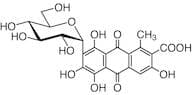
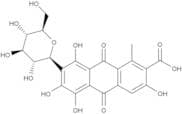
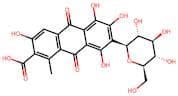
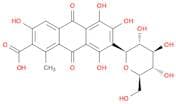
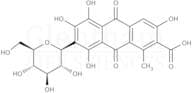
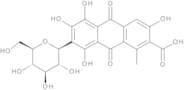
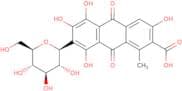
Acide carminique, avec le numéro CAS 1260-17-9, est un composé organique naturel dérivé principalement de l'insecte cochenille, spécifiquement de l'échelle du Dactylopius coccus. C'est un pigment rouge qui appartient à la classe des anthraquinones et est connu pour sa couleur vive, souvent utilisée dans les aliments, les cosmétiques et les textiles. Acide carminique est soluble dans l'eau et l'alcool, mais insoluble dans les solvants non polaires, ce qui le rend polyvalent pour diverses applications. Le composé présente de fortes caractéristiques d'absorption UV-Vis, contribuant à son utilisation en tant que colorant. De plus, Acide carminique a été étudié pour ses potentielles propriétés antioxydantes. Sa stabilité peut être affectée par le pH et l'exposition à la lumière, ce qui est important pour son application dans les produits. En tant que colorant naturel, il est souvent préféré aux alternatives synthétiques en raison de sa toxicité et de son impact environnemental moindres. Cependant, il est important de noter que certaines personnes peuvent avoir des réactions allergiques à Acide carminique, ce qui doit être pris en compte dans son utilisation.
Formule :C22H20O13
InChI :InChI=1S/C22H20O13/c1-4-8-5(2-6(24)9(4)22(33)34)13(25)10-11(15(8)27)16(28)12(18(30)17(10)29)21-20(32)19(31)14(26)7(3-23)35-21/h2,7,14,19-21,23-24,26,28-32H,3H2,1H3,(H,33,34)/t7-,14-,19+,20-,21+/m1/s1
Code InChI :InChIKey=DGQLVPJVXFOQEV-JNVSTXMASA-N
SMILES :O=C1C=2C(C(=O)C=3C1=C(C)C(C(O)=O)=C(O)C3)=C(O)C(O)=C(C2O)[C@@H]4O[C@H](CO)[C@@H](O)[C@H](O)[C@H]4O
Synonymes :- (1R)-1,5-anhydro-1-(7-carboxy-1,3,4,6-tetrahydroxy-8-methyl-9,10-dioxo-9,10-dihydroanthracen-2-yl)-D-glucitol
- (1R)-1,5-anhydro-1-(7-carboxylato-1,3,4,6-tetrahydroxy-8-methyl-9,10-dioxo-9,10-dihydroanthracen-2-yl)-D-glucitol
- (1S)-1,5-anhydro-1-(7-carboxy-1,3,4,6-tetrahydroxy-8-methyl-9,10-dioxo-9,10-dihydroanthracen-2-yl)-D-glucitol
- 1,5-Anhydro-1-(7-Carboxy-1,3,4,6-Tetrahydroxy-8-Methyl-9,10-Dioxo-9,10-Dihydroanthracen-2-Yl)Hexitol
- 2-Anthracenecarboxylic acid, 7-β-<span class="text-smallcaps">D</span>-glucopyranosyl-9,10-dihydro-3,5,6,8-tetrahydroxy-1-methyl-9,10-dioxo-
- 2-Anthracenecarboxylic acid, 7-β-D-glucopyranosyl-9,10-dihydro-3,5,6,8-tetrahydroxy-1-methyl-9,10-dioxo-
- 2-Anthroic acid, 7-<span class="text-smallcaps">D</span>-glucopyranosyl-9,10-dihydro-3,5,6,8-tetrahydroxy-1-methyl-9,10-dioxo-
- 2-Anthroic acid, 7-D-glucopyranosyl-9,10-dihydro-3,5,6,8-tetrahydroxy-1-methyl-9,10-dioxo-
- 7-β-<span class="text-smallcaps">D</span>-Glucopyranosyl-9,10-dihydro-3,5,6,8-tetrahydroxy-1-methyl-9,10-dioxo-2-anthracenecarboxylic acid
- 7-β-D-Glucopyranosyl-9,10-dihydro-3,5,6,8-tetrahydroxy-1-methyl-9,10-dioxo-2-anthracenecarboxylic acid
- Acide carminique
- Acido Carminico
- Carmine 5297
- Carmine Cochineal
- Carmine Red E 120
- Cochineal Red PWD
- Creasperse Carmine CP 057
- E 120
- E 120 (dye)
- Karminsaure
- Natural Red 2180
- Natural Red 4
- Nsc 326224
- San Red 1
- San-Ei Gen San Red 1
- Sun Red 1
- Sun Red No. 1
- C.I. Natural Red 4
- C.I. Natural red 4
- Voir plus de synonymes
Trier par
Degré de pureté (%)
0
100
|
0
|
50
|
90
|
95
|
100
11 produits trouvés.
Carminic Acid (Natural dye)
CAS :Formule :C22H20O13Degré de pureté :min. 85 %Couleur et forme :Orange to Brown to Dark red powder to crystalMasse moléculaire :492.39Carminic acid
CAS :Carminic acid analytical standard provided with chromatographic purity, to be used as reference material for qualitative determination.Formule :C22H20O13Degré de pureté :(HPLC) ≥85%Couleur et forme :PowderMasse moléculaire :492.39Cochineal
CAS :Formule :C22H20O13Degré de pureté :85%Couleur et forme :SolidMasse moléculaire :492.3864Carminic acid
CAS :Formule :C22H20O13Degré de pureté :≥ 90.0%Couleur et forme :Red, dark red to orange or purple-brown crystalline powderMasse moléculaire :492.39Carminic acid (E120) 100 µg/mL in Acetonitrile:Methanol
CAS :Produit contrôléFormule :C22H20O13Couleur et forme :Single SolutionMasse moléculaire :492.39Carminic acid
CAS :Carminic acid, from cochineal, deters ants, and acts as an antioxidant protecting cells and DNA; also exhibits antitumor properties.Formule :C22H20O13Degré de pureté :90.52% - 99.94%Couleur et forme :Red Monoclinic Prisms From Aqueous MethanolMasse moléculaire :492.39Carminic acid
CAS :Natural glycosideFormule :C22H20O13Degré de pureté :≥ 95.0 % (HPLC)Couleur et forme :PowderMasse moléculaire :492.93Carminic Acid,>70%
CAS :Applications A red glucosidal hydroxyanthrapurin, it is produced naturally within some insects as a defense mechanism. Dyes and metabolites, Environmental Testing.
References Enoch, S., et al.: Chem. Res. Toxicol., 23, 1547 (2010), Valianou, L., et al.: Anal. Bioanal. Chem., 396, 3115 (2010), Gohil, V., et al.: Nat. Biotechnol., 28, 249 (2010),Formule :C22H20O13Degré de pureté :>70%Couleur et forme :NeatMasse moléculaire :492.39Carminic acid
CAS :Carminic acid is a natural pigment, which is a red dye obtained from the cochineal insect, Dactylopius coccus. This compound is extracted through the processing of these insects, which are primarily harvested from cacti. The mode of action of carminic acid involves its ability to bind with proteins and metal ions, creating a stable colorant that is resistant to heat and light. This stability makes it particularly valuable in applications requiring long-lasting pigmentation.Formule :C22H20O13Couleur et forme :PowderMasse moléculaire :492.39 g/mol