CAS 126347-74-8
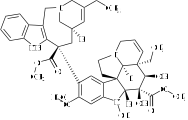
:désacétylnavelbine
- C'-Norvincaleukoblastine, O4-deacetyl-3',4'-didehydro-4'-deoxy-
- methyl (2beta,3beta,4beta,5alpha,19alpha)-15-[(6R,8S)-4-ethyl-8-(methoxycarbonyl)-1,3,6,7,8,9-hexahydro-2,6-methanoazecino[4,3-b]indol-8-yl]-3,4-dihydroxy-16-methoxy-1-methyl-6,7-didehydroaspidospermidine-3-carboxylate
- Desacetylnavelbine
Vinorelbine EP Impurity B (4-O-Deacetylvinorelbine)
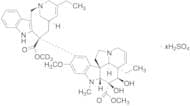
CAS :Formule :C43H52N4O7Masse moléculaire :736.92Deacetyl Vinorelbine-d3 Sulfate
CAS :Produit contrôléStability Hygroscopic
Applications Deacetyl Vinorelbine-d3 Sulfate Salt is a labelled metabolite of Vinorelbine (V315000).
References Elmarakby, S., et al.: J. Med. Chem., 32, 2158 (1989), Jehl, F., et al.: Cancer Res., 51, 2073 (1991), Kajita, J., et al.: Drug Metab. Dispos., 28, 1121 (2000), Puozzo, C., et al.: J. Pharm. Biomed. Anal., 44, 144 (2007),Formule :C43H49D3N4O7xH2SO4Couleur et forme :NeatMasse moléculaire :739.91Deacetyl vinorelbine
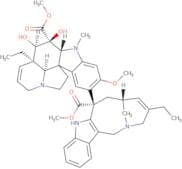
CAS :Produit contrôléDeacetyl vinorelbine is a prodrug that is metabolized to its active form, vinorelbine. It is used in the treatment of cancer and lung cancer. Deacetyl vinorelbine is converted by hydrolysis to deacetylvinorelbine, which inhibits the enzyme topoisomerase II and blocks DNA synthesis, leading to cell death. Vinorelbine also inhibits cellular respiration by inhibiting mitochondrial cytochrome c oxidase and blocking electron transfer from cytochrome c to oxygen. The drug binds to human serum albumin with high affinity and has been shown to have a long half-life in humans due to its ability to bind tightly with proteins such as serum albumin. This binding prevents the drug from being eliminated through the kidneys or liver, prolonging its activity in the body.
Formule :C43H52N4O7Degré de pureté :Min. 95%Couleur et forme :SolidMasse moléculaire :736.9 g/mol