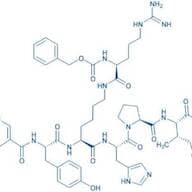
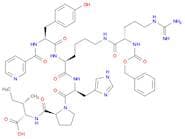
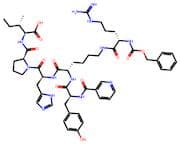
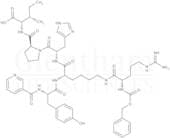
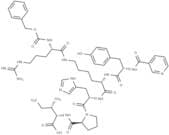
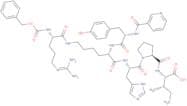
![N~6~-{N~2~-[(benzyloxy)carbonyl]-N~5~-(diaminomethylidene)-L-ornithyl}-N~2~-[N-(pyridin-3-ylcarbon…](/_next/image/?url=https%3A%2Fstatic.cymitquimica.com%2Fcas-image%2Fthumb-webp%2F302711-n-6-n-2-benzyloxy-carbonyl-n-5-diaminomethylidene-l-ornithyl-n-2-n-pyridin-3-ylcarbonyl-l-tyrosyl-l-lysyl-l-histidyl-l-prolyl-l-isoleucine.webp&w=3840&q=75)
CAS 127060-75-7
:N~6~-{N~2~-[(benzyloxy)carbonyle]-N~5~-(diaminométhylidène)-L-ornithyl}-N~2~-[N-(pyridin-3-ylcarbonyle)-L-tyrosyl]-L-lysyl-L-histidyl-L-prolyl-L-isoleucine
Description :
La substance chimique portant le nom "N~6~-{N~2~-[(benzyloxy)carbonyle]-N~5~-(diaminométhylidène)-L-ornithyl}-N~2~-[N-(pyridin-3-ylcarbonyle)-L-tyrosyl]-L-lysyl-L-histidyl-L-prolyl-L-isoleucine" et le numéro CAS 127060-75-7 est un dérivé peptidique complexe. Elle présente plusieurs résidus d'acides aminés, y compris l'ornithine, la lysine, l'histidine, la proline et l'isoleucine, qui contribuent à ses propriétés structurelles et fonctionnelles. La présence de groupes benzyloxycarbonyle et pyridin-3-ylcarbonyle indique qu'elle a été modifiée pour améliorer sa stabilité ou sa bioactivité. Ce composé peut présenter des activités biologiques spécifiques, potentiellement liées à ses interactions avec des récepteurs biologiques ou des enzymes, ce qui le rend intéressant pour la recherche pharmaceutique. Sa structure complexe suggère des applications potentielles dans la conception de médicaments, en particulier pour cibler des voies ou des conditions spécifiques. Cependant, des études détaillées seraient nécessaires pour élucider pleinement ses propriétés pharmacologiques et ses mécanismes d'action. Comme beaucoup de peptides, sa solubilité, sa stabilité et sa réactivité peuvent varier en fonction des conditions environnementales et des modifications.
Formule :C52H69N13O11
InChI :InChI=1/C52H69N13O11/c1-3-32(2)43(50(73)74)64-48(71)42-17-11-25-65(42)49(72)41(27-36-29-56-31-59-36)62-46(69)39(60-47(70)40(26-33-18-20-37(66)21-19-33)61-44(67)35-14-9-22-55-28-35)15-7-8-23-57-45(68)38(16-10-24-58-51(53)54)63-52(75)76-30-34-12-5-4-6-13-34/h4-6,9,12-14,18-22,28-29,31-32,38-43,66H,3,7-8,10-11,15-17,23-27,30H2,1-2H3,(H,56,59)(H,57,68)(H,60,70)(H,61,67)(H,62,69)(H,63,75)(H,64,71)(H,73,74)(H4,53,54,58)/t32-,38-,39-,40-,41-,42-,43-/m0/s1
SMILES :CC[C@H](C)[C@@H](C(=O)O)N=C([C@@H]1CCCN1C(=O)[C@H](Cc1cnc[nH]1)N=C([C@H](CCCCN=C([C@H](CCCNC(=N)N)N=C(O)OCc1ccccc1)O)N=C([C@H](Cc1ccc(cc1)O)N=C(c1cccnc1)O)O)O)O
Trier par
Degré de pureté (%)
0
100
|
0
|
50
|
90
|
95
|
100
7 produits concernés.
Angiotensin II Receptor Ligand
CAS :Depending on concentrations, CGP-42112 acts as a selective agonist or antagonist of AT₂ receptor-mediated effects.Formule :C52H69N13O11Degré de pureté :98.2%Couleur et forme :Yellowish PowderMasse moléculaire :1052.2(2S,3S)-2-((S)-1-((5S,12S,15S)-15-((1H-Imidazol-5-yl)methyl)-5-(3-guanidinopropyl)-12-((S)-3-(4-hydroxyphenyl)-2-(nicotinamido)propanamido)-3,6,13-trioxo-1-phenyl-2-oxa-4,7,14-triazahexadecan-16-oyl)p
CAS :(2S,3S)-2-((S)-1-((5S,12S,15S)-15-((1H-Imidazol-5-yl)methyl)-5-(3-guanidinopropyl)-12-((S)-3-(4-hydroxyphenyl)-2-(nicotinamido)propanamido)-3,6,13-trioxo-1-phenyl-2-oxa-4,7,14-triazahexadecan-16-oyl)pDegré de pureté :98%Masse moléculaire :1052.2g/molCGP-42112
CAS :CGP-42112 is an agonist of the Angiotensin-II subtype 2 receptor (AT2 R).Formule :C52H69N13O11Couleur et forme :White SolidMasse moléculaire :1052.18CGP 42112
CAS :CGP 42112 is a peptide that inhibits the binding of ligands to their receptors. It has been shown to be an effective inhibitor of protein interactions and has been used in research tools for the study of protein-protein interactions. CGP 42112 is an activator of the Ligand-gated ion channels and can be used as an antibody for receptor detection. This compound has a high purity with a CAS number 127060-75-7.Formule :C52H69N13O11Degré de pureté :Min. 95%Masse moléculaire :1,052.2 g/molAngiotensin II Receptor Ligand Nicotinoyl-Tyr-Lys(Z-Arg)-His-Pro-Ile-OH
CAS :Angiotensin II receptor ligand nicotinoyl-tyrosine-arginine-proline-ile (ANGII) is a peptide that acts as a potent angiotensin II receptor agonist. It can be used to anesthetize rats and cause bradykinin b2 receptor activation. ANGII has been shown to inhibit the growth of several types of tumors, such as human melanoma cells, in animal experiments. This drug also has antiangiogenic properties, which may be due to its ability to induce the production of tumor necrosis factor-α (TNF-α).Formule :C52H69N13O11Degré de pureté :Min. 95%Masse moléculaire :1,052.19 g/mol