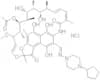
CAS 127923-87-9
:Chlorhydrate de rifapentine
Description :
Chlorhydrate de rifapentine est un antibiotique synthétique appartenant à la classe des rifamycines, principalement utilisé dans le traitement de la tuberculose, en particulier dans le cadre d'une thérapie combinée pour les souches sensibles et résistantes aux médicaments. Il présente un large spectre d'activité antibactérienne en inhibant la synthèse de l'ARN bactérien par liaison à l'enzyme ARN polymérase dépendante de l'ADN. Ce composé se caractérise par sa demi-vie relativement longue, permettant une posologie moins fréquente par rapport à d'autres rifamycines, ce qui améliore l'observance du patient. Chlorhydrate de rifapentine est généralement administré par voie orale et est connu pour sa bonne biodisponibilité. La forme de sel hydrochlorique améliore sa solubilité et sa stabilité. Les effets secondaires courants peuvent inclure des troubles gastro-intestinaux, des éruptions cutanées et une élévation potentielle des enzymes hépatiques, nécessitant une surveillance pendant le traitement. De plus, il est important de considérer les interactions médicamenteuses, car la rifapentine peut affecter le métabolisme de divers médicaments en raison de son influence sur les enzymes du cytochrome P450. Dans l'ensemble, Chlorhydrate de rifapentine représente une avancée significative dans la thérapie de la tuberculose, en particulier dans le contexte des stratégies de thérapie observée directement.
Formule :C47H65ClN4O12
InChI :InChI=1/C47H64N4O12.ClH/c1-24-13-12-14-25(2)46(59)49-37-32(23-48-51-20-18-50(19-21-51)31-15-10-11-16-31)41(56)34-35(42(37)57)40(55)29(6)44-36(34)45(58)47(8,63-44)61-22-17-33(60-9)26(3)43(62-30(7)52)28(5)39(54)27(4)38(24)53;/h12-14,17,22-24,26-28,31,33,38-39,43,53-57H,10-11,15-16,18-21H2,1-9H3,(H,49,59);1H/b13-12+,22-17+,25-14-,48-23+;/t24-,26+,27+,28+,33?,38-,39+,43+,47?;/m0./s1
Synonymes :- Rifamycin, 3-[[(4-Cyclopentyl-1-Piperazinyl)Imino]Methyl]-, Monohydrochloride
- 3-[[(4-Cyclopentyl-1-Piperazinyl)-Imino]Methyl]Rifamycin/Rifapentine Hydrochloride
- Rifapentine Pharma-0630
- (2S,12Z,14E,16S,17S,18R,19R,20R,21S,22R,23S,24E)-8-{(E)-[(4-cyclopentylpiperazin-1-yl)imino]methyl}-5,6,9,17,19-pentahydroxy-23-methoxy-2,4,12,16,18,20,22-heptamethyl-1,11-dioxo-1,2-dihydro-2,7-(epoxypentadeca[1,11,13]trienoimino)naphtho[2,1-b]furan-21-yl acetate
- (12Z,14E,16S,17S,18R,19R,20R,21S,22R,24E)-8-{(E)-[(4-cyclopentylpiperazin-1-yl)imino]methyl}-5,6,9,17,19-pentahydroxy-23-methoxy-2,4,12,16,18,20,22-heptamethyl-1,11-dioxo-1,2-dihydro-2,7-(epoxypentadeca[1,11,13]trienoimino)naphtho[2,1-b]furan-21-yl acetate hydrochloride (1:1)
- Rifapentine hydrochloride USP/EP/BP
- RIFAPENTINE
- RIFAPENTINE HYDROCHLORIDE
- Rifamycin hydrochloride
- 3-[[(4-Cyclopentyl-1-piperazinyl)imino]methyl]rifamycin hydrochloride
Trier par
Degré de pureté (%)
0
100
|
0
|
50
|
90
|
95
|
100
1 produits concernés.
RifapentineHydrochloride
CAS :<p>Rifapentine is an anti-tuberculosis drug that belongs to the class of rifamycins. It is the most active of the rifamycins for the treatment of tuberculosis. Rifapentine inhibits bacterial growth by binding to DNA-dependent RNA polymerase, thereby preventing transcription and replication. The high frequency of human activity has been shown using a patch-clamp technique on human erythrocytes. This active form is metabolized through a number of metabolic transformations, including hydrolysis by esterases or glucuronidases, oxidation by cytochrome P450 enzymes, reduction by glutathione reductase, or conjugation with glucuronic acid. Rifapentine also specifically binds to markers expressed at high levels in Mycobacterium tuberculosis strains (e.g., ESX-1 secretion system protein) and inhibits cell growth in culture.</p>Formule :C47H65ClN4O12Degré de pureté :Min. 95%Masse moléculaire :913.49 g/mol
