CAS 129601-61-2
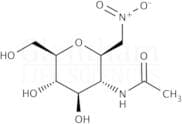
:2-acétamido-2-désoxy-beta-D-glucopyranosyl nitrométhane
Description :
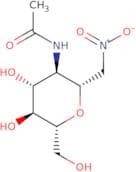
2-acétamido-2-désoxy-beta-D-glucopyranosyl nitrométhane est un composé chimique qui présente un moiety glucopyranosyle, qui est une structure cyclique à six membres dérivée du glucose. Ce composé est caractérisé par la présence d'un groupe acétamido (-NHCOCH3) et d'un groupe nitrométhane (-NO2) attachés à la structure glucopyranosyle. Le groupe acétamido contribue à la solubilité et à la réactivité du composé, tandis que le groupe nitrométhane est connu pour son potentiel en tant que groupe nitro, qui peut participer à diverses réactions chimiques, y compris des substitutions nucléophiles et des réductions. La configuration bêta indique l'orientation du groupe hydroxyle sur le carbone anomérique, ce qui influence l'activité biologique et les interactions du composé. Ce composé peut avoir des applications en chimie médicinale et en biochimie, en particulier dans le développement de composés glycosylés ou comme intermédiaire potentiel dans des voies synthétiques. Cependant, des propriétés spécifiques telles que le point de fusion, le point d'ébullition et la solubilité nécessiteraient des données empiriques pour une caractérisation précise.
Formule :C9H16N2O7
Synonymes :- 2-Acetamido-2-deoxy-b-D-glucopyranosylnitromethane
- 2-Acetamido-2-Deoxy-Ss-D-Glucopyranosyl Nitromethane
Trier par
Degré de pureté (%)
0
100
|
0
|
50
|
90
|
95
|
100
3 produits concernés.
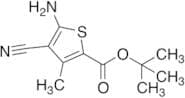
Tert-butyl 5-Amino-4-cyano-3-methylthiophene-2-carboxylate
CAS :Produit contrôléFormule :C9H16N2O7Couleur et forme :Neat2-Acetamido-2-deoxy-β-D-glucopyranosylnitromethane
CAS :2-Acetamido-2-deoxy-b-D-glucopyranosylnitromethane is a natural product that can be found in the extract of gladiolus. It has been shown to have antimalarial activity against Plasmodium falciparum and other species. 2-Acetamido-2-deoxy-b-D-glucopyranosylnitromethane inhibits the growth of bacteria by binding to the 50S ribosomal subunit, preventing transcription and replication. The high frequency of human activity has been shown using a patch clamp technique on human erythrocytes. This active form is metabolized through a number of metabolic transformations, including hydrolysis by esterases or glucuronidases, oxidation by cytochrome P450 enzymes, reduction by glutathione reductase, or conjugation with glucuronic acid.
Formule :C9H16N2O7Degré de pureté :Min. 95%Couleur et forme :PowderMasse moléculaire :264.23 g/mol