CAS 130209-90-4
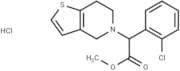
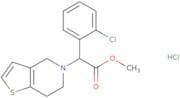
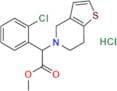
:(±)-Clopidogrel chlorhydrate
Description :
(±)-Clopidogrel chlorhydrate est un dérivé de thiénopyridine principalement utilisé comme médicament antiplaquettaire pour prévenir les caillots sanguins chez les patients atteints de maladies cardiovasculaires. Il fonctionne comme un pro-médicament, nécessitant une activation métabolique pour exercer ses effets thérapeutiques en inhibant de manière irréversible le récepteur P2Y12 sur les plaquettes, réduisant ainsi l'agrégation plaquettaire. La substance apparaît sous forme de poudre cristalline blanche à blanc cassé et est soluble dans l'eau et le méthanol, avec une solubilité limitée dans les solvants organiques. Sa formule moléculaire reflète une structure complexe qui comprend un anneau de thiophène, contribuant à son activité pharmacologique. La forme de sel chlorhydrate améliore sa stabilité et sa solubilité, facilitant l'administration orale. Le clopidogrel est souvent prescrit en association avec l'aspirine pour une thérapie antiplaquettaire double, en particulier après la pose de stents ou chez les patients présentant des syndromes coronariens aigus. Les effets secondaires peuvent inclure des complications hémorragiques, des troubles gastro-intestinaux et, dans de rares cas, des réactions d'hypersensibilité. La surveillance est essentielle pour garantir l'efficacité et la sécurité, en particulier chez les patients présentant des polymorphismes génétiques spécifiques affectant le métabolisme du médicament.
Formule :C16H16ClNO2S·ClH
InChI :InChI=1S/C16H16ClNO2S.ClH/c1-20-16(19)15(12-4-2-3-5-13(12)17)18-8-6-14-11(10-18)7-9-21-14;/h2-5,7,9,15H,6,8,10H2,1H3;1H
Code InChI :InChIKey=XIHVAFJSGWDBGA-UHFFFAOYSA-N
SMILES :C(C(OC)=O)(N1CC2=C(CC1)SC=C2)C3=C(Cl)C=CC=C3.Cl
Synonymes :- Thieno[3,2-c]pyridine-5(4H)-acetic acid, α-(2-chlorophenyl)-6,7-dihydro-, methyl ester, hydrochloride
- PCR 4099
- Methyl 2-(2-chlorophenyl)-2-(6,7-dihydro-4H-thieno[3,2-c]pyridin-5-yl)acetate hydrochloride
- Thieno[3,2-c]pyridine-5(4H)-acetic acid, α-(2-chlorophenyl)-6,7-dihydro-, methyl ester, hydrochloride, (±)-
- Thieno[3,2-c]pyridine-5(4H)-acetic acid, α-(2-chlorophenyl)-6,7-dihydro-, methyl ester, hydrochloride (1:1)
Trier par
Degré de pureté (%)
0
100
|
0
|
50
|
90
|
95
|
100
5 produits concernés.
(R,S)-Methyl-2-(2-chlorophenyl)-2-(4,5,6,7-tetrahydrothino[3.2-c]pyridin-5-yl)acetatehydrochloride
CAS :Formule :C16H17Cl2NO2SDegré de pureté :98%Couleur et forme :SolidMasse moléculaire :358.2827Methyl 2-(2-chlorophenyl)-2-(6,7-dihydrothieno[3,2-c]pyridin-5(4H)-yl)acetate hydrochloride
CAS :Methyl 2-(2-chlorophenyl)-2-(6,7-dihydrothieno[3,2-c]pyridin-5(4H)-yl)acetate hydrochlorideDegré de pureté :98%Masse moléculaire :358.29g/mol(±)-Clopidogrel (hydrochloride)
CAS :Clopidogrel is an antithrombic compound whose active metabolite is a selective, irreversible antagonist of the platelet purinergic P2Y12 receptor (IC50 = 100 nMFormule :C16H17Cl2NO2SCouleur et forme :SolidMasse moléculaire :358.28(±)-Clopidogrel hydrochloride
CAS :Clopidogrel is a prodrug that must be activated by the enzyme CYP2C19 to become its active form, clopidogrel. It is a platelet inhibitor used as an anti-platelet agent and diagnostic tool. Clopidogrel inhibits the action of adenosine diphosphate (ADP) on the P2Y12 receptor and is also a potent pump inhibitor. The major route of metabolism of clopidogrel is through CYP2C19, although other routes such as enteric are present. Inhibitors of this enzyme can affect clopidogrel's effectiveness. Clopidogrel has been shown to be effective in preventing cancer and tumours in rodents, but not humans. It has been found to inhibit cell proliferation in human epithelial cancers when applied orally or topically.
Formule :C16H17Cl2NO2SDegré de pureté :Min. 95%Masse moléculaire :358.3 g/mol
![(R,S)-Methyl-2-(2-chlorophenyl)-2-(4,5,6,7-tetrahydrothino[3.2-c]pyridin-5-yl)acetatehydrochloride](/_next/image/?url=https%3A%2Fstatic.cymitquimica.com%2Fproducts%2FIN%2Fthumb%2FDA00A7RT.jpg&w=3840&q=75)

![Methyl 2-(2-chlorophenyl)-2-(6,7-dihydrothieno[3,2-c]pyridin-5(4H)-yl)acetate hydrochloride](/_next/image/?url=https%3A%2Fstatic.cymitquimica.com%2Fproducts%2F54%2Fthumb%2FOR1063179.jpg&w=3840&q=75)