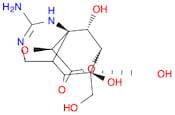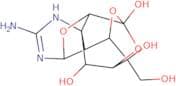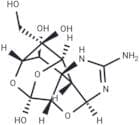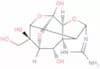
CAS 13072-89-4
:4,9-Anhydrotétrodotoxine
Description :
4,9-Anhydrotétrodotoxine est une puissante neurotoxine dérivée du poisson-globe, spécifiquement des espèces du genre Fugu. C'est un dérivé de la tétraodotoxine, connue pour sa capacité à bloquer les canaux sodiques voltage-dépendants dans les cellules nerveuses, entraînant une paralysie et, potentiellement, une défaillance respiratoire fatale. Ce composé se caractérise par sa structure moléculaire complexe, qui comprend un cadre bicyclique et plusieurs groupes fonctionnels qui contribuent à son activité biologique. 4,9-Anhydrotétrodotoxine présente une haute toxicité, avec des effets pouvant se manifester rapidement après exposition. Son mécanisme d'action implique l'inhibition sélective de l'entrée des ions sodium, perturbant la signalisation neuronale normale. En raison de sa toxicité extrême, cette substance suscite un intérêt considérable dans la recherche pharmacologique, en particulier dans l'étude des canaux ioniques et des applications thérapeutiques potentielles. Cependant, la manipulation et la recherche impliquant 4,9-Anhydrotétrodotoxine nécessitent des protocoles de sécurité stricts en raison des risques associés à ses propriétés toxiques.
Formule :C11H15N3O7
InChI :InChI=1/C11H15N3O7/c12-8-13-6-2-4-9(17,1-15)5-3(16)10(2,14-8)7(19-6)11(18,20-4)21-5/h2-7,15-18H,1H2,(H3,12,13,14)/t2?,3-,4?,5-,6?,7+,9+,10-,11+/m1/s1
Code InChI :InChIKey=STNXQECXKDMLJK-PZKHIREQSA-N
SMILES :O[C@H]1[C@]23[C@@]4([C@@]5([C@](CO)(O)[C@]1(O[C@](O)([C@]2(O[C@@]4(N=C(N)N3)[H])[H])O5)[H])[H])[H]
Synonymes :- (2S,3R,4S,5R,11S,12S)-7-amino-2-(hydroxymethyl)-10,13,15-trioxa-6,8-diazapentacyclo[7.4.1.1~3,12~.0~5,11~.0~5,14~]pentadec-7-ene-2,4,12-triol (non-preferred name)
- (4-beta,9-beta)-4,9-Dideoxy-4,9-epoxytetrodotoxin
- (4S,5aS,6S,8R,9S,10S,11S,11aR,12R)-2-Amino-1,4,5a,6,8,9,10,11-octahydro-9-(hydroxymethyl)-6,10-epoxy-4,8,11a-metheno-11aH-oxocino[4,3-f][1,3,5]oxadiazepine-6,9,11-triol
- 4,9-Anhydrotetrodotoxin
- 4-beta,9-beta-Dideoxy-4,9-epoxytetrodotoxin
- 6,10-Epoxy-4,8,11a-metheno-11aH-oxocino(4,3-f)(1,3,5)oxadiazepine-6,9,11-triol, 2-amino-1,4,5a,6,8,9,10,11-octahydro-9-(hydroxymethyl)-, (4S,5aS,6S,8R,9S,10S,11S,11aR,12R)-
- Anhydroepitetrodotoxin
- Tetrodotoxin, 4,9-anhydro-
- Tetrodotoxin, 4,9-dideoxy-4,9-epoxy-, (4-beta,9-beta)- (9CI)
- Tetrodotoxin, 4,9-dideoxy-4,9-epoxy-, (4beta,9beta)-
- Tetrodotoxin, 4,9-dideoxy-4,9-epoxy-, (4β,9β)-
- Tetrodotoxin, anhydro-
- Anhydrotetrodotoxin
- 4,9-Dideoxy-4β,9β-epoxytetrodotoxin
- 4,9Anhydrotetrodotoxin,4,9 Anhydrotetrodotoxin
- (8S)-4,9-Dideoxy-4β,9β-epoxytetrodotoxin
- Voir plus de synonymes
Trier par
Degré de pureté (%)
0
100
|
0
|
50
|
90
|
95
|
100
3 produits concernés.
(4S,5aS,6S,8R,9S,10S,11S,11aR,12R)-2-Amino-1,4,5a,6,8,9,10,11-octahydro-9-(hydroxymethyl)-6,10-epoxy-4,8,11a-metheno-11aH-oxocino[4,3-f][1,3,5]oxadiazepine-6,9,11-triol
CAS :Formule :C11H15N3O7Couleur et forme :SolidMasse moléculaire :301.25274,9-Anhydrotetrodotoxin
CAS :4,9-Anhydrotetrodotoxin is a sodium citrate salt of 4,9-dihydro-4,9-dihydroxytetrodotoxin (anhydrotetrodotoxin). It has been shown to bind to the nicotinic acetylcholine receptor on leukemic cells. The hydroxyl group of the cyclohexane ring interacts with the serine hydroxyl group of the receptor and stabilizes the binding. This toxin inhibits calcium ion influx into cells by blocking voltage-gated calcium channels. Chronic oral administration of this drug has been shown to induce clinical responses in patients with chronic myelogenous leukemia who have not responded to other treatments. Hydrophilic interaction chromatography (HILIC) was used to purify 4,9-anhydrotetrodotoxin from a crude extract and monoclonal antibodies were developed for use in immunoassays.Formule :C11H15N3O7Degré de pureté :Min. 95%Masse moléculaire :301.25 g/mol4,9-Anhydrotetrodotoxin
CAS :4,9-anhydro-TTX blocks Nav1.6 channels (IC50=7.8 nM); has varying IC50 for Nav1.2-Nav1.8.Formule :C11H15N3O7Couleur et forme :SolidMasse moléculaire :301.25