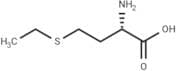
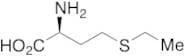
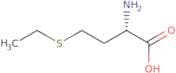
CAS 13073-35-3
:L-Homocystéine, S-éthyl-
Description :
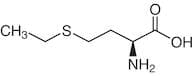
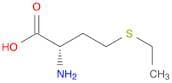
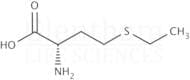
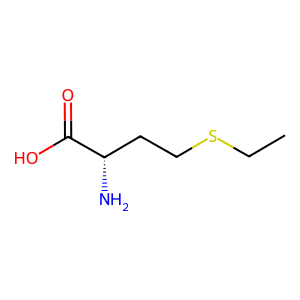
L-Homocystéine, S-éthyl- est un dérivé d'acide aminé contenant du soufre qui joue un rôle dans divers processus biochimiques, en particulier dans le métabolisme de l'homocystéine, un acide aminé important dans le corps. Ce composé se caractérise par la présence d'un groupe éthyle attaché à l'atome de soufre de l'homocystéine, ce qui peut influencer sa réactivité et son activité biologique. L-Homocystéine, S-éthyl- est typiquement un solide blanc à blanc cassé et est soluble dans l'eau, ce qui le rend accessible pour diverses applications en recherche biochimique et dans des contextes thérapeutiques potentiels. Sa structure comprend un groupe amino, un groupe carboxyle et un groupe thiol, qui sont des caractéristiques communes des acides aminés. Le composé est d'un intérêt particulier dans les études liées à la santé cardiovasculaire, car des niveaux élevés d'homocystéine sont associés à un risque accru de maladies cardiovasculaires. De plus, il peut servir de précurseur dans la synthèse d'autres composés biologiquement pertinents. Comme de nombreux dérivés d'acides aminés, sa stabilité et sa réactivité peuvent être influencées par des facteurs environnementaux tels que le pH et la température.
Formule :C6H13NO2S
InChI :InChI=1/C6H13NO2S/c1-2-10-4-3-5(7)6(8)9/h5H,2-4,7H2,1H3,(H,8,9)/t5-/m0/s1
Code InChI :InChIKey=GGLZPLKKBSSKCX-YFKPBYRVSA-N
SMILES :[C@H](CCSCC)(C(O)=O)N
Synonymes :- (2S)-2-Amino-4-(ethylsulfanyl)butanoic acid
- (2S)-2-Azaniumyl-4-ethylsulfanylbutanoate
- <span class="text-smallcaps">L</span>-Ethionine
- <span class="text-smallcaps">L</span>-Homocysteine, S-ethyl-
- Butanoic acid, 2-amino-4-(ethylthio)-, (S)-
- Butyric acid, 2-amino-4-(ethylthio)-, <span class="text-smallcaps">L</span>-
- Butyric acid, 2-amino-4-(ethylthio)-, L-
- ETH
- Ethionine
- L-Ethionine
- Nsc 82393
- S-Ethyl-<span class="text-smallcaps">L</span>-homocysteine
- S-Ethyl-L-homocystein
- S-Ethyl-L-homocysteine
- S-Ethylhomocysteine
- S-etil-L-homocisteina
- L-Homocysteine, S-ethyl-
- s-ethyl-homocystein
- alpha-amino-gamma-(ethylmercapto)butyricacid
- L-ETHIONINE 99%
- (S)-2-Amino-4-(ethylthio)butyric acid
- H-ETH-OH
- homocysteines-ethylether
- L-2-AMINO-4-(ETHYLTHIO)BUTYRIC ACID
- 2-amino-4-(ethylthio)-butanoicaci
- [S,(+)]-2-Amino-4-(ethylthio)butyric acid
- L-ETHIONINE 98+%
- Voir plus de synonymes
Trier par
Degré de pureté (%)
0
100
|
0
|
50
|
90
|
95
|
100
9 produits concernés.
L-Ethionine
CAS :Formule :C6H13NO2SDegré de pureté :>98.0%(T)Couleur et forme :White to Almost white powder to crystalMasse moléculaire :163.24L-Homocysteine, S-ethyl-
CAS :Formule :C6H13NO2SDegré de pureté :98%Couleur et forme :SolidMasse moléculaire :163.2379L-Ethionine
CAS :Formule :C6H13NO2SDegré de pureté :≥ 98.0%Couleur et forme :White solidMasse moléculaire :163.24(S)-2-Amino-4-(Ethylthio)Butanoic Acid
CAS :(S)-2-Amino-4-(Ethylthio)Butanoic AcidDegré de pureté :98%Masse moléculaire :163.24g/molEthionine
CAS :Ethionine (NSC-82393) is an antimetabolite and methionine antagonist. It also produces liver neoplasms.Formule :C6H13NO2SDegré de pureté :99.28% - ≥95%Couleur et forme :Crystals White SolidMasse moléculaire :163.24L-Ethionine
CAS :Produit contrôléApplications Ethionine-induced inhibition of protein synthesis and lowering of ATP level in the liver.
References Rotig, A., et al.: Lancet, 356, 391 (2000), Forsgren, M., et al.: Biochem. J., 382, 519 (2004), Johnson, A., et al.: J. Biol. Chem., 280, 31397 (2005), Horvath, R., et al.: Neurology, 66, 253 (2006), Mollet, M., et al.: J. Clin. Invest., 117, 765 (2007),Formule :C6H13NO2SCouleur et forme :NeatMasse moléculaire :163.24L-Ethionine
CAS :L-Ethionine is an amino acid that can be synthesized by the body through the transsulfuration pathway. It has been shown to inhibit the growth of Aeromonas hydrophilia, a bacterium that is resistant to many antibiotics. L-Ethionine has also been shown to have effects on DNA replication and repair, protein synthesis, cell lysis, and energy metabolism in vitro. In vivo studies have demonstrated its efficacy against Methicillin-resistant Staphylococcus aureus (MRSA). L-Ethionine may be used as a potential therapeutic agent for MRSA infections.Formule :C6H13NO2SDegré de pureté :Min. 95%Couleur et forme :White PowderMasse moléculaire :163.24 g/mol