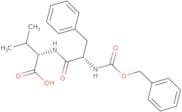
CAS 13123-00-7
:Z-Phe-Val-OH
Description :
Z-Phe-Val-OH, également connu sous le nom de Z-phénylvaline, est un dérivé peptidique synthétique caractérisé par la présence d'une séquence d'acides aminés de phénylalanine (Phe) et de valine (Val), avec un groupe protecteur Z (benzyloxycarbonyle) à l'extrémité amino. Ce composé est généralement utilisé dans la synthèse de peptides et la recherche en raison de son rôle en tant que bloc de construction dans la formation de peptides plus complexes. Le groupe Z sert à protéger le groupe amino pendant la synthèse, permettant des réactions sélectives sur d'autres groupes fonctionnels. Z-Phe-Val-OH est généralement soluble dans des solvants organiques et présente une stabilité dans des conditions de laboratoire standard. Ses propriétés, telles que le point de fusion et la solubilité, peuvent varier en fonction des conditions spécifiques et de la pureté de l'échantillon. En tant que dérivé peptidique, il peut présenter une activité biologique, ce qui le rend intéressant dans les études pharmacologiques. Cependant, les applications et interactions spécifiques dépendraient du contexte de son utilisation dans des recherches ou des environnements thérapeutiques.
Formule :C22H26N2O5
InChI :InChI=1S/C22H26N2O5/c1-15(2)19(21(26)27)24-20(25)18(13-16-9-5-3-6-10-16)23-22(28)29-14-17-11-7-4-8-12-17/h3-12,15,18-19H,13-14H2,1-2H3,(H,23,28)(H,24,25)(H,26,27)/t18-,19-/m0/s1
Code InChI :InChIKey=AJQYZRHQCXCROF-OALUTQOASA-N
SMILES :[C@@H](C(N[C@@H]([C@H](C)C)C(O)=O)=O)(CC1=CC=CC=C1)NC(OCC2=CC=CC=C2)=O
Synonymes :- (Benzoyloxycarbonyl)-<span class="text-smallcaps">L</smallcap>-phenylalanyl-<smallcap>L</span>-valine
- <span class="text-smallcaps">L</smallcap>-Valine, N-[(phenylmethoxy)carbonyl]-<smallcap>L</span>-phenylalanyl-
- <span class="text-smallcaps">L</smallcap>-Valine, N-[N-[(phenylmethoxy)carbonyl]-<smallcap>L</span>-phenylalanyl]-
- L-Valine, N-(N-((phenylmethoxy)carbonyl)-L-phenylalanyl)-
- N-(Benzyloxycarbonyl)-<span class="text-smallcaps">L</smallcap>-phenylalanyl-<smallcap>L</span>-valine
- N-(Benzyloxycarbonyl)phenylalanylvaline
- N-(N-((Benzoyloxy)carbonyl)-L-phenylalanyl)-L-valine
- N-Benzyloxycarbonylphenylalanyl-valine
- N-[(Phenylmethoxy)carbonyl]-<span class="text-smallcaps">L</smallcap>-phenylalanyl-<smallcap>L</span>-valine
- NSC 322479
- Valine, N-(N-carboxy-3-phenyl-<span class="text-smallcaps">L</smallcap>-alanyl)-, N-benzyl ester, <smallcap>L</span>-
- Valine, N-(N-carboxy-3-phenyl-<span class="text-smallcaps">L</span>-alanyl)-, N-benzyl ester
- Valine, N-(N-carboxy-3-phenyl-L-alanyl)-, N-benzyl ester, L-
- L-Valine, N-[(phenylmethoxy)carbonyl]-L-phenylalanyl-
- N-[(Phenylmethoxy)carbonyl]-L-phenylalanyl-L-valine
- Voir plus de synonymes
Trier par
Degré de pureté (%)
0
100
|
0
|
50
|
90
|
95
|
100
2 produits concernés.
L-Valine, N-[(phenylmethoxy)carbonyl]-L-phenylalanyl-
CAS :Formule :C22H26N2O5Masse moléculaire :398.4522Z-Phe-Val-OH
CAS :Z-Phe-Val-OH is an optical isomer of the molecule Z-Val-OH. It can be synthesized from the reactants Isobutyl, Chloroformate, and Hydrophobic. This synthetic product has been shown to have high yields and specificities. The chiral center in this molecule causes it to rotate light in one direction or another, which means that it can be used to create a spectrum of colors. The synthesis of this molecule takes place in a kinetically controlled manner. When mixed with amines, carboxylic acids, and tripeptides, this compound will form a tripeptide bond with two amino acids on either side of the peptide chain.
Formule :C22H26N2O5Degré de pureté :Min. 95%Masse moléculaire :398.45 g/mol
![L-Valine, N-[(phenylmethoxy)carbonyl]-L-phenylalanyl-](/_next/image/?url=https%3A%2Fstatic.cymitquimica.com%2Fproducts%2FIN%2Fthumb%2FDA000VRV.jpg&w=3840&q=75)