CAS 13138-78-8
:Acide 1-méthyl-4-nitro-1H-pyrrole-2-carboxylique
Description :
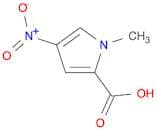
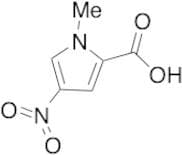
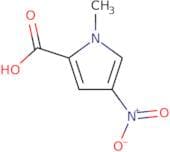
Acide 1-méthyl-4-nitro-1H-pyrrole-2-carboxylique, avec le numéro CAS 13138-78-8, est un composé organique caractérisé par sa structure en anneau de pyrrole, qui est un hétérocycle aromatique à cinq membres contenant de l'azote. Ce composé présente un groupe méthyle et un groupe nitro aux positions 1 et 4, respectivement, ainsi qu'un groupe fonctionnel acide carboxylique à la position 2. La présence du groupe nitro contribue à ses propriétés d'attraction des électrons, influençant sa réactivité et ses applications potentielles en synthèse organique. Le groupe acide carboxylique confère des caractéristiques acides, permettant des interactions potentielles avec des bases et d'autres nucléophiles. Ce composé peut présenter une activité biologique, ce qui le rend intéressant en chimie médicinale et en recherche pharmaceutique. Sa solubilité et sa stabilité peuvent varier en fonction du solvant et des conditions environnementales. Dans l'ensemble, Acide 1-méthyl-4-nitro-1H-pyrrole-2-carboxylique est un composé polyvalent avec des applications potentielles dans divers domaines, y compris la synthèse organique et le développement de médicaments.
Formule :C6H6N2O4
InChI :InChI=1/C6H6N2O4/c1-7-3-4(8(11)12)2-5(7)6(9)10/h2-3H,1H3,(H,9,10)
SMILES :Cn1cc(cc1C(=O)O)N(=O)=O
Synonymes :- Iflab-Bb F2124-0630
Trier par
Degré de pureté (%)
0
100
|
0
|
50
|
90
|
95
|
100
3 produits concernés.
1-Methyl-4-nitropyrrole-2-carboxylic Acid
CAS :Produit contrôléApplications 1-Methyl-4-nitropyrrole-2-carboxylic Acid is used in the synthesis of Lexitropsin and distamycin analogs with antimicrobial activities.
References Anthony, N., et al.: J. Med. Chem., 50, 6116 (2007); Khalaf, A., et al.: J. Med. Chem., 47, 2133 (2004)Formule :C6H6N2O4Couleur et forme :NeatMasse moléculaire :170.121-Methyl-4-nitro-1H-pyrrole-2-carboxylic acid
CAS :1-Methyl-4-nitro-1H-pyrrole-2-carboxylic acid is a molecule that has been shown to be cytotoxic to cancer cells. It interacts with the DNA at the sequences that are responsible for the production of amino acids and inhibits the synthesis of proteins. This drug also interacts with a chromophore, which is an organic molecule that absorbs light, and it can be conjugated to other molecules in order to increase its cytotoxicity. The anticancer activity of 1MNP was found to be bimodal, meaning it has different effects on different types of cancer cells.Formule :C6H6N2O4Degré de pureté :Min. 95%Masse moléculaire :170.12 g/mol