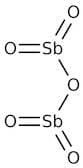
CAS 1314-60-9
:Pentoxyde d'antimoine
- 1,3-Dioxodistiboxane 1,3-Dioxide
- A 1510N
- A 1530
- A 1530 (metal oxide)
- A 1550
- A 1550 (metal oxide)
- A 1588Lp
- A 2550
- A 2550L
- Adp 480
- Ago 40
- Amf 130S
- Amt 130S
- Amt 330S
- Anchimonzol A 2550
- Antagi 1000
- Antimon(V)-Oxid
- Antimonic Acid
- Antimonic anhydride
- Antimonic oxide
- Antimony oxide
- Antimony oxide (Sb2O5)
- Antimony oxide (Sb<sub>2</sub>O<sub>5</sub>)
- Antimony oxide (SbO<sub>2.5</sub>)
- Antimony pentaoxide
- Antimony pentoxide (Sb2O5)
- Antimony pentoxide (Sb<sub>2</sub>O<sub>5</sub>)
- Antimony(V) oxide
- Apox S
- BurnEx 6220
- BurnEx A 1582
- BurnEx ADP 494
- Diantimonpentoxid
- Diantimony Pentoxide
- Diantimony pentaoxide
- Dp 6085
- Elcom 4514
- Elcom 7514
- Elcom MR 1009SBV
- Elcom MR 1009SBV-P30
- Elcom NE 1002SBV
- Elcom PC 14
- Elcom RK 1022SBV
- Elcom V 4514
- Elcom V 4562
- Elcom V 4566
- HY 1030 (metal oxide)
- Hfr 201
- Hy 1030
- Na 1030
- Nyacol 1030
- Nyacol 1550
- Nyacol A 1550
- Nyacol A 1588LP
- Nyacol A 1590
- Nyacol ADP 480
- Nyacol AGO 40
- Nyacol APE 1540
- Nyacol APE 3040
- Nyacol DP 6215
- Pentoxido De Diantimonio
- Pentoxyde de diantimoine
- Pox-C
- Pox-S
- Rsb-Ku
- Rsb-Ku 70
- Sandoflam Sb 90
- Sanka Anchimonzol 1510P
- Sanka Anchimonzol A 2550M
- Stibic anhydride
- Sun Epoch EFR 6N
- Sun Epoch EFR 6NJ
- Sun Epoch NA 100
- Sun Epoch NA 1030
- Sun Epoch NA 1040L
- Sun Epoch NA 3010
- Sun Epoch NA 3070
- Sun Epoch NA 3070P
- Sun Epoch NA 3080
- Sun Epoch NA 3080P
- Suncolloid AME 130
- Suncolloid AMT 130
- Suncolloid AMT 130S
- Suncolloid AMT 135
- Suncolloid AMT 330S
- Suncolloid AMT 332S
- Suncolloid ATL 130
- Tl 45
- Tsb 110
- V 4521
- V 4524
- V 4562
- V 4564
- Xh 307Wm1
- Voir plus de synonymes
Antimony(V) oxide, Puratronic™, 99.998% (metals basis)
CAS :It is used as flame retardants in acrylonitrile-butadiene-styrene (ABS) polymer, plastics, rubbers, paper and textiles. It finds use as a flocculant in the production of titanium dioxide. It also finds use in ion-exchange resin. It is also employed as catalyst in certain polymerization and oxidati
Formule :O5Sb2Degré de pureté :99.998%Couleur et forme :Light Yellow, PowderMasse moléculaire :323.52Antimony(V) oxide (99.9%-Sb)
CAS :Antimony(V) oxide (99.9%-Sb)
Formule :Sb2O5Degré de pureté :(99.9%-Sb)Couleur et forme :white to light yellow pwdr.Masse moléculaire :323.5Antimony(V) oxide, elec. gr. (99.998%-Sb) PURATREM
CAS :Antimony(V) oxide, elec. gr. (99.998%-Sb) PURATREM
Formule :Sb2O5Degré de pureté :(99.998%-Sb)Couleur et forme :white to light yellow pwdr.Masse moléculaire :323.50Antimony(v) oxide - 99.9%
CAS :Antimony(v) oxide is an inorganic compound that is used as a corrosion inhibitor and antimicrobial agent. It is a hydrated form of antimony trioxide, consisting of two hydroxyl groups. Antimony(v) oxide has been shown to be effective against bacteria, fungi, and viruses in flow systems with a high pH. The reaction solution for the production of antimony(v) oxide includes sodium carbonate and hydrogen fluoride. This process also yields pentoxide and zirconium oxide as byproducts. Antimony(v) oxide has been shown to inhibit the activity of certain enzymes, such as proteases and lipases, due to its ability to bind to sulfhydryl groups on the enzyme surface.
Formule :Sb2O5Degré de pureté :Min. 95%Couleur et forme :PowderMasse moléculaire :323.52 g/mol