CymitQuimica logo

CAS 132295-44-4

:

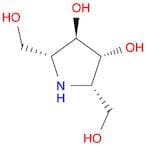
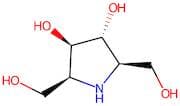
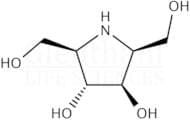
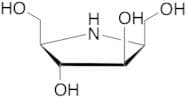
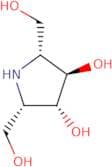
2,5-Anhydro-2,5-imino-D-glucitol

Description :
2,5-Anhydro-2,5-imino-D-glucitol, également connu sous le nom de "D-Glucitol, 2,5-anhydro-2,5-imino", est un composé chimique caractérisé par sa structure unique qui présente à la fois un groupe anhydro et un groupe imino. Ce composé est un dérivé du D-glucose et est remarquable pour ses applications potentielles en chimie médicinale, en particulier dans le développement d'agents antidiabétiques. C'est un solide blanc à blanc cassé qui est soluble dans l'eau, ce qui est une caractéristique commune de nombreux dérivés de sucre. La présence du groupe imino peut influencer sa réactivité et son activité biologique, en faisant un sujet d'intérêt pour la recherche. De plus, sa structure moléculaire permet diverses interactions avec des macromolécules biologiques, ce qui peut contribuer à ses propriétés pharmacologiques. Comme pour de nombreuses substances chimiques, la manipulation doit être effectuée avec précaution, et les données de sécurité doivent être consultées pour garantir que les précautions appropriées sont prises lors de l'utilisation.
Formule :C6H13NO4
InChI :InChI=1/C6H13NO4/c8-1-3-5(10)6(11)4(2-9)7-3/h3-11H,1-2H2/t3-,4+,5+,6?/m0/s1
Synonymes :
  • 2,5-Dideoxy-2,5-imino-D-glucitol
  • (2R,4R,5S)-2,5-bis(hydroxymethyl)pyrrolidine-3,4-diol
Trier par

Degré de pureté (%)
0
100
|
0
|
50
|
90
|
95
|
100
5 produits concernés.
  • 2,5-Dideoxy-2,5-imino-D-glucitol

    CAS :
    Formule :C6H13NO4
    Couleur et forme :Solid
    Masse moléculaire :163.1717

    Ref: IN-DA0010HR

    ne
    À demander
  • 2,5-Anhydro-2,5-imino-D-glucitol

    CAS :
    2,5-Anhydro-2,5-imino-D-glucitol
    Degré de pureté :≥95%

    Ref: 54-OR4830T

    ne
    À demander
  • 2,5-Anhydro-2,5-imino-D-glucitol

    CAS :
    Masse moléculaire :163.17

    Ref: 7W-GC4552

    ne
    À demander
  • 2,5-Anhydro-2,5-imino-D-glucitol

    Produit contrôlé
    CAS :
    <p>Applications Many pyrrolidines are powerful inhibitors of glycohydrolases, enzymes responsible for cleavage of glycosidic bonds, glycoprotein processing and the gastrointestinal breakdown of dietary carbohydrates. These compounds are charged at physiological pH and are believed to associate with acidic amino acids at the active site. Inhibition of glycohydrolases could be of therapeutic value for the treatment of viral infections, cancer, diabetes, and obesity.<br>References Fellows, L.E., et al.: J. Chem. Brit., 287, (1987), Elbein, A.D.: Annu. Rev. Biochem., 56, 497 (1987), Fleet, G.W., et al.: J. Chem. Brit., 287, (1989) Baxter, E.W., et al.: J. Org. Chem., 59, 3175 (1994); Tyms, A.S. et al. Lancet 1025, (1987); Spearman, M.A. et al. Expt. Cell Res. 168, 116 (1987); Horii, S. et al. J. Med. Chem. 29, 1038 (1986).<br></p>
    Formule :C6H13NO4
    Couleur et forme :Neat
    Masse moléculaire :163.17

    Ref: TR-A648300

    5mg
    150,00€
  • 2,5-Dideoxy-2,5-imino-D-glucitol

    CAS :
    <p>2,5-Dideoxy-2,5-imino-D-glucitol is a potent inhibitor of glycosidases. It has been shown to have significant antifungal activity against Candida albicans in the caco-2 cell model system. 2,5-Dideoxy-2,5-imino-D-glucitol inhibits β-(1→3)-glycosidase activity by binding to the active site of the enzyme and preventing substrate hydrolysis. The compound is also an enantiopure and asymmetric synthesis. This drug has been shown to be a model system for studying glycosidase inhibition.</p>
    Formule :C6H13NO4
    Degré de pureté :Min. 95%
    Masse moléculaire :163.17 g/mol
    Ref: 3D-MD04565

    10mg
    135,00€