CAS 133-13-1
:1,3-Diéthyl 2-éthylpropanedioate
Description :
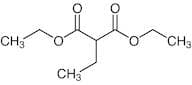
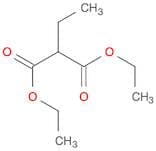
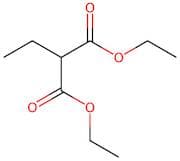
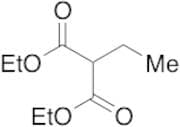
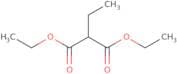
1,3-Diéthyl 2-éthylpropanedioate, avec le numéro CAS 133-13-1, est un composé organique appartenant à la classe des diesters. Il présente une structure centrale de propanedioate avec des groupes éthyles attachés aux positions 1 et 3, ainsi qu'un groupe éthyle supplémentaire à la position 2. Ce composé est généralement un liquide incolore à jaune pâle avec une odeur fruitée, indicative de sa nature d'esther. Il est soluble dans des solvants organiques mais a une solubilité limitée dans l'eau en raison de ses chaînes alkyles hydrophobes. Le composé est souvent utilisé dans la synthèse organique et comme intermédiaire dans la production de divers produits chimiques. Sa réactivité est caractérisée par la présence de groupes fonctionnels d'esters, ce qui le rend susceptible aux réactions d'hydrolyse et de transestérification. Les données de sécurité indiquent que, comme de nombreux esters, il doit être manipulé avec précaution, car il peut provoquer des irritations au contact de la peau ou des yeux. Un stockage approprié dans un endroit frais et sec, à l'écart des agents oxydants forts, est recommandé pour maintenir sa stabilité.
Formule :C9H16O4
InChI :InChI=1/C9H16O4/c1-4-7(8(10)12-5-2)9(11)13-6-3/h7H,4-6H2,1-3H3
Code InChI :InChIKey=VQAZCUCWHIIFGE-UHFFFAOYSA-N
SMILES :C(C(OCC)=O)(C(OCC)=O)CC
Synonymes :- 1,3-Diethyl 2-ethylpropanedioate
- 2-Ethylmalonic acid diethyl ester
- Diethyl 2-ethylmalonate
- Diethyl Ethylpropanedioate
- Diethyl α-ethylmalonate
- Ethylmalonic acid diethyl ester
- Ethylpropanedioic acid diethyl ester
- Malonic acid, ethyl-, diethyl ester
- NSC 8706
- Propanedioic acid, 2-ethyl-, 1,3-diethyl ester
- Propanedioic acid, ethyl-, diethyl ester
- Diethyl ethylmalonate
- ethyl-propanedioicacidiethylester
- Diethylethylmalonat
- ethyl-propanedioicaciddiethylester
- Ethylmalonicacid,diethylest
- 2-ethyl-malonicaciddiethylester
- Ethylmalonicester
- Diethyl 2-ethylpropanedioate
- 2-Ethylpropanedioic acid diethyl ester
- DIETHYL ETHYLAMAONATE
- DEEM
- Voir plus de synonymes
Trier par
Degré de pureté (%)
0
100
|
0
|
50
|
90
|
95
|
100
8 produits concernés.
Diethyl Ethylmalonate
CAS :Formule :C9H16O4Degré de pureté :>98.0%(GC)Couleur et forme :Colorless to Almost colorless clear liquidMasse moléculaire :188.22Propanedioic acid, 2-ethyl-, 1,3-diethyl ester
CAS :Formule :C9H16O4Degré de pureté :98%Couleur et forme :LiquidMasse moléculaire :188.2209Diethyl ethylmalonate
CAS :Formule :C9H16O4Degré de pureté :(GC) ≥ 99.0%Couleur et forme :Clear, colourless liquidMasse moléculaire :188.221,3-Diethyl 2-ethylpropanedioate
CAS :1,3-Diethyl 2-ethylpropanedioate
Degré de pureté :95%Masse moléculaire :188.22g/molRef: 54-OR79849
25gÀ demander25lÀ demander100gÀ demander2.5lÀ demander25mlÀ demander100mlÀ demander500mlÀ demanderDiethyl Ethylmalonate
CAS :Produit contrôléApplications Diethyl Ethylmalonate is used in the synthesis of HIV-1 reverse transcriptase inhibitors. Also used in the preparation of Peloruside A, a novel antimitotic agent used as a potential anti-cancer agent.
References Wu, H. et al.: Bioorg. Med. Chem., 21, 6477 (2013); Hood, L. et al.: Cancer Res., 62, 3356 (2002);Formule :C9H16O4Couleur et forme :NeatMasse moléculaire :188.22Diethyl 2-ethylmalonate
CAS :Formule :C9H16O4Degré de pureté :97%Couleur et forme :LiquidMasse moléculaire :188.223Diethyl Ethylmalonate
CAS :Diethyl ethylmalonate is a chemical compound that belongs to the group of polycarboxylic acids. It is primarily used as a solvent for coatings and adhesives, as well as a catalyst in the Friedel-Crafts reaction. Diethyl ethylmalonate has been shown to undergo a number of reactions, often in the presence of chlorine or another halogen atom. This compound reacts with malonic acid to form diethyl succinate, which can be hydrolyzed by water to form carbon dioxide and ethanol. Diethyl ethylmalonate also binds to receptors on cells, which may be related to its viscosity. The reactivity of this compound can be controlled by varying the particle size.Formule :C9H16O4Degré de pureté :Min. 95%Masse moléculaire :188.22 g/mol