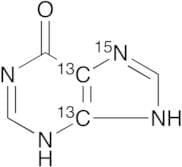
CAS 1330265-04-7
:Hypoxanthine-13C2,15N
CAS :Produit contrôléApplications A labelled analog of a naturally occurring purine derivative.
References Wetmore, D., et al.: J. Biol. Chem., 285, 30516 (2010), Jung, Y., et al.: J. Agric. Food Chem., 58, 10458 (2010), Cao, H., et al.: J. Biol. Chem., 285, 28044 (2010),Formule :C2C3H415NN3ODegré de pureté :>90%Couleur et forme :NeatMasse moléculaire :139.09Hypoxanthine-13C2,15N
CAS :Hypoxanthine-13C2,15N is an inhibitor that has been used in Chinese medicine to treat a variety of ailments. It is an analog of hypoxanthine, a naturally occurring substance found in urine. Hypoxanthine-13C2,15N has been shown to inhibit the production of calcitonin, a hormone produced by the thyroid gland that regulates calcium levels in the blood. It also inhibits the activity of kinases, enzymes that play a role in cell division and growth. Studies have shown that hypoxanthine-13C2,15N can induce apoptosis (programmed cell death) in cancer cells, making it a potential treatment for various types of tumors. Additionally, this substance has been found to inhibit the activity of oxytocin and galanin, two neuropeptides involved in various physiological processes. Overall, hypoxanthine-13C2,15N shows promising potential as a therapeutic agent for cancer and other diseases
Formule :C5H4N4ODegré de pureté :90%Masse moléculaire :139.09 g/mol