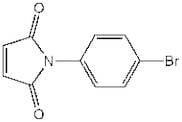
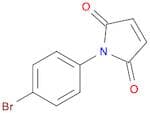
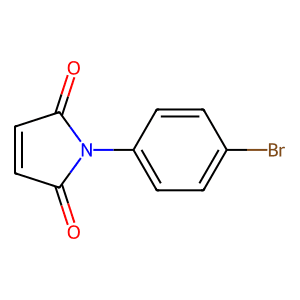
CAS 13380-67-1
:N-(4-BROMOPHÉNYL)MALEIMIDE
- Asischem S97816
- Akos Msc-0026
- 1-(4-Bromophenyl)-1H-Pyrrole-2,5-Dione
- 1-(4-Bromphenyl)-1H-Pyrrole-2,5-Dione
- N-(4-Bromophenyl)maleinimide
- N-(4-Bromophenyl)maleimide 98%
- 1-(4-Bromophenyl)-2,5-Dioxo-Pyrrole
N-(4-Bromophenyl)maleimide, 98%
CAS :This Thermo Scientific Chemicals brand product was originally part of the Alfa Aesar product portfolio. Some documentation and label information may refer to the legacy brand. The original Alfa Aesar product / item code or SKU reference has not changed as a part of the brand transition to Thermo SciFormule :C10H6BrNO2Degré de pureté :98%Couleur et forme :Pale yellow, Crystals or powder or crystalline powderMasse moléculaire :252.07N-(4-Bromophenyl)maleimide
CAS :Formule :C10H6BrNO2Degré de pureté :95%Couleur et forme :SolidMasse moléculaire :252.0641N-(4-Bromophenyl)maleimide
CAS :N-(4-Bromophenyl)maleimideFormule :C10H6BrNO2Degré de pureté :98%Couleur et forme : faint yellow powderMasse moléculaire :252.06g/molN-(4-Bromophenyl)maleimide
CAS :Formule :C10H6BrNO2Degré de pureté :95%Couleur et forme :SolidMasse moléculaire :252.0671-(4-Bromophenyl)-1H-pyrrole-2,5-dione
CAS :1-(4-Bromophenyl)-1H-pyrrole-2,5-dione is an inhibitor of styrene polymerization. This compound was shown to inhibit styrene polymerization in a concentration dependent manner and has been used as a model for the evaluation of other inhibitors. The inhibition mechanism of 1-(4-bromophenyl)-1H-pyrrole-2,5-dione can be attributed to its ability to bind to the active site of the enzyme Styrene Synthase and block reaction by steric hindrance. It also inhibits fatty acid synthesis by blocking lipases. This compound has been used in copolymerization techniques with styrene and other monomers due to its stability in organic solvents. 1-(4-Bromophenyl)-1H-pyrrole-2,5-dione has also been shown to have a strong radiation sensitive effect on polystyrene films when used as a sensitizer in
Formule :C10H6BrNO2Degré de pureté :Min. 95%Couleur et forme :PowderMasse moléculaire :252.06 g/mol