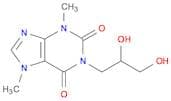
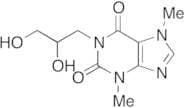
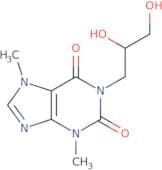
CAS 13460-96-3
:1-(2,3-Dihydroxypropyl)-3,7-dihydro-3,7-diméthyl-1H-purine-2,6-dione
Description :
1-(2,3-Dihydroxypropyl)-3,7-dihydro-3,7-diméthyl-1H-purine-2,6-dione, communément connu sous le nom de théobromine, est un composé de méthylxanthine avec des propriétés pharmacologiques notables. C'est une poudre cristalline blanche à blanc cassé qui est soluble dans l'eau et présente un goût légèrement amer. La substance se trouve principalement dans les fèves de cacao et est un composant clé du chocolat. La théobromine agit comme un stimulant, similaire à la caféine, mais avec des effets plus doux sur le système nerveux central. Elle est connue pour ses propriétés vasodilatatrices, qui peuvent entraîner une augmentation du flux sanguin et une réduction de la pression artérielle. De plus, la théobromine a des effets diurétiques et peut favoriser la relaxation des muscles lisses, en particulier dans les voies respiratoires. Sa structure moléculaire présente une base purique avec des substituants hydroxyle et méthyle, contribuant à son activité biologique. La théobromine est également étudiée pour ses potentiels bienfaits pour la santé, y compris des propriétés antioxydantes et des effets sur l'amélioration de l'humeur. Cependant, elle peut être toxique pour certains animaux, comme les chiens, en raison de leur incapacité à la métaboliser efficacement.
Formule :C10H14N4O4
InChI :InChI=1S/C10H14N4O4/c1-12-5-11-8-7(12)9(17)14(3-6(16)4-15)10(18)13(8)2/h5-6,15-16H,3-4H2,1-2H3
Code InChI :InChIKey=RRBSZTYIWIHPST-UHFFFAOYSA-N
SMILES :O=C1C2=C(N(C)C(=O)N1CC(CO)O)N=CN2C
Synonymes :- 1-(2,3-Dihydroxy-propyl)-3,7-dimethyl-3,7-dihydro-purine-2,6-dione
- 1-(2,3-Dihydroxypropyl)-3,7-dimethylpurine-2,6-dione
- 1-(2,3-Dihydroxypropyl)-3,7-dimethylxanthine
- 1-(2,3-Dihydroxypropyl)theobromine
- 1-(2,3-Dihydroxypropyl-3,7-dimethyl-2,6(1H,3H)-purindion
- 1-(2,3-Dihydroxypropyl-3,7-dimethyl-2,6(1H,3H)-purindion [IUPAC]
- 1-(2,3-Dwuhydroksypropylo)-teobrominy
- 1-(2,3-Dwuhydroksypropylo)-teobrominy [Polish]
- 1-(2,3-dihydroxypropyl)-3,7-dimethyl-3,7-dihydro-1H-purine-2,6-dione
- 1-(beta,gamma-Dioxypropyl)-theobromin
- 1-(beta,gamma-Dioxypropyl)-theobromin [German]
- 1-Dihydroxypropyltheobromine
- 1H-Purine-2,6-dione, 1-(2,3-dihydroxypropyl)-3,7-dihydro-3,7-dimethyl-
- 1H-Purine-2,6-dione, 1-(2,3-dihydroxypropyl)-3,7-dihydro-3,7-dimethyl- (9CI)
- 1H-Purine-2,6-dione, 3,7-dihydro-1-(2,3-dihydroxypropyl)-
- Brn 0284032
- Isobromin
- Nsc 515487
- Theobromine, 1-(2,3-dihydroxypropyl)-
- Theocardin
- Theocardine
- 4-26-00-02370 (Beilstein Handbook Reference)
- 1-(2,3-Dihydroxypropyl)-3,7-dihydro-3,7-dimethyl-1H-purine-2,6-dione
- Voir plus de synonymes
Trier par
Degré de pureté (%)
0
100
|
0
|
50
|
90
|
95
|
100
3 produits concernés.
1-(2,3-dihydroxypropyl)-3,7-dihydro-3,7-dimethyl-1H-purine-2,6-dione
CAS :Formule :C10H14N4O4Degré de pureté :98%Couleur et forme :SolidMasse moléculaire :254.24261-(2,3-Dihydroxypropyl)-3,7-dihydro-3,7-dimethyl-1H-purine-2,6-dione
CAS :Produit contrôlé1-(2,3-Dihydroxypropyl)-3,7-dihydro-3,7-dimethyl-1H-purine-2,6-dione (theophylline) is a bronchodilator and anti-inflammatory agent. It is used to treat asthma and other respiratory conditions. Theophylline is structurally similar to caffeine and theobromine and has been shown to have a similar effect on the heart and blood vessels as these stimulants. It also stimulates the central nervous system in a manner similar to that of theobromine. Theophylline has shown some benefit in congestive heart failure patients but has not been proven effective for treating high blood pressure or fibrillation.Formule :C10H14N4O4Degré de pureté :Min. 95%Masse moléculaire :254.24 g/mol