


CAS 136310-95-7
:Tiotropium Related Compound C ((1R,3s,5S)-3-[2-Hydroxy-2,2-di(thiophen-2-yl)acetoxy]-8,8-dimethyl-8-azabicyclo[3.2.1]oct-6-en-8-ium bromide)
CAS :Nucleic acids and their salts, whether or not chemically defined; other heterocyclic compounds, nesoiFormule :C19H22BrNO3S2Couleur et forme :White Yellow PowderMasse moléculaire :455.02245Tiotropium Bromide EP Impurity C Bromide
CAS :Formule :C19H22NO3S2·BrCouleur et forme :Off-White SolidMasse moléculaire :376.51 79.90(1R,3s,5S)-3-(2-Hydroxy-2,2-di(thiophen-2-yl)acetoxy)-8,8-dimethyl-8-azabicyclo[3.2.1]oct-6-en-8-ium bromide (Tiotropium Bromide Impurity)
CAS :(1R,3s,5S)-3-(2-Hydroxy-2,2-di(thiophen-2-yl)acetoxy)-8,8-dimethyl-8-azabicyclo[3.2.1]oct-6-en-8-ium bromide (Tiotropium Bromide Impurity)Degré de pureté :98%(1R,3S,5S)-3-(2-Hydroxy-2,2-di(thiophen-2-yl)acetoxy)-8,8-dimethyl-8-azabicyclo[3.2.1]oct-6-en-8-ium Bromide
CAS :Produit contrôléImpurity Tiotropium bromide EP impurity C
Applications (1R,3S,5S)-3-(2-Hydroxy-2,2-di(thiophen-2-yl)acetoxy)-8,8-dimethyl-8-azabicyclo[3.2.1]oct-6-en-8-ium Bromide is an impurity in the synthesis of Tiotropium Bromide (T444850), a muscarinic receptor antagonist. Bronchodilator.
References Haddad, E.-B., et al.: Mol. Pharmacol., 45, 899 (1994); Donohue, J. F., et al.: Chest, 122, 47 (2002); Profita, M., et al.: Allergy, 60, 1361 (2005); Dusser, D., et al.: Eur. Respir. J., 27, 547 (2006);Formule :C19H22NO3S2·BrCouleur et forme :NeatMasse moléculaire :456.42(1R,3S,5S)-3-(2-Hydroxy-2,2-di(thiophen-2-yl)acetoxy)-8,8-dimethyl-d3-8-azabicyclo[3.2.1]oct-6-en-8-ium Bromide
CAS :Produit contrôléApplications (1R,3S,5S)-3-(2-Hydroxy-2,2-di(thiophen-2-yl)acetoxy)-8,8-dimethyl-d3-8-azabicyclo[3.2.1]oct-6-en-8-ium Bromide is the labeled analogue of (1R,3S,5S)-3-(2-Hydroxy-2,2-di(thiophen-2-yl)acetoxy)-8,8-dimethyl-8-azabicyclo[3.2.1]oct-6-en-8-ium Bromide (H941715), an impurity in the synthesis of Tiotropium Bromide (T444850), a muscarinic receptor antagonist. Bronchodilator.
References Haddad, E.-B., et al.: Mol. Pharmacol., 45, 899 (1994); Donohue, J. F., et al.: Chest, 122, 47 (2002); Profita, M., et al.: Allergy, 60, 1361 (2005); Dusser, D., et al.: Eur. Respir. J., 27, 547 (2006);Formule :C19D3H19NO3S2·BrCouleur et forme :NeatMasse moléculaire :459.435(1R,3S,5S)-3-(2-Hydroxy-2,2-di(thiophen-2-yl)acetoxy)-8,8-dimethyl-8-azabicyclo[3.2.1]oct-6-en bromide
CAS :The human red blood cell (RBC) is a non-nucleated cell in the human blood that carries oxygen to the body's cells. The erythrocyte is characterized by its biconcave shape and its lack of organelles. It has a volume of about 80 fL, and a diameter of about 7 micrometers. The RBCs are produced in bone marrow from precursor cells that differentiate into erythroid progenitor cells. This drug binds to the hemoglobin molecules in the red blood cells and alters their shape, causing an increase in their deformability. In addition, this drug decreases the viscosity of the plasma outside of the red blood cell, which increases its extravascular sensitivity. Evaluations have been performed on low doses to evaluate sensitivities within capillaries with microscopy parameters such as magnification and resolution. These evaluations have shown that this drug can be used for quantifying changes in capillary size due to low doses (
Formule :C19H22NO3S2·BrDegré de pureté :Min. 95%Masse moléculaire :456.42 g/mol


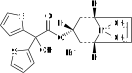

![(1R,3s,5S)-3-(2-Hydroxy-2,2-di(thiophen-2-yl)acetoxy)-8,8-dimethyl-8-azabicyclo[3.2.1]oct-6-en-8-i…](/_next/image/?url=https%3A%2Fstatic.cymitquimica.com%2Fproducts%2F54%2Fthumb%2FOR1076474.jpg&w=3840&q=75)

![(1R,3S,5S)-3-(2-Hydroxy-2,2-di(thiophen-2-yl)acetoxy)-8,8-dimethyl-8-azabicyclo[3.2.1]oct-6-en-8-i…](/_next/image/?url=https%3A%2Fstatic.cymitquimica.com%2Fproducts%2FTR%2Fthumb%2FH941715.jpg&w=3840&q=75)

![(1R,3S,5S)-3-(2-Hydroxy-2,2-di(thiophen-2-yl)acetoxy)-8,8-dimethyl-d3-8-azabicyclo[3.2.1]oct-6-en-…](/_next/image/?url=https%3A%2Fstatic.cymitquimica.com%2Fproducts%2FTR%2Fthumb%2FH941717.jpg&w=3840&q=75)
![(1R,3S,5S)-3-(2-Hydroxy-2,2-di(thiophen-2-yl)acetoxy)-8,8-dimethyl-8-azabicyclo[3.2.1]oct-6-en bro…](/_next/image/?url=https%3A%2Fstatic.cymitquimica.com%2Fproducts%2F3D%2Fthumb%2FIH42882.jpg&w=3840&q=75)


