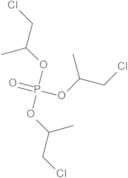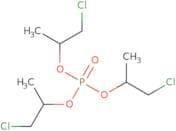
CAS 13674-84-5
:Tris(2-chloroisopropyl) phosphate
Description :
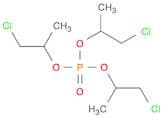
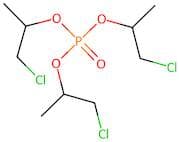
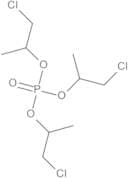
Tris(2-chloroisopropyl) phosphate, communément appelé TCPP, est un composé organophosphoré caractérisé par son utilisation comme retardant de flamme et plastifiant dans diverses applications, y compris les textiles, les plastiques et les revêtements. C'est un liquide incolore à jaune pâle avec un point d'ébullition relativement élevé et une faible volatilité, ce qui contribue à son efficacité en matière de résistance au feu. Le TCPP est connu pour sa capacité à améliorer la stabilité thermique des matériaux tout en offrant un certain degré de flexibilité. La présence d'atomes de chlore dans sa structure confère des propriétés supplémentaires de retardant de flamme, ce qui le rend particulièrement utile dans les applications où la sécurité incendie est une préoccupation. Cependant, comme de nombreux organophosphorés, le TCPP a soulevé des préoccupations environnementales et sanitaires en raison de sa toxicité potentielle et de sa persistance dans l'environnement. Il est important de manipuler cette substance avec précaution, en suivant les directives de sécurité appropriées pour minimiser l'exposition. Dans l'ensemble, le TCPP joue un rôle significatif dans la science des matériaux, en particulier dans l'amélioration de la sécurité et des performances de divers produits.
Formule :C9H18Cl3O4P
InChI :InChI=1S/C9H18Cl3O4P/c1-7(4-10)14-17(13,15-8(2)5-11)16-9(3)6-12/h7-9H,4-6H2,1-3H3
Code InChI :InChIKey=KVMPUXDNESXNOH-UHFFFAOYSA-N
SMILES :P(OC(CCl)C)(OC(CCl)C)(OC(CCl)C)=O
Synonymes :- 1,3-Dichloro-2-propanol phosphate
- 1-Chloro-2-Propanophosphate(3:1)
- 1-Chloro-2-propanolphosphate(3:1)
- 2-Propanol, 1-chloro-, 2,2′,2′′-phosphate
- 2-Propanol, 1-chloro-, phosphate (3:1)
- Amgard TMCP
- Antiblaze 80
- Antiblaze AB 80
- Antiblaze TMCP
- Bs 5852
- Daltoguard F
- Fyrol PCF
- Hostaflam OP 820
- Levagard PP
- Levagard PP 2
- Levagard PP-Z
- Levagard TCPP
- Pc 1389
- Phireguard TCPP
- Phosphoric acid tris(2-chloro-1-methylethyl) ester
- ProFlame PC 1389
- Puma 4010
- Tcpp
- Tmpcc
- Tolgard TMCP
- Tri(2-chloroisopropyl) phosphate
- Tri(chloropropyl) phosphate
- Tris(1-chloro-2-isopropyl)phosphate
- Tris(1-chloropropan-2-yl) phosphate
- Tris(1-chloropropyl)phosphate
- Tris(1-methyl-2-chloroethyl) phosphate
- Tris(2-chloro-1-methyl-ethyl) phosphate
- Tris(2-chloro-1-methylethyl) phosphate
- Tris(2-chloroisopropyl) phosphate
- Tris(2-chloropropyl) phosphate
- Tris(chloroISOPROPYL)phosphate
- Tris(chloropropyl)phosphate
- Tris(clorisopropyl)phosphate
- Tris(monochloropropyl) phosphate
- Tris(β-chloroisopropyl) phosphate
- Wsfr-Tcpp
- Yoke TCPP
- Tris(1-chloro-2-propyl)phosphate
- Tris(1-chloro-2-propyl) phosphate
- Voir plus de synonymes
Trier par
Degré de pureté (%)
0
100
|
0
|
50
|
90
|
95
|
100
7 produits concernés.
Tris(1-chloropropan-2-yl) phosphate
CAS :Formule :C9H18Cl3O4PDegré de pureté :85.0%Couleur et forme :LiquidMasse moléculaire :327.56Tris(2-chloroisopropyl) phosphate
CAS :Formule :C9H18Cl3O4PDegré de pureté :98%Couleur et forme :LiquidMasse moléculaire :327.5696Tris(2-Chloro-1-Methylethyl) Phosphate
CAS :Tris(2-Chloro-1-Methylethyl) PhosphateDegré de pureté :P:9.5%Masse moléculaire :327.57g/molTris(2-chloroisopropyl) phosphate
CAS :Formule :C9H18Cl3O4PCouleur et forme :ColourlessMasse moléculaire :327.57Tris(1-chloro-2-propyl) Phosphate
CAS :Produit contrôléStability Moisture Sensitive
Applications Tris(1-chloro-2-propyl) Phosphate is a flame retardant of low hydrolytic stability, used in polyurethane (PU) rigid and flexible foam, PVC, EVA, phenolics and epoxy resin.
References Grump, D., et al.: Toxicol. Sci., 126, 140 (2012); Paciorek, S.J., et al.: J. Porous. Mater., 19, 161 (2012);Formule :C9H18Cl3O4PCouleur et forme :ColourlessMasse moléculaire :327.57Tris(1-chloro-2-propyl) phosphate - mixture of isomers
CAS :Tris(1-chloro-2-propyl) phosphate is a synthetic compound that belongs to the class of diphenyl ethers. It is used as an intermediate in the production of other chemicals, such as plastics and pesticides. Tris(1-chloro-2-propyl) phosphate has been shown to be toxic to cells by inhibiting mitochondrial membrane potential and interfering with cellular metabolism. This chemical can cause severe health effects, such as liver damage and death, at high doses. Tris(1-chloro-2-propyl) phosphate can also be detected in human serum and urine samples with high sensitivity.Formule :C9H18Cl3O4PDegré de pureté :Min. 95%Masse moléculaire :327.57 g/mol