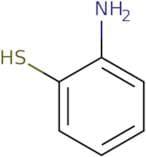
CAS 137-07-5
:2-Aminothiophénol
- 1-Amino-2-mercaptobenzene
- 2-Amino Thiophenol
- 2-Amino-1-mercaptobenzene
- 2-Aminobencenotiol
- 2-Aminobenzenethiol
- 2-Aminobenzenethiol Hydrochloride (1:1)
- 2-Aminobenzenethiolate
- 2-Aminobenzolthiol
- 2-Aminophenyl mercaptan
- 2-Mercaptoaniline
- 2-Thioaniline
- Benzenethiol, 2-amino-
- Benzenethiol, o-amino-
- Nsc 106635
- O-Aminothiophenol
- o-Aminobenzenethiol
- o-Aminophenyl mercaptan
- o-Mercaptoaniline
- Voir plus de synonymes
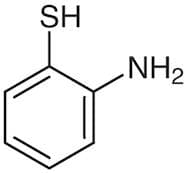
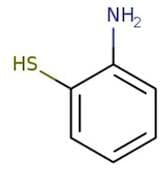
2-Aminobenzenethiol
CAS :Formule :C6H7NSDegré de pureté :>97.0%(T)Couleur et forme :Light yellow to Yellow to Orange clear liquidMasse moléculaire :125.192-Aminothiophenol, 98%
CAS :2-Aminothiophenol was used in the synthesis of 1,5-benzothiazepines derivatives by reacting with 1,3-diphenylpropenone derivatives and using aluminosilicate solid catalysts. It was also used in the synthesis of benzothiazole2 and 3-(benzothiazol-2-yl)coumarin derivatives. The ternary complexes of coFormule :C6H7NSDegré de pureté :98%Couleur et forme :Crystals or powder or crystalline powder or fused solid or clear liquid as melt, Yellow to brownMasse moléculaire :125.192-Aminothiophenol
CAS :Formule :C6H7NSCouleur et forme :Light yellow to yellow or orange liquidMasse moléculaire :125.192-Aminothiophenol
CAS :Formule :C6H7NSDegré de pureté :98.0%Couleur et forme :Low Melting SolidMasse moléculaire :125.192-Aminothiophenol
CAS :2-AminothiophenolFormule :C6H7NSDegré de pureté :98%Couleur et forme : clear. yellow liquidMasse moléculaire :125.19g/mol2-Aminothiophenol 90%
CAS :Produit contrôléStability Air Sensitive
Applications A multifunctional compound which shows antioxidant activity in a skin cell model of UVA-induced stress.
Not a dangerous good if item is equal to or less than 1g/ml and there is less than 100g/ml in the package
References Sies, H., et al.: Eur. J. Biochem., 215, 213 (1993), Meotti, F., et al.: Environ. Res., 94, 276 (2004),Formule :C6H7NSDegré de pureté :90%Couleur et forme :NeatMasse moléculaire :125.192-Aminothiophenol
CAS :2-Aminothiophenol is a chemical compound that belongs to the class of thiophenols and can be prepared by reacting sodium carbonate with hydrochloric acid. It has been shown to be an effective inhibitor of human immunoglobulin production in colorectal adenocarcinoma cells. 2-Aminothiophenol also inhibits the growth of bacteria, fungi, and some viruses. This compound binds to proteins by nucleophilic displacement of sulfur groups from cysteine residues on protein molecules, forming covalent bonds between amino groups and sulfur atoms. 2-Aminothiophenol has been used as a fluorescent derivative for the detection of disulfide bonds in proteins. The reaction mechanism is the same as that for other thiols: formation of a sulfenic acid intermediate followed by reduction to form disulfides. Analysis can be done using electrochemical impedance spectroscopy (EIS) or adsorption methods such as gas
Formule :C6H7NSDegré de pureté :Min. 95%Masse moléculaire :125.18 g/mol