


CAS 137018-93-0
:Trier par
Degré de pureté (%)
0
100
|
0
|
50
|
90
|
95
|
100
4 produits concernés.
L-Tyrosine, N-[(9H-fluoren-9-ylmethoxy)carbonyl]-3-hydroxy-
CAS :Formule :C24H21NO6Degré de pureté :97%Couleur et forme :SolidMasse moléculaire :419.4266(S)-2-((((9H-Fluoren-9-yl)methoxy)carbonyl)amino)-3-(3,4-dihydroxyphenyl)propanoic acid
CAS :(S)-2-((((9H-Fluoren-9-yl)methoxy)carbonyl)amino)-3-(3,4-dihydroxyphenyl)propanoic acidDegré de pureté :97%Masse moléculaire :419.43g/mol(S)-2-((((9H-Fluoren-9-yl)methoxy)carbonyl)amino)-3-(3,4-dihydroxyphenyl)propanoic acid
CAS :Degré de pureté :97%Masse moléculaire :419.4330139(2S)-3-(3,4-dihydroxyphenyl)-2-{[(9H-fluoren-9-ylmethoxy)carbonyl]amino}propanoic acid
CAS :3,4-Dihydroxyphenylalanine (3,4-DOPA) is a non-protein amino acid that is an intermediate in the synthesis of dopamine and norepinephrine. 3,4-DOPA is metabolized by the enzyme dopa decarboxylase to dopamine and then by catechol-O-methyl transferase to norepinephrine. 3,4-DOPA has antioxidant properties and has been shown to have anticancer effects in animals. It also has been shown to interact with other biomolecules such as proteins and nucleic acids. 3,4-DOPA binds strongly to metal ions through its carboxylic acid group and can chelate metals such as copper or iron. This property may be used for coatings on metal surfaces or for interacting with other molecules.br>br> 3,4-Dopa contains a chiral center due to the presence of two stereogenic carbons on the phenFormule :C24H21NO6Degré de pureté :Min. 95%Masse moléculaire :419.4 g/mol
![L-Tyrosine, N-[(9H-fluoren-9-ylmethoxy)carbonyl]-3-hydroxy-](/_next/image/?url=https%3A%2Fstatic.cymitquimica.com%2Fproducts%2FIN%2Fthumb%2FDA0012PD.jpg&w=3840&q=75)

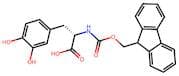


![(2S)-3-(3,4-dihydroxyphenyl)-2-{[(9H-fluoren-9-ylmethoxy)carbonyl]amino}propanoic acid](/_next/image/?url=https%3A%2Fstatic.cymitquimica.com%2Fproducts%2F3D%2Fthumb%2FMFA01893.jpg&w=3840&q=75)
