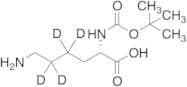
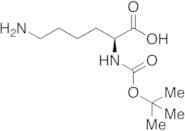
CAS 13734-28-6
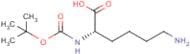
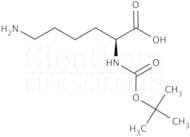
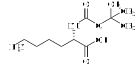
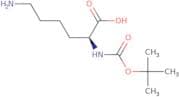
:α-tert-butoxycarbonyle-L-lysine
Description :
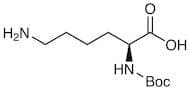
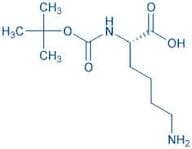
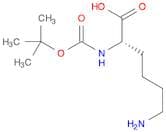
α-tert-butoxycarbonyle-L-lysine, communément appelé Boc-L-lysine, est un dérivé de l'acide aminé lysine, caractérisé par la présence d'un groupe protecteur tert-butyloxycarbonyle (Boc). Ce composé est généralement utilisé dans la synthèse peptidique et la chimie organique comme groupe protecteur pour le groupe amino de la lysine, ce qui permet des réactions sélectives sans interférence de la fonctionnalité amino. La Boc-L-lysine est un solide cristallin blanc à blanc cassé qui est soluble dans des solvants organiques tels que le dichlorométhane et le diméthylsulfoxyde, mais moins soluble dans l'eau. Sa structure moléculaire comprend un squelette de lysine, qui contribue à ses propriétés basiques, et le groupe Boc, qui améliore la stabilité et la réactivité dans des conditions spécifiques. Le composé est sensible à l'humidité et doit être stocké dans un endroit frais et sec pour maintenir son intégrité. En plus de son rôle en chimie synthétique, la Boc-L-lysine peut également être utilisée dans l'étude de la structure et de la fonction des protéines en raison de son incorporation dans des peptides.
Formule :C11H22N2O4
InChI :InChI=1S/C11H22N2O4/c1-11(2,3)17-10(16)13-8(9(14)15)6-4-5-7-12/h8H,4-7,12H2,1-3H3,(H,13,16)(H,14,15)/t8-/m0/s1
Code InChI :InChIKey=DQUHYEDEGRNAFO-QMMMGPOBSA-N
SMILES :[C@H](NC(OC(C)(C)C)=O)(CCCCN)C(O)=O
Synonymes :- (2S)-6-Amino-2-[[(tert-butoxy)carbonyl]amino]hexanoic acid
- (2S)-6-Azaniumyl-2-[(2-methylpropan-2-yl)oxycarbonylamino]hexanoate
- (S)-6-Amino-2-(tert-butoxycarbonylamino)hexanoic acid
- <span class="text-smallcaps">L</span>-Lysine, N<sup>2</sup>-[(1,1-dimethylethoxy)carbonyl]-
- BOC-<span class="text-smallcaps">L</span>-Lys-OH
- Boc-L-lysine
- Boc-Lys-OH
- Lysine, N<sup>2</sup>-carboxy-, N<sup>2</sup>-tert-butyl ester, <span class="text-smallcaps">L</span>-
- N-Boc-L-Lysine
- N-tert-Butoxycarbonyllysine
- N-α-(tert-Butoxycarbonyl)-<span class="text-smallcaps">L</span>-lysine
- N<sub>α</sub>-Boc-<span class="text-smallcaps">L</span>-lysine
- N<sup>2</sup>-[(1,1-Dimethylethoxy)carbonyl]-<span class="text-smallcaps">L</span>-lysine
- N<sup>2</sup>-tert-Butoxycarbonyl-<span class="text-smallcaps">L</span>-lysine
- N<sup>α</sup>-BOC-<span class="text-smallcaps">L</span>-lysine
- NSC 343721
- N~2~-(tert-butoxycarbonyl)lysine
- N~6~-(tert-butoxycarbonyl)-L-lysine
- α-N-Boc-lysine
- α-N-tert-Butoxycarbonyl-<span class="text-smallcaps">L</span>-lysine
- α-tert-Butoxycarbonyl-<span class="text-smallcaps">L</span>-lysine
- N2-tert-Butoxycarbonyl-L-lysine
- Lysine, N2-carboxy-, N2-tert-butyl ester, L-
- N2-[(1,1-Dimethylethoxy)carbonyl]-L-lysine
- Voir plus de synonymes
Trier par
Degré de pureté (%)
0
100
|
0
|
50
|
90
|
95
|
100
12 produits concernés.
Nα-(tert-Butoxycarbonyl)-L-lysine
CAS :Formule :C11H22N2O4Degré de pureté :>98.0%(T)Couleur et forme :White to Light yellow powder to lumpMasse moléculaire :246.31Nα-Boc-L-lysine, 97%
CAS :N-Boc-L-lysine is a protected analogue of a major amino acid participating in the binding of AcH to proteins. N-Boc-L-lysine as well as other t-butoxycarbonyl (Boc) amino acids can be converted to their respective amino acids via cleavage of the urethane bond. This Thermo Scientific Chemicals brandFormule :C11H22N2O4Degré de pureté :97%Masse moléculaire :246.31Boc-Lys-OH
CAS :Educt for the synthesis of Boc- and Fmoc-ε-azido-norleucine.Formule :C11H22N2O4Couleur et forme :WhiteMasse moléculaire :246.31Boc-L-Lys-OH
CAS :Formule :C11H22N2O4Degré de pureté :97%Couleur et forme :SolidMasse moléculaire :246.3034Ref: IN-DA0038XW
1kgÀ demander1g21,00€5g23,00€10g28,00€25g49,00€50g89,00€100g117,00€250g228,00€500g541,00€Boc-Lys-OH
CAS :Boc-Lys-OHFormule :C11H22N2O4Degré de pureté :98%Couleur et forme : white solidMasse moléculaire :246.30g/molBoc-Lys-OH
CAS :Formule :C11H22N2O4Degré de pureté :≥ 98.0%Couleur et forme :White powderMasse moléculaire :246.30N-Boc-L-Lysine
CAS :N-Boc-L-Lysine is a model of the amino acid lysine. This compound has been shown to inhibit the growth of cancer cells in vitro and in vivo. N-Boc-L-Lysine inhibits protein synthesis by blocking the formation of peptide bonds between amino acids, thus stopping the production of proteins vital for cell division. The inhibition of fatty acid synthesis by this compound may be due to its ability to inhibit the activity of fatty acid synthase, which catalyzes the conversion of acetyl coenzyme A into fatty acids. This product can also be synthesized from caproic acid and an ester hydrochloride or from a fatty acid and an ester hydrochloride.
Formule :C11H22N2O4Degré de pureté :Min. 95%Couleur et forme :White Off-White PowderMasse moléculaire :246.3 g/molBoc-Lys-OH
CAS :M03297 - Boc-Lys-OH
Formule :C11H22N2O4Degré de pureté :95%Couleur et forme :SolidMasse moléculaire :246.307N-Boc-L-lysine-d4
CAS :Produit contrôléFormule :C11D4H18N2O4Couleur et forme :NeatMasse moléculaire :250.328N-Boc-L-lysine
CAS :Produit contrôléFormule :C11H22N2O4Couleur et forme :White To Light YellowMasse moléculaire :246.3