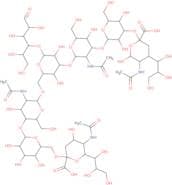
CAS 137636-98-7
:O-(N-Acétyl-α-neuraminosyl)-(2→3)-O-β-D-galactopyranosyl-(1→3)-O-2-(acétylamino)-2-désoxy-β-D-glucopyranosyl-(1→3)-O-[O-(N-acétyl-α-neuraminosyl)-(2→6)-O-β-D-galactopyranosyl-(1→4)-2-(acétylamino)-2-désoxy-β-D-glucopyranosyl-(1→6)]-O-β-D-galactopyranosyl-(1→4)-D-glucose
Description :
La substance chimique connue sous le nom de O-(N-Acétyl-α-neuraminosyl)-(2→3)-O-β-D-galactopyranosyl-(1→3)-O-2-(acétylamino)-2-désoxy-β-D-glucopyranosyl-(1→3)-O-[O-(N-acétyl-α-neuraminosyl)-(2→6)-O-β-D-galactopyranosyl-(1→4)-2-(acétylamino)-2-désoxy-β-D-glucopyranosyl-(1→6)]-O-β-D-galactopyranosyl-(1→4)-D-glucose, avec le numéro CAS 137636-98-7, est un composé glycosylé complexe caractérisé par plusieurs unités de sucre liées par des liaisons glycosidiques spécifiques. Cette molécule présente de l'acide N-acétyl neuraminique, qui est un dérivé de l'acide sialique, contribuant à son importance biologique, en particulier dans les processus de reconnaissance et de signalisation cellulaire. La présence de diverses unités de sucre, y compris des dérivés de galactose et de glucosamine, indique son rôle potentiel dans les structures de glycoprotéines ou de glycolipides. De tels composés sont souvent impliqués dans les interactions cellulaires, les réponses immunitaires et la reconnaissance des pathogènes. La structure complexe suggère qu'elle pourrait présenter des propriétés de liaison spécifiques, ce qui la rend pertinente dans la recherche biochimique et les applications thérapeutiques potentielles. Sa stabilité et sa solubilité dans les systèmes biologiques dépendraient de l'arrangement de ses liaisons glycosidiques et de la présence de groupes fonctionnels.
Formule :C62H102N4O47
InChI :InChI=1S/C62H102N4O47/c1-16(74)63-31-20(78)5-61(59(96)97,111-50(31)36(85)23(81)8-68)101-15-30-38(87)43(92)44(93)56(106-30)108-48-28(13-73)104-54(33(42(48)91)65-18(3)76)100-14-29-41(90)52(45(94)57(105-29)107-47(25(83)10-70)35(84)22(80)7-67)110-55-34(66-19(4)77)49(39(88)26(11-71)102-55)109-58-46(95)53(40(89)27(12-72)103-58)113-62(60(98)99)6-21(79)32(64-17(2)75)51(112-62)37(86)24(82)9-69/h7,20-58,68-73,78-95H,5-6,8-15H2,1-4H3,(H,63,74)(H,64,75)(H,65,76)(H,66,77)(H,96,97)(H,98,99)/t20-,21-,22-,23+,24+,25+,26+,27+,28+,29+,30+,31+,32+,33+,34+,35+,36+,37+,38-,39+,40-,41-,42+,43-,44+,45+,46+,47+,48+,49+,50+,51+,52-,53-,54+,55-,56-,57-,58-,61+,62-/m0/s1
Code InChI :InChIKey=KRJQBUMEJQLMJO-IYWOAXAFSA-N
SMILES :O([C@@]1(C(O)=O)O[C@@]([C@@H]([C@@H](CO)O)O)([C@H](NC(C)=O)[C@@H](O)C1)[H])[C@@H]2[C@@H](O)[C@H](O[C@@H]3[C@@H](NC(C)=O)[C@H](O[C@@H]4[C@@H](O)[C@H](O[C@@H]([C@@H]([C@H](C=O)O)O)[C@@H](CO)O)O[C@H](CO[C@H]5[C@H](NC(C)=O)[C@@H](O)[C@H](O[C@@H]6O[C@H](CO[C@@]7(C(O)=O)O[C@@]([C@@H]([C@@H](CO)O)O)([C@H](NC(C)=O)[C@@H](O)C7)[H])[C@H](O)[C@H](O)[C@H]6O)[C@@H](CO)O5)[C@@H]4O)O[C@H](CO)[C@H]3O)O[C@H](CO)[C@@H]2O
Synonymes :- 5-(acetylamino)-2-[(6-{[5-(acetylamino)-6-[(4-{[3-(acetylamino)-4-{[4-{[5-(acetylamino)-2-carboxy-6-hydroxy-4-(1,2,3-trihydroxypropyl)tetrahydro-2H-pyran-2-yl]oxy}-3,5-dihydroxy-6-(hydroxymethyl)tetrahydro-2H-pyran-2-yl]oxy}-5-hydroxy-6-(hydroxymethyl)tetrahydro-2H-pyran-2-yl]oxy}-6-[1-(1,2-dihydroxyethyl)-2,3-dihydroxy-4-oxobutoxy]-3,5-dihydroxytetrahydro-2H-pyran-2-yl)methoxy]-4-hydroxy-2-(hydroxymethyl)tetrahydro-2H-pyran-3-yl]oxy}-3,4,5-trihydroxytetrahydro-2H-pyran-2-yl)methoxy]-4-hydroxy-6-(1,2,3-trihydroxypropyl)tetrahydro-2H-pyran-2-carboxylic acid (non-preferred name)
- 5-Acetamido-2-[2-[3-Acetamido-2-[2-[[3-Acetamido-5-[6-[[5-Acetamido-2-Carboxy-4-Hydroxy-6-(1,2,3-Trihydroxypropyl)Oxan-2-Yl]Oxymethyl]-3,4,5-Trihydroxyoxan-2-Yl]Oxy-4-Hydroxy-6-(Hydroxymethyl)Oxan-2-Yl]Oxymethyl]-3,5-Dihydroxy-6-(1,2,4,5-Tetrahydroxy-6-Oxohexan-3-Yl)Oxyoxan-4-Yl]Oxy-5-Hydroxy-6-(Hydroxymethyl)Oxan-4-Yl]Oxy-3,5-Dihydroxy-6-(Hydroxymethyl)Oxan-4-Yl]Oxy-6-Hydroxy-4-(1,2,3-Trihydroxypropyl)Oxane-2-Carboxylic Acid
- <span class="text-smallcaps">D</smallcap>-Glucose, O-(N-acetyl-α-neuraminosyl)-(2→3)-O-β-<smallcap>D</smallcap>-galactopyranosyl-(1→3)-O-2-(acetylamino)-2-deoxy-β-<smallcap>D</smallcap>-glucopyranosyl-(1→3)-O-[O-(N-acetyl-α-neuraminosyl)-(2→6)-O-β-<smallcap>D</smallcap>-galactopyranosyl-(1→4)-2-(acetylamino)-2-deoxy-β-<smallcap>D</smallcap>-glucopyranosyl-(1→6)]-O-β-<smallcap>D</span>-galactopyranosyl-(1→4)-
- Disialyllacto-N-hexaose I
- Dslnh-I
- O-(N-Acetyl-α-neuraminosyl)-(2→3)-O-β-<span class="text-smallcaps">D</smallcap>-galactopyranosyl-(1→3)-O-2-(acetylamino)-2-deoxy-β-<smallcap>D</smallcap>-glucopyranosyl-(1→3)-O-[O-(N-acetyl-α-neuraminosyl)-(2→6)-O-β-<smallcap>D</smallcap>-galactopyranosyl-(1→4)-2-(acetylamino)-2-deoxy-β-<smallcap>D</smallcap>-glucopyranosyl-(1→6)]-O-β-<smallcap>D</smallcap>-galactopyranosyl-(1→4)-<smallcap>D</span>-glucose
- D-Glucose, O-(N-acetyl-α-neuraminosyl)-(2→3)-O-β-D-galactopyranosyl-(1→3)-O-2-(acetylamino)-2-deoxy-β-D-glucopyranosyl-(1→3)-O-[O-(N-acetyl-α-neuraminosyl)-(2→6)-O-β-D-galactopyranosyl-(1→4)-2-(acetylamino)-2-deoxy-β-D-glucopyranosyl-(1→6)]-O-β-D-galactopyranosyl-(1→4)-
- O-(N-Acetyl-α-neuraminosyl)-(2→3)-O-β-D-galactopyranosyl-(1→3)-O-2-(acetylamino)-2-deoxy-β-D-glucopyranosyl-(1→3)-O-[O-(N-acetyl-α-neuraminosyl)-(2→6)-O-β-D-galactopyranosyl-(1→4)-2-(acetylamino)-2-deoxy-β-D-glucopyranosyl-(1→6)]-O-β-D-galactopyranosyl-(1→4)-D-glucose
Trier par
Degré de pureté (%)
0
100
|
0
|
50
|
90
|
95
|
100
1 produits concernés.
Disialyllacto-N-hexaose I
CAS :Disialyllacto-N-hexaose I is a complex carbohydrate that belongs to a class of saccharides called polysaccharides. Disialyllacto-N-hexaose I is synthesized through the methylation and glycosylation of sucrose. It has been modified by Click chemistry with a maleimide group to create an amide bond between the terminal alpha position on the glucose residue and the terminal alpha position on the N-acetylglucosamine residue. This modification can be used for Polysaccharide analysis, such as MALDI TOF MS. Disialyllacto-N-hexaose I has a CAS number of 137636-98-7 and has been shown to have high purity without any impurities or contaminants.
Formule :C62H102N4O47Degré de pureté :Min. 95%Masse moléculaire :1,655.47 g/mol