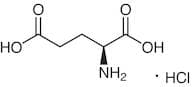
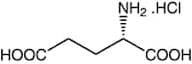
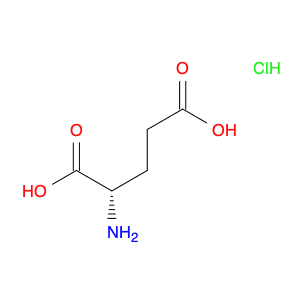
CAS 138-15-8
:Acide L(+)-glutamique chlorhydrate
Description :
Acide L(+)-glutamique chlorhydrate, avec le numéro CAS 138-15-8, est le sel chlorhydrate de l'acide L-glutamique, un acide aminé qui joue un rôle crucial dans le métabolisme cellulaire et la neurotransmission. Ce composé est généralement une poudre cristalline blanche soluble dans l'eau, ce qui le rend utile dans diverses applications, y compris l'aromatisation des aliments et comme complément alimentaire. L'acide L-glutamique est classé comme un acide aminé non essentiel, ce qui signifie qu'il peut être synthétisé par le corps. Il est connu pour son rôle de neurotransmetteur excitateur dans le système nerveux central, contribuant à des fonctions cognitives telles que l'apprentissage et la mémoire. En plus de son importance biologique, Acide L(+)-glutamique chlorhydrate est souvent utilisé dans l'industrie pharmaceutique et dans des contextes de recherche. Son profil de sécurité est généralement favorable, bien qu'une consommation excessive puisse entraîner des effets indésirables chez les individus sensibles. Dans l'ensemble, ce composé est apprécié pour ses propriétés fonctionnelles tant dans des contextes biologiques qu'industriels.
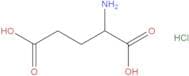
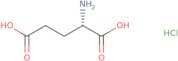
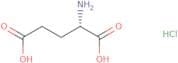
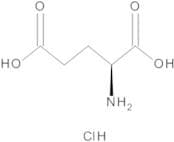
Formule :C5H10ClNO4
InChI :InChI=1/C5H9NO4.ClH/c6-3(5(9)10)1-2-4(7)8;/h3H,1-2,6H2,(H,7,8)(H,9,10);1H/t3-;/m0./s1
Code InChI :InChIKey=RPAJSBKBKSSMLJ-DFWYDOINSA-N
SMILES :[C@H](CCC(O)=O)(C(O)=O)N.Cl
Synonymes :- 2-Aminopentanedioic acid hydrochloride
- <span class="text-smallcaps">L</span>(+)-Glutamic acid hydrochloride
- <span class="text-smallcaps">L</span>-Glutamic acid monohydrochloride
- <span class="text-smallcaps">L</span>-Glutamic acid, hydrochloride (1:1)
- Acidalin
- Acidogen
- Acidoride
- Acidothyn
- Acidulen
- Acidulin
- Aciglumin
- Aclor
- Acridogen
- Acridoride
- Antalka
- Gastuloric
- Glusatin
- Glutamic Acid Hydrochloride (1:1)
- Glutamic acid hydrochloride
- Glutamic acid monohydrochloride
- Glutamic acid, hydrochloride, <span class="text-smallcaps">L</span>-
- Glutamidin
- Glutan HCl
- Glutan Hydrochloric
- Glutan hydrochloride
- Glutasin
- Hydrionic
- Hypochylin
- L-Glutamic Acid HCL
- Muriamic
- NSC 9239
- Pepsdol
- Pepsidol
- Glutamic acid, hydrochloride, L-
- L-Glutamic acid, hydrochloride (1:1)
- L-(+)-Glutamic acid hydrochloride
- L-Glutamic acid, hydrochloride
- L-Glutamic acid hydrochloride
- L-(+)-Glutamic Acid Hydrochloride
- GLUTAMIC ACID HCL
- L-GLU HCL
- L-2-AMINOGLUTARIC ACID HYDROCHLORIDE
- 2-aminopentanedioicacidhydrochloride
- H-GLU-OH HCL
- [S]-2-AMINOPENTANEDIOIC ACID HYDROCHLORIDE
- (S)-2-AMINOGLUTARIC ACID HYDROCHLORIDE
- Voir plus de synonymes
Trier par
Degré de pureté (%)
0
100
|
0
|
50
|
90
|
95
|
100
10 produits concernés.
L-Glutamic Acid Hydrochloride
CAS :Formule :C5H9NO4·HClDegré de pureté :>98.0%(T)(HPLC)Couleur et forme :White to Almost white powder to crystalMasse moléculaire :183.59L-Glutamic acid hydrochloride, 99%
CAS :L-Glutamic acid hydrochloride is used as a digestive aid. It is used in cell culture as a component of MEM non-essential amino acids solution. It has been used as a nitrogen source in the culture of Aspergillus fumigatus NRRL 2436 for fumagillin production. This Thermo Scientific Chemicals brand proFormule :C5H10ClNO4Degré de pureté :99%Couleur et forme :White, Crystals or powder or crystalline powderMasse moléculaire :183.59L-Glutamic Acid Hydrochloride
CAS :Glutamic acid and its saltsFormule :C5H9NO4·HCICouleur et forme :PowderMasse moléculaire :286.96545Glutamic acid, hydrochloride
CAS :Formule :C5H10ClNO4Degré de pureté :98%Couleur et forme :SolidMasse moléculaire :183.5902L-Glutamic acid hydrochloride
CAS :Formule :C5H9NO4HClDegré de pureté :(Titration) ≥ 99.0%Couleur et forme :White to almost white powderMasse moléculaire :183.59L-Glutamic acid hydrochloride
CAS :Formule :C5H10ClNO4Degré de pureté :95%~99%Masse moléculaire :183.588L-Glutamic acid hydrochloride
CAS :L-Glutamic acid hydrochloride is a high quality reagent that is used as an intermediate in the production of fine chemicals. It is also used as a useful scaffold for the synthesis of valuable compounds and as a useful building block for research chemicals. L-Glutamic acid hydrochloride can be used in reactions to produce versatile building blocks, reaction components, and other speciality chemicals.Formule :C5H10ClNO4Degré de pureté :Min. 98 Area-%Masse moléculaire :183.59 g/molL-(+)-Glutamic acid HCl
CAS :L-(+)-Glutamic acid HCl is a monosodium salt that belongs to the group of water-soluble organic acids. It has been used as a food additive and in wastewater treatment, as well as for the production of polymers and pharmaceuticals. Glutamate can be converted to glutamic acid by hydrolysis with sodium hydroxide or other strong bases. Glutamic acid is an important biochemical precursor in the synthesis of proteins, peptides, and nucleic acids. It also functions as a neurotransmitter in the central nervous system. L-(+)-glutamic acid HCl has been shown to induce apoptosis in human HL-60 cells by increasing reactive oxygen species (ROS) levels and activating caspase-3 activity in these cells. The crystalline cellulose used in this study was obtained from cellulose powder (Avicel PH101).Formule :C5H9NO4·HClDegré de pureté :Min. 95%Couleur et forme :White PowderMasse moléculaire :183.59 g/mol(S)-2-Aminopentanedioic acid hydrochloride
CAS :Formule :C5H10ClNO4Degré de pureté :98%Masse moléculaire :183.59L-Glutamic Acid Hydrochloride
CAS :Produit contrôléFormule :C5H9NO4·ClHCouleur et forme :NeatMasse moléculaire :183.59