CAS 13965-03-2
:Dichlorobis(triphénylphosphine)palladium
Description :
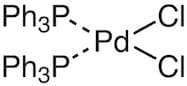
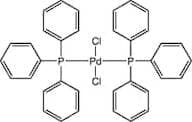
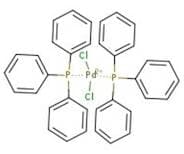
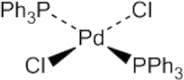
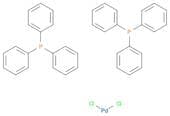
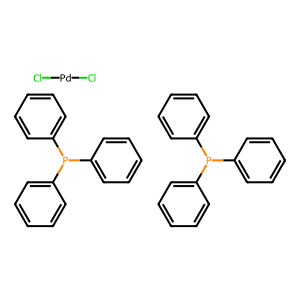
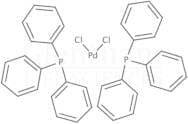
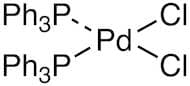
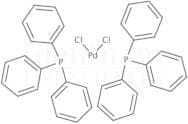
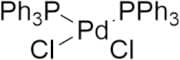
Dichlorobis(triphénylphosphine)palladium, communément appelé Pd(PPh₃)₂Cl₂, est un complexe de coordination du palladium qui présente deux ligands de triphénylphosphine et deux ions chlorure. Ce composé se caractérise par sa géométrie carrée plane, typique de nombreux complexes métalliques d⁸, ce qui contribue à sa stabilité et à sa réactivité. Il est souvent utilisé comme catalyseur dans diverses réactions organiques, en particulier dans les réactions de couplage croisé telles que les réactions de Suzuki et Heck, en raison de sa capacité à faciliter la formation de liaisons carbone-carbone. La présence des ligands de triphénylphosphine améliore la solubilité du complexe dans les solvants organiques et fournit un encombrement stérique, ce qui peut influencer la sélectivité de la réaction. Pd(PPh₃)₂Cl₂ est généralement manipulé sous atmosphères inertes pour éviter la dégradation et est sensible à l'humidité. Ses applications s'étendent à la synthèse de produits pharmaceutiques, d'agrochimie et de matériaux avancés, ce qui en fait un composé précieux tant en chimie académique qu'industrielle.
Formule :C36H30Cl2P2Pd
InChI :InChI=1S/2C18H15P.2ClH.Pd/c2*1-4-10-16(11-5-1)19(17-12-6-2-7-13-17)18-14-8-3-9-15-18;;;/h2*1-15H;2*1H;/q;;;;+2/p-2
Code InChI :InChIKey=YNHIGQDRGKUECZ-UHFFFAOYSA-L
SMILES :[P]([Pd+2]([P](C1=CC=CC=C1)(C2=CC=CC=C2)C3=CC=CC=C3)([Cl-])[Cl-])(C4=CC=CC=C4)(C5=CC=CC=C5)C6=CC=CC=C6
Synonymes :- B 1667
- Bis(triphenylphosphine)dichloropalladium
- Bis(triphenylphosphine)dichloropalladium(II)
- Bis(triphenylphosphine)palladium chloride
- Bis(triphenylphosphine)palladium dichloride
- Bis(triphenylphosphine)palladium(II) dichloride
- Bis(triphenylphosphino)-palladium(II) dichloride
- Bis(triphenylphosphino)palladium chloride
- Cis-Bis(Triphenylphosphine)Platinum(Ii) Dichloride
- Dichlorobis(Triphenylphosphine)Palladate (Ii)
- Dichlorobis(Triphenylphosphine)Palladium
- Dichlorobis(triphenylphosphin)palladium
- Dichlorobis(triphenylphosphine)palladium(II)
- Dichlorobis(triphenylphosphine)platinum (II)
- Diclorobis(Trifenilfosfina)Paladio
- Nsc 122924
- Palladium(2+) Chloride-Triphenylphosphane (1:2:2)
- Palladium, dichlorobis(triphenylphosphine)-
- Palladiumbis(triphenylphosphine) dichloride
- Phosphine, Triphenyl-, Palladium(2+) Salt, Dihydrochloride
- Trans-Dichlorobis(triphenyl-phosphine) Palladium(II)
- cis-Bis(triphenylphosphine)platinum(II) chloride
- trans-Bis(triphenylphosphine)palladium dichloride
- Voir plus de synonymes
Trier par
Degré de pureté (%)
0
100
|
0
|
50
|
90
|
95
|
100
15 produits trouvés.
Bis(triphenylphosphine)palladium(II) Dichloride
CAS :Formule :C36H30Cl2P2PdDegré de pureté :>98.0%(T)Couleur et forme :Light yellow to Brown powder to crystalMasse moléculaire :701.90trans-Dichlorobis(triphenylphosphine)palladium(II), Pd 14.0% min
CAS :Hydrogenation, hydrosilation, carbonylation, oxidation, and C-C bond formationFormule :C36H30Cl2P2PdMasse moléculaire :701.90trans-Dichlorobis(triphenylphosphine)palladium(II), Premion™, 99.95% (metals basis), Pd 14.7% min
CAS :As a catalyst of choice in hydrogenation, hydrosilation, carbonylation, oxidation, elimination, reduction, allyl aceate isomerization, dimerization of 1,3-dienes, and C-C bond formation such as Negishi coupling, Suzuki coupling, Kumada coupling, Sonogashira coupling, Heck coupling and Sonogashira-HFormule :C36H30Cl2P2PdDegré de pureté :99.95%Masse moléculaire :701.90Bis(triphenylphosphine)palladium(II) dichloride
CAS :Degré de pureté :98%Couleur et forme :White to yellow powder or crystalsMasse moléculaire :701.90trans-Dichlorobis(triphenylphosphine)palladium(II), 99% (99.9+%-Pd)
CAS :trans-Dichlorobis(triphenylphosphine)palladium(II), 99% (99.9+%-Pd)
Formule :PdCl2(P(C6H5)3Degré de pureté :(99.9+%-Pd)Couleur et forme :yellow pwdr.Masse moléculaire :701.89Dichlorobis(triphenylphosphine)palladium
CAS :Formule :C36H30Cl2P2PdDegré de pureté :98%Couleur et forme :SolidMasse moléculaire :701.8969Ref: IN-DA001BFX
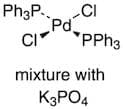
1gÀ demander5gÀ demander10gÀ demander25gÀ demander50gÀ demander100mgÀ demander250mgÀ demandertrans-Dichlorobis(triphenylphosphine)palladium(II)/potassium phosphate admixture [CatKit single-use vials - 6.32 wt% Pd complex]
CAS :trans-Dichlorobis(triphenylphosphine)palladium(II)/potassium phosphate admixture [CatKit single-use vials - 6.32 wt% Pd complex]
Formule :PdCl2P(C6H5)3K3PO4Couleur et forme :off-white pwdr.Masse moléculaire :701.89Bis(triphenylphosphine)palladium(II) chloride
CAS :Bis(triphenylphosphine)palladium(II) chlorideFormule :·2C18H15P·Cl2PdDegré de pureté :98%Couleur et forme : yellow solidMasse moléculaire :701.89692g/molBis(triphenylphosphine)palladium(II)chloride
CAS :Formule :C36H30Cl2P2PdCouleur et forme :Yellow to gold crystalline powderMasse moléculaire :701.91PdCl2(PPh3)2 (HPMC encapsulated)
CAS :Formule :C36H30Cl2P2PdCouleur et forme :White to Light yellow to Light orange capsuleMasse moléculaire :701.90Bis(Triphenylphosphine)palladium (II) chloride
CAS :Formule :C36H30Cl2P2PdDegré de pureté :98.0%Couleur et forme :Solid, Crystalline Powder or PowderMasse moléculaire :701.9Bis(triphenylphosphine) palladium(II) chloride, 99.95% (metals basis)
CAS :Formule :(C6H5)3PPdCI2Degré de pureté :≥ 99.95%Couleur et forme :Pale yellow to brown powder or crystalsMasse moléculaire :701.89Bis(triphenylphosphine)palladium(II) dichloride
CAS :Bis(triphenylphosphine)palladium(II) dichloride is an organometallic compound that has antibiotic activity. It is the active methylene in a number of drug molecules, including methyldopa, which is used to treat high blood pressure and postural hypotension. Bis(triphenylphosphine)palladium(II) dichloride also has potential use as a target enzyme for cross-coupling reactions. Cross-coupling reactions involve the coupling of organic compounds with organometallic reagents using palladium as a catalyst. The mechanism of this reaction involves the formation of a palladium-carbon bond by oxidative addition and reductive elimination, followed by the release of carbon monoxide. This process leads to the formation of an organometallic compound and an aryl halide. Bis(triphenylphosphine)palladium(II) dichloride can also be used in gel permeation chromFormule :C36H30Cl2P2PdDegré de pureté :Min. 95%Couleur et forme :Yellow PowderMasse moléculaire :701.9 g/molBis(Triphenylphosphine) Palladium(II) Dichloride extrapure, 14%-15.50% Pd
CAS :Formule :C36H30Cl2P2PdMasse moléculaire :701.90Dichlorobis(triphenylphosphine) Palladium (II)
CAS :Produit contrôléApplications Dichlorobis(triphenylphosphine) Palladium (II) is used primarily in organometallic catalytic reactions due to the palladium content of the compound. It is also involved in crystalized structures of metallacyclic complexes which show antiinflammatory and antifungal properties.
References Paul, P. et al.: J. Organometal. Chem., 724, 281 (2013); Pandiarajan, D. et al.: J. Organometal. Chem., 708-709, 18, (2012); Shhaheen, F. et al.: J. Organometal. Chem., 693, 315 (2010);Formule :C36H30Cl2P2PdCouleur et forme :NeatMasse moléculaire :701.89