CAS 1404-93-9
:Vancomycine, chlorhydrate
Description :
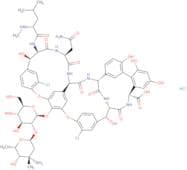
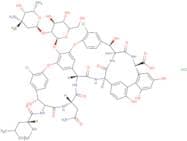
L'hydrochlorure de vancomycine est un antibiotique glycopeptidique principalement utilisé pour traiter des infections bactériennes graves, en particulier celles causées par des bactéries Gram-positives, y compris Staphylococcus aureus résistant à la méthicilline (MRSA). Il se caractérise par sa structure complexe, qui comprend une série d'acides aminés et de groupes de sucre qui contribuent à son mécanisme d'action. La vancomycine agit en inhibant la synthèse de la paroi cellulaire dans les bactéries, entraînant finalement la lyse cellulaire et la mort. La forme hydrochlorure améliore sa solubilité dans l'eau, ce qui la rend adaptée à l'administration intraveineuse. Elle est généralement administrée dans un cadre clinique en raison de sa puissance et de la nécessité de surveiller les effets secondaires potentiels, tels que la néphrotoxicité et l'ototoxicité. La vancomycine est également remarquable pour son spectre d'activité, qui est limité à certains types de bactéries, et elle est souvent réservée aux cas où d'autres antibiotiques sont inefficaces. Son utilisation est guidée par des tests de sensibilité pour garantir son efficacité et lutter contre le développement de la résistance aux antibiotiques.
Formule :C66H75Cl2N9O24·xClH
InChI :InChI=1S/C66H75Cl2N9O24.ClH/c1-23(2)12-34(71-5)58(88)76-49-51(83)26-7-10-38(32(67)14-26)97-40-16-28-17-41(55(40)101-65-56(54(86)53(85)42(22-78)99-65)100-44-21-66(4,70)57(87)24(3)96-44)98-39-11-8-27(15-33(39)68)52(84)50-63(93)75-48(64(94)95)31-18-29(79)19-37(81)45(31)30-13-25(6-9-36(30)80)46(60(90)77-50)74-61(91)47(28)73-59(89)35(20-43(69)82)72-62(49)92;/h6-11,13-19,23-24,34-35,42,44,46-54,56-57,65,71,78-81,83-87H,12,20-22,70H2,1-5H3,(H2,69,82)(H,72,92)(H,73,89)(H,74,91)(H,75,93)(H,76,88)(H,77,90)(H,94,95);1H/t24-,34+,35-,42+,44-,46+,47+,48-,49+,50-,51+,52+,53+,54-,56+,57+,65-,66-;/m0./s1
Code InChI :InChIKey=LCTORFDMHNKUSG-XTTLPDOESA-N
SMILES :O(C=1C2=CC3=CC1OC=4C(Cl)=CC(=CC4)[C@@H](O)[C@@H](NC([C@@H](CC(C)C)NC)=O)C(=O)N[C@@H](CC(N)=O)C(=O)N[C@]3(C(=O)N[C@@]5(C=6C=C(C=7C([C@@H](C(O)=O)NC(=O)[C@]([C@H](O)C=8C=C(Cl)C(O2)=CC8)(NC5=O)[H])=CC(O)=CC7O)C(O)=CC6)[H])[H])[C@H]9[C@H](O[C@H]%10C[C@](C)(N)[C@H](O)[C@H](C)O%10)[C@@H](O)[C@H](O)[C@@H](CO)O9.Cl
Synonymes :- (1S,2R,18R,19R,22S,25R,28R,40S)-48-{[(2S,3R,4S,5S,6R)-3-{[(2S,4S,5S,6S)-4-amino-5-hydroxy-4,6-dimethyltetrahydro-2H-pyran-2-yl]oxy}-4,5-dihydroxy-6-(hydroxymethyl)tetrahydro-2H-pyran-2-yl]oxy}-22-(2-amino-2-oxoethyl)-5,15-dichloro-2,18,32,35,37-pentahydroxy-19-{[(2R)-4-methyl-2-(methylamino)pentanoyl]amino}-20,23,26,42,44-pentaoxo-7,13-dioxa-21,24,27,41,43-pentaazaoctacyclo[26.14.2.23,6.214,17.18,12.129,33.010,25.034,39]pentaconta-3,5,8(48),9,11,14,16,29(45),30,32,34,36,38,46,49-pentadecaene-40-carboxylic acid hydrochloride (non-preferred name)
- (1S,2R,18R,19R,22S,25R,28R,40S)-48-{[(2S,3R,4S,5S,6R)-3-{[(2S,4S,5S,6S)-4-amino-5-hydroxy-4,6-dimethyltetrahydro-2H-pyran-2-yl]oxy}-4,5-dihydroxy-6-(hydroxymethyl)tetrahydro-2H-pyran-2-yl]oxy}-22-(2-amino-2-oxoethyl)-5,15-dichloro-2,18,32,35,37-pentahydroxy-19-{[(2R)-4-methyl-2-(methylamino)pentanoyl]amino}-20,23,26,42,44-pentaoxo-7,13-dioxa-21,24,27,41,43-pentaazaoctacyclo[26.14.2.2~3,6~.2~14,17~.1~8,12~.1~29,33~.0~10,25~.0~34,39~]pentaconta-3,5,8(48),9,11,14,16,29(45),30,32,34,36,38,46,49-pentadecaene-40-carboxylic acid (non-preferred name)
- (3S-(3R*,6S*(S*),7S*,22S*,23R*,26R*,36S*,38aS*))-3-(2-Amino-2-oxoethyl)-44-((2-O-(3-amino-2,3,6-trideoxy-3-C-methyl-alpha-L-lyxo-hexopyranosyl)-beta-D-glucopyranosyl)oxy)-10,19-dichloro-2,3,4,5,6,7,23,24,25,26,36,37,38,38a-tetradecahydro-7,22,28,30,32-pentahydroxy-6-((4-methyl-2-(methylamino)-1-oxopentyl)amino)-2,5,24,38,39-pentaoxo-22H-8,11:18,21-dietheno-23,36-(iminomethano)-13,16:31,35-dimetheno-1H,16H-(1,6,9)oxadiazacyclohexadecino(4,5-m)(10,2,16)benzoxadiazacyclotetracosine-26-carboxylic acid, monohydrochloride
- 22H-8,11:18,21-Dietheno-23,36-(iminomethano)-13,16:31,35-dimetheno-1H,16H-[1,6,9]oxadiazacyclohexadecino[4,5-m][10,2,16]benzoxadiazacyclotetracosine, vancomycin deriv.
- 48-({3-[(4-amino-5-hydroxy-4,6-dimethyltetrahydro-2H-pyran-2-yl)oxy]-4,5-dihydroxy-6-(hydroxymethyl)tetrahydro-2H-pyran-2-yl}oxy)-22-(2-amino-2-oxoethyl)-5,15-dichloro-2,18,32,35,37-pentahydroxy-19-{[4-methyl-2-(methylamino)pentanoyl]amino}-20,23,26,42,44-pentaoxo-7,13-dioxa-21,24,27,41,43-pentaazaoctacyclo[26.14.2.2~3,6~.2~14,17~.1~8,12~.1~29,33~.0~10,25~.0~34,39~]pentaconta-3,5,8(48),9,11,14,16,29(45),30,32,34,36,38,46,49-pentadecaene-40-carboxylic acid hydrochloride (1:1) (non-preferred name)
- Laikexin
- Lyphocin
- Unii-71Wo621Tjd
- Vancocin hydrochloride
- Vancocine hydrochloride
- Vancocyn
- Vancomycin HCl
- Vancomycin monohydrochloride
- Vancor
- Voir plus de synonymes
Trier par
Degré de pureté (%)
0
100
|
0
|
50
|
90
|
95
|
100
Vancomycin hydrochloride
CAS :<p>Inhibitor of cell wall biogenesis; glycopeptide antibiotic</p>Formule :C66H76Cl3N9O24Degré de pureté :Min. 88 Area-%Couleur et forme :PowderMasse moléculaire :1,485.71 g/molVancomycin hydrochloride (1:1)
CAS :<p>Vancomycin hydrochloride (1:1) is a glycopeptide antibiotic with action on bacterial cell wall synthesis and is used for treating severe bacterial infections like septicemia, endocarditis, and skin infections.</p>Formule :C66H76Cl3N9O24Degré de pureté :Min. 95%Couleur et forme :PowderMasse moléculaire :1,485.72 g/molVancomycin hydrochloride, Antibiotic for Culture Media Use Only
CAS :<p>Vancomycin hydrochloride is an antibiotic that is used against Gram-positive bacteria, including Staphylococcus aureus. It has been shown to inhibit the growth of bacteria by binding the D-alanyl-D-alanine moiety of the peptidoglycan cell wall precursor, inhibiting the peptidoglycan synthesis and disrupting its cross linking. It also inhibits particle formation when it reacts with human plasma, which can lead to hemolysis and hemagglutination. The absorption spectrum for vancomycin hydrochloride shows maxima at 230, 260, 290, and 320 nm, which are characteristic for this compound. Vancomycin has been used in several studies for treatment of methicillin-resistant Staphylococcus aureus infections.</p>Formule :C66H76Cl3N9O24Masse moléculaire :1,485.71 g/molRef: 3D-Q-201920
25gÀ demander50gÀ demander100gÀ demander250gÀ demander500gÀ demander-Unit-ggÀ demanderVancomycin Hydrochloride (VNC), 90%
CAS :Formule :C66H75CI2N9O24·HCIDegré de pureté :min. 90%Couleur et forme :Off white to Light pink to Orange brown, Crystalline powder, ClearMasse moléculaire :1485.73